What Is the Mirror Image Rule in Contract Law?
TL;DR
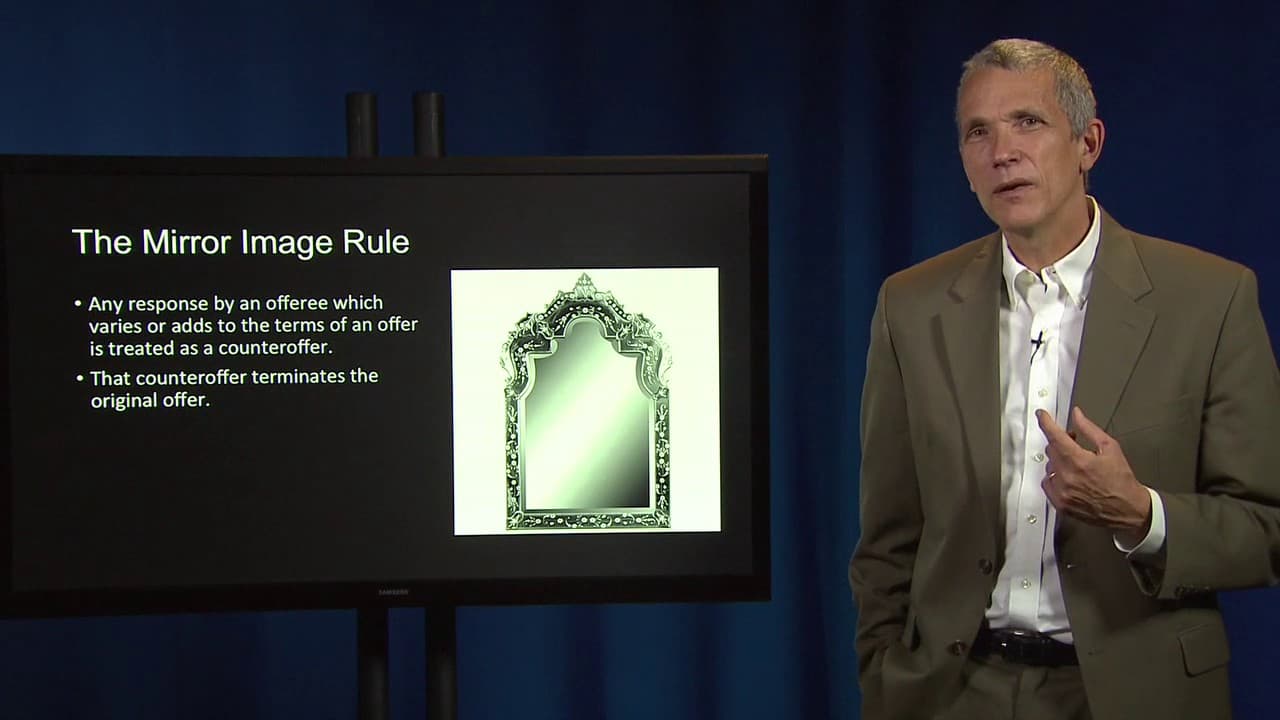
The mirror image rule in contract law states that an acceptance must exactly match the terms of the offer for a contract to be valid. Any deviation in terms is considered a counter offer, which terminates the original offer and requires further negotiation. This rule clarifies contract formation but can complicate the process due to its strict requirements.
Transcript
an offer that is unequivocally accepted creates a contract but what happens when an offer attempts to accept an offer while modifying the terms today we consider that question and learn about the mirror image rule by looking at the 1886 case decided by the United States Supreme Court called Minneapolis and St Louis Railway company versus Columbus R... Read More
Key Insights
- 💁 The mirror image rule, rooted in the common law, requires an acceptance to be an exact reflection of the offer to form a valid contract.
- 😫 Deviations from the terms of the offer are treated as counter offers, terminating the original offer and setting the stage for further negotiation.
- 💁 While the mirror image rule provides clarity and prevents unilateral changes to the terms of an offer, it can make contract formation more difficult.
- 💱 The Restatement of Contracts offers some flexibility to the mirror image rule, allowing an acceptance to request additional changes as long as it does not depend on those changes.
- 📏 By contracting around the mirror image rule, the offeror and offeree can modify the default rule to suit their preferences.
Install to Summarize YouTube Videos and Get Transcripts
Explore YouTube Video Summarizer or Get YouTube Transcript Extractor
Questions & Answers
Q: What is the mirror image rule?
The mirror image rule states that the acceptance of an offer must precisely mirror the terms of the offer without any variations or additions. Any changes to the terms constitute a counter offer and terminate the original offer.
Q: What happens if an offeree varies the terms of an offer in their acceptance?
If an offeree introduces new or different terms in their acceptance, it is considered a counter offer. The original offer is terminated, and further negotiation is required to reach a mutual agreement.
Q: Can a non-material variation in terms, such as an air freshener, affect the validity of an acceptance?
Yes, even a non-material variation can be fatal to the acceptance under the mirror image rule. The assumption is that any new or different terms introduced in the acceptance require further negotiation.
Q: Can the mirror image rule be bypassed or altered?
Yes, both the offeror and offeree can contract around the mirror image rule. Through explicit agreements or specifying that a counter offer does not terminate the original offer, the parties can modify the default rule.
Summary & Key Takeaways
-
In the case Minneapolis and St Louis Railway Company v. Columbus Rolling Mill Company, the court held that no contract was formed when the plaintiff attempted to accept the defendant's offer while modifying the terms.
-
The mirror image rule requires total congruence between the offer and acceptance, and any variation in terms is treated as a counter offer, ending the negotiation.
-
The mirror image rule makes it more difficult to create contracts, but it provides clarity and limits the potential for confusion or manipulation.
Read in Other Languages (beta)
Share This Summary 📚
Summarize YouTube Videos and Get Video Transcripts with 1-Click
Try YouTube Summary with ChatGPT & Claude or YouTube Transcript Generator
Explore More Summaries from YaleCourses 📚






Summarize YouTube Videos and Get Video Transcripts with 1-Click
Try YouTube Summary with ChatGPT & Claude or YouTube Transcript Generator