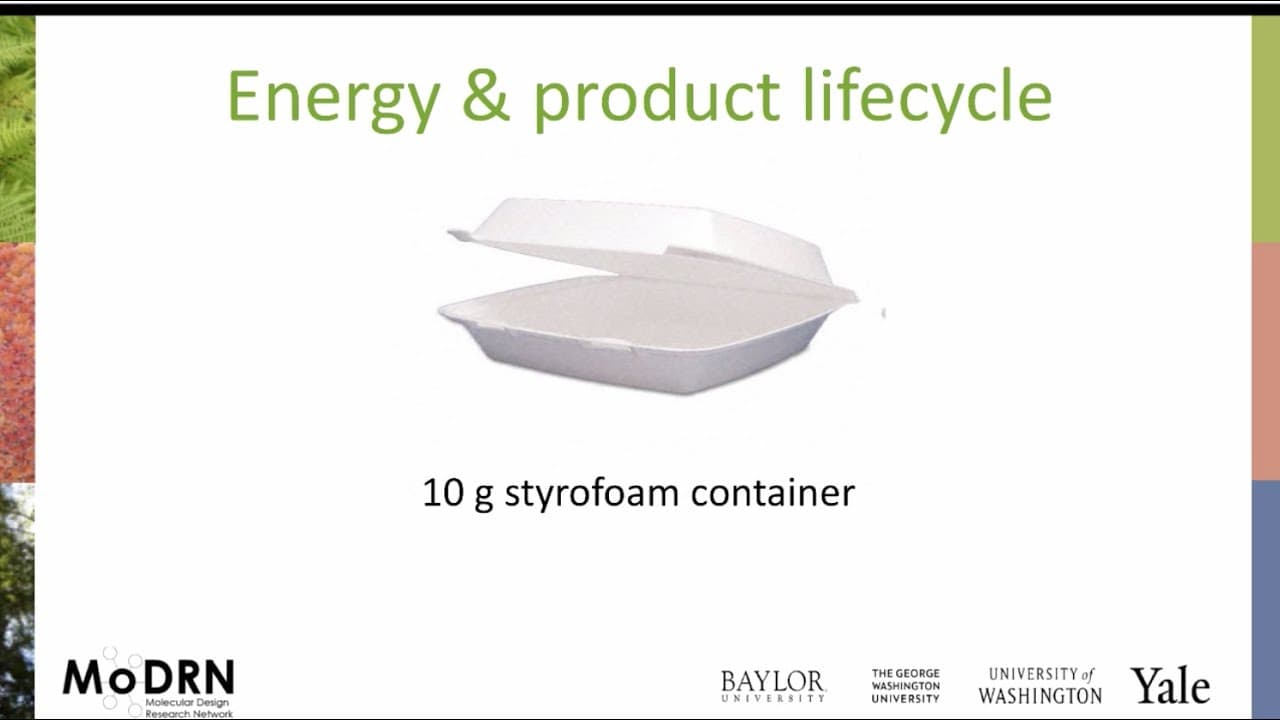
M6B MoDRN Energy: Energy Lifecycle Considerations Styrofoam Box Example
TL;DR
Understanding the laws of thermodynamics and kinetics in chemical reactions allows chemists to optimize energy consumption and reduce environmental impact.
Transcript
so getting back to how chemists can have some control over this problem a lot of it does boil down to the laws of nature so when you're going to carry out a chemical reaction you have to be thinking about the thermodynamics and the kinetics so you're starting out a chemical reaction with raw materials that have some intrinsic energy and then you're... Read More
Key Insights
- 🎮 Chemists can control energy consumption in chemical reactions by considering thermodynamics and kinetics, and utilizing catalysts to minimize the energy required.
- 😒 The energy embedded in a product is the sum of energy used in raw material extraction, refining, manufacturing, transportation, use, and end-of-life options.
- 😥 Intrinsic factors of molecules, such as carbon content and boiling points, play a significant role in energy consumption during manufacturing processes.
- 🍓 Designing more sustainable alternatives requires evaluating alternative raw material sources and considering the desired function of the product.
- ❓ Functionality of a product should be prioritized over specific chemical composition when seeking more environmentally friendly options.
- 🍓 Efficiencies in the entire product life cycle, from raw material extraction to disposal, should be considered to reduce energy consumption and environmental impact.
- 😒 The use of renewable energy sources and eco-friendly manufacturing processes can significantly reduce the energy consumption of chemical products.
Install to Summarize YouTube Videos and Get Transcripts
Explore YouTube Video Summarizer or Get YouTube Transcript Extractor
Questions & Answers
Q: How do thermodynamics and kinetics affect chemical reactions?
Thermodynamics determines the feasibility of a chemical reaction, while kinetics studies the rate at which the reaction occurs. Chemists must consider both aspects to optimize reaction conditions and minimize energy consumption.
Q: What is the role of catalysts in chemical reactions?
Catalysts lower the activation energy required to reach the transition state, making it easier for reactions to occur. This reduces the amount of energy needed and improves reaction efficiency.
Q: How does the energy consumption of a product accumulate throughout its life cycle?
Energy consumption occurs during the extraction of raw materials, refining processes, manufacturing, transportation, use, and end-of-life options. Each stage contributes to the cumulative energy embedded in the final product.
Q: How can chemists design more sustainable alternatives?
Chemists should consider intrinsic factors of molecules, such as carbon atoms and boiling points, and evaluate different raw material sources. Additionally, they should focus on the function of the product and explore alternative materials that can provide the same functionality with less environmental impact.
Summary & Key Takeaways
-
Chemical reactions require energy to overcome thermodynamic and kinetic barriers, and catalysts are crucial in minimizing the energy required for reactions to proceed.
-
The energy embedded in a product is the cumulative sum of the energy used in obtaining raw materials, manufacturing processes, transportation, use, and end-of-life options.
-
Chemists should consider the intrinsic factors of molecules, such as carbon content and boiling points, as well as the function of the product when designing more sustainable alternatives.
Read in Other Languages (beta)
Share This Summary 📚
Summarize YouTube Videos and Get Video Transcripts with 1-Click
Try YouTube Summary with ChatGPT & Claude or YouTube Transcript Generator
Explore More Summaries from YaleCourses 📚





Summarize YouTube Videos and Get Video Transcripts with 1-Click
Try YouTube Summary with ChatGPT & Claude or YouTube Transcript Generator