Hemodialysis Kinetics 101 06 What is Kt/V
TL;DR
Kt/V is a dimensionless ratio that measures hemodialysis adequacy as fractional urea clearance. Its three components are dialyzer urea clearance (K), dialysis time (T), and urea distribution volume (V), with total body water estimated at about 60% of dry weight in men and 50% in women. Read on to see how flow rates, membrane characteristics, and KoA affect the delivered dose.
Transcript
now let's talk about KP over V or you yuria clearance is the preferred method says hemodialysis dose and adequacy kt / v area measures hemodialysis adequacy in terms of fractional urea clearance it is a mathematically computed dimensionless ratio and has three components the first is K which is the dialyzer clearance of urea in milliliters per minu... Read More
Key Insights
- 🎆 Hemodialysis adequacy is quantified using the KT/V ratio, which measures the clearance of urea during a dialysis session.
- ☠️ Dialyzer clearance of urea (K) depends on blood and dialysate flow rates, as well as the characteristics of the dialyzer membrane.
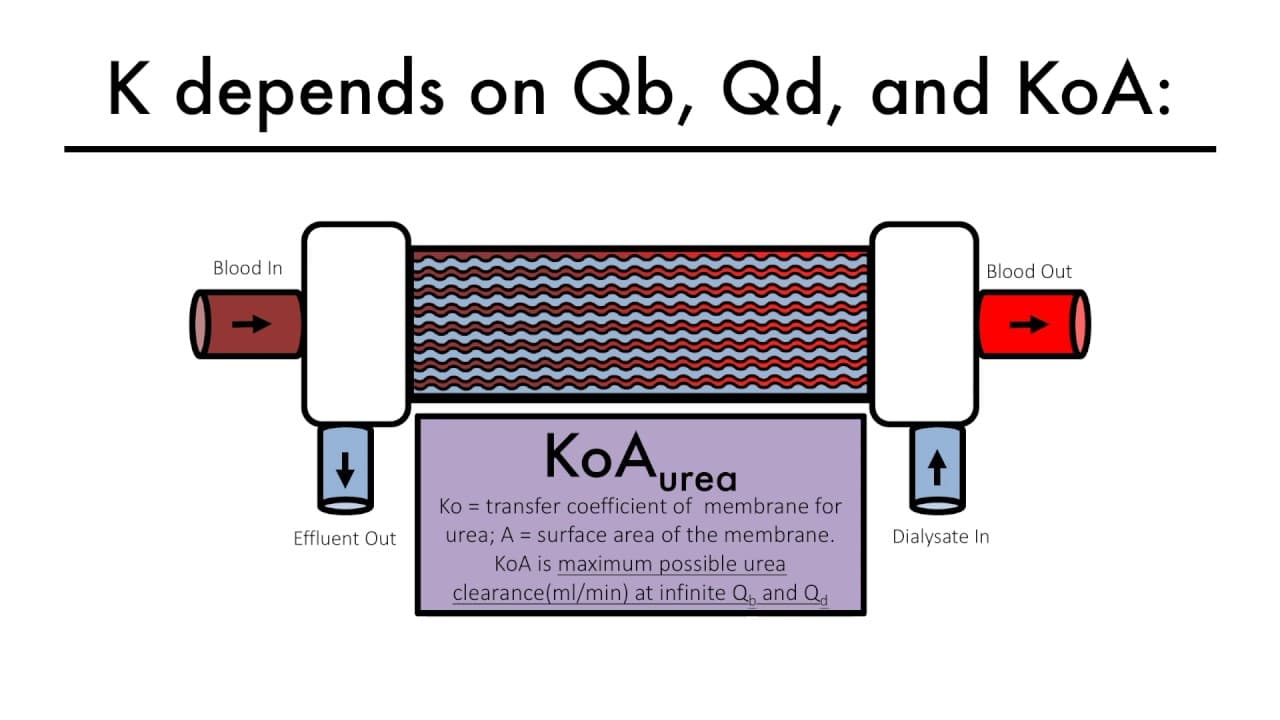
- 🐨 The transfer coefficient of the membrane (KoA) determines the efficiency of the dialyzer in clearing urea.
- 😘 The delivered KT/V may be lower than the prescribed value due to factors such as calibration errors and differences between in vitro and in vivo measurements.
- ⏳ Achieving optimal KT/V values requires considerations of volume of distribution, time on dialysis, dialyzer flow rates, and dialyzer KoA.
- 🎨 Dialyzer design, membrane thickness, and pore number all influence the efficiency and KoA of the dialyzer.
- ✋ Manufacturer-provided KoA values are generally higher than in vivo measurements.
Install to Summarize YouTube Videos and Get Transcripts
Explore YouTube Video Summarizer or Get YouTube Transcript Extractor
Questions & Answers
Q: What is Kt/V in hemodialysis?
Kt/V is a mathematically computed, dimensionless ratio used to measure hemodialysis dose and adequacy in terms of fractional urea clearance. K is dialyzer urea clearance, T is time on dialysis, and V is the volume of distribution of urea.
Q: What does K represent in Kt/V?
K is the dialyzer clearance of urea, measured in milliliters per minute. It indicates how many milliliters of blood the dialyzer can clear of urea in one minute.
Q: What does T represent in Kt/V?
T is the time spent on dialysis, measured in minutes. Multiplying K by T gives the dialysis dose, defined here as the total volume of blood cleared of urea during the treatment session.
Q: What does V represent in Kt/V?
V is the volume of distribution of urea in milliliters. It equals total body water corrected for the ultrafiltration volume during the hemodialysis session.
Q: How is total body water estimated for Kt/V?
Total body water is estimated as approximately 60% of estimated dry weight in men. For women, it is estimated at about 50% of dry weight.
Q: What determines dialyzer urea clearance?
Dialyzer urea clearance depends on blood flow into the dialyzer, dialysate flow, and dialyzer membrane characteristics. In high-efficiency dialysis, K is typically more than 210 milliliters per minute.
Q: What is dialyzer KoA, and why does it matter?
KoA combines the membrane's solute transfer coefficient for urea with its surface area and determines dialyzer efficiency. At extremely high blood and dialysate flow rates, it represents the maximum possible urea clearance; a high-efficiency dialyzer typically has a KoA above 800 milliliters per minute.
Q: Why can delivered Kt/V be lower than prescribed Kt/V?
The manufacturer's KoA comes from in vitro studies and is 20% to 30% higher than in vivo measurements. Calibration errors and differences between prescribed and delivered blood or dialysate flow can also contribute, so delivered Kt/V is often lower than prescribed Kt/V.
Summary & Key Takeaways
-
Hemodialysis adequacy is assessed using the KT/V ratio, which measures the clearance of urea during a dialysis session.
-
Dialyzer clearance of urea (K) is determined by factors such as blood and dialysate flow rates, as well as dialyzer membrane characteristics.
-
Dialyzer efficiency is influenced by the transfer coefficient of the membrane (KoA), which is determined by the design, thickness, and porosity of the membrane.
Read in Other Languages (beta)
Share This Summary 📚
Summarize YouTube Videos and Get Video Transcripts with 1-Click
Try YouTube Summary with ChatGPT & Claude or YouTube Transcript Generator
Explore More Summaries from YaleCourses 📚





Summarize YouTube Videos and Get Video Transcripts with 1-Click
Try YouTube Summary with ChatGPT & Claude or YouTube Transcript Generator