How to Prepare a Codebase for AI Coding Agents
TL;DR
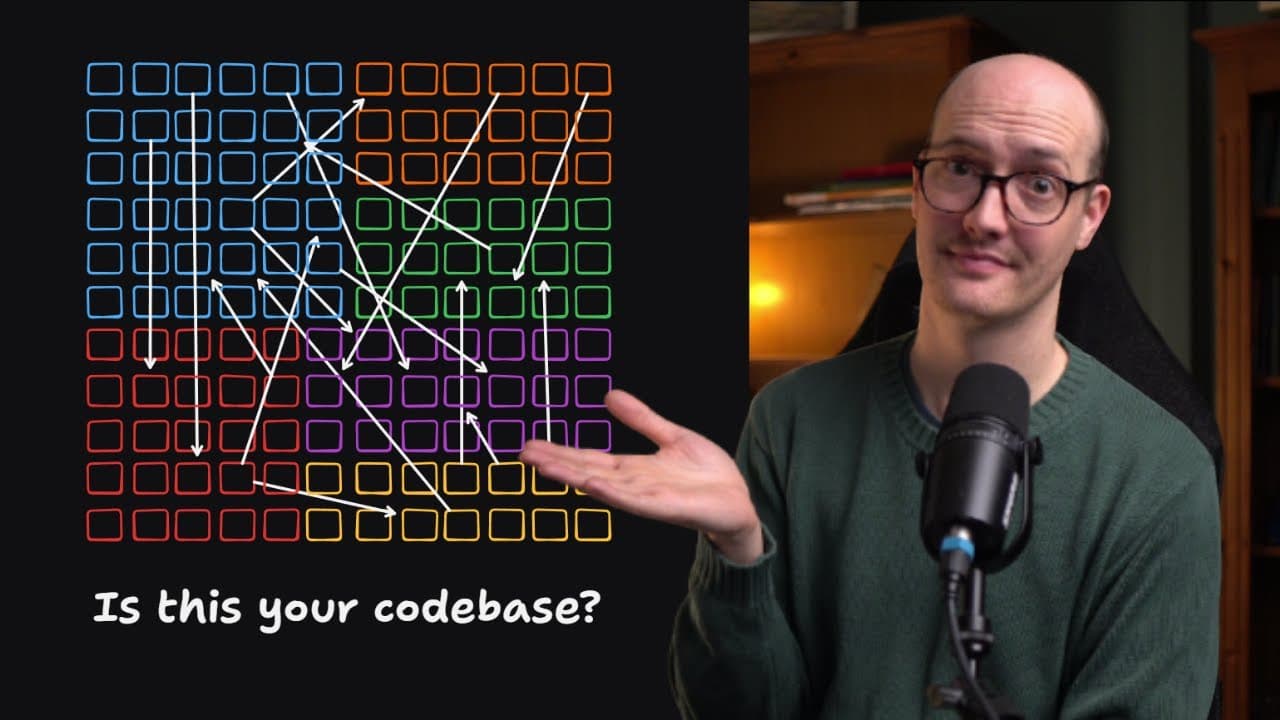
Organize a codebase into deep modules with simple, carefully designed public interfaces, strong tests, and clear filesystem boundaries. This structure helps AI find relevant functionality, understand behavior progressively, verify its changes quickly, and work without forcing developers to track a tangled web of shallow modules and cross-cutting dependencies.
Transcript
AI imposes super weird constraints on your code base. And most code bases out there in the world, probably including yours, are not ready. Your code base, way more than the prompts that you use, way more than your agents.md file, is the biggest influence on AI's output. And if it's designed wrong, it can cost you in a bunch of different ways. It ca... Read More
Key Insights
- The codebase is the strongest influence on AI coding output because its structure determines how easily an agent can locate functionality, understand relationships, make changes, and receive useful feedback about whether those changes worked.
- A tangled filesystem hides the developer's mental model from AI because the agent enters without prior experience of the codebase. Natural feature groupings should therefore be reflected clearly in folders, modules, and constrained relationships.
- Deep modules place substantial implementation behind a simple public interface. This structure replaces a web of small, shallow modules with larger functional units whose exported behavior can be understood, controlled, and tested at a clear boundary.
- Progressive disclosure of complexity helps AI navigate a codebase efficiently. An obvious interface and exported types explain what a service does first, while implementation details remain available only when the task requires inspection or modification.
- Gray box modules reduce the need to review every implementation detail. Developers can delegate internal changes to AI while relying on carefully designed interfaces and behavioral tests, then inspect the internals when taste, performance, or a particular outcome requires attention.
- Clear module boundaries reduce cognitive burnout by letting developers reason about a small set of major services instead of remembering numerous relationships among tiny units. Human judgment remains essential at the boundaries where responsibilities and interfaces are defined.
- AI agents should be treated like repeated new starters because they enter a codebase without the developer's accumulated mental map. A navigable architecture, explicit service boundaries, documentation, and tests help each agent begin contributing effectively.
- Tests and fast feedback loops are essential for AI-assisted development because they show how a change affects behavior across the codebase. Module impact, interface design, and testing strategy should be considered during planning, issue creation, and every coding session.
Install to Summarize YouTube Videos and Get Transcripts
Explore YouTube Video Summarizer or Get YouTube Transcript Extractor
Questions & Answers
Q: How do you prepare a codebase for AI coding agents?
Prepare the codebase by grouping related functionality into deep modules with simple, controlled public interfaces. Make those modules obvious in the filesystem, document their exported types, and prevent unrelated code from forming arbitrary dependencies. Add behavioral tests around each module so an AI agent can understand its contract, make an internal change, and quickly verify whether the resulting behavior matches the intended outcome.
Q: Why does codebase architecture affect AI-generated code?
Codebase architecture controls what an AI agent can discover and understand when it enters without prior memory of the project. If files and dependencies do not reflect the system's natural feature groupings, the agent sees disconnected modules instead of the developer's mental map. Clear boundaries, visible interfaces, and tests give it useful context while also providing feedback about whether a change worked.
Q: What is a deep module in AI-assisted development?
A deep module contains substantial implementation behind a small, simple public interface. Other parts of the codebase access its capabilities through that controlled boundary instead of importing arbitrary internal details. For AI-assisted development, this creates a clear seam: the agent can understand the exported contract first, modify internal implementation when needed, and use tests to confirm that the module's externally visible behavior remains correct.
Q: How does progressive disclosure help an AI navigate code?
Progressive disclosure presents the simplest and most important information first. A module's folder, documentation, public interface, and exported types tell the AI what the service does without requiring it to read every internal file. If the task only needs the existing behavior, the agent can trust the contract. If the task changes that behavior, it can then inspect the implementation in greater depth.
Q: Why are shallow modules difficult for AI coding agents?
Shallow modules distribute behavior across many small units and allow numerous relationships among files that may not belong together conceptually. An AI agent must spend more effort locating relevant code, reconstructing hidden feature groupings, and understanding how changes ripple through dependencies. The same structure also burdens developers because they must keep many small units and their interconnections in mind while reviewing or directing AI work.
Q: How do tests improve AI-assisted software development?
Tests provide the feedback an AI agent needs to determine whether a code change accomplished its intended purpose. Strong behavioral tests can lock down a module's public contract while allowing the internal implementation to change. They also reveal how a modification ripples outward, reducing reliance on manual inspection and helping an agent contribute more effectively despite entering the codebase without accumulated project knowledge.
Q: What should developers focus on when AI edits module internals?
Developers should focus on defining module responsibilities, designing the public interfaces, and deciding how behavior will be tested. They do not always need to inspect every internal detail when the interface and tests provide sufficient confidence. Internal review remains appropriate when the implementation needs human taste, performance improvements, or direct influence over a particular outcome. AI assistance does not remove architectural judgment at module boundaries.
Q: When should module design be considered in an AI coding workflow?
Module design should be considered throughout every coding session, beginning with early planning. Product requirements and implementation issues should identify which modules will change, how their public interfaces may be affected, and how the resulting behavior will be tested. Addressing these questions before implementation gives the AI clearer boundaries and faster feedback, while helping developers avoid gradually rebuilding a tangled network of shallow dependencies.
Summary & Key Takeaways
-
A codebase influences AI-generated changes more than prompts or an agents file because its architecture determines what the AI can find, understand, modify, and test. Tangled relationships among small modules slow feedback, obscure intended boundaries, and require developers to retain too much structural knowledge while supervising repeated AI coding sessions.
-
Deep modules group substantial implementation behind small, controlled public interfaces. Their folders and exported types make major services visible before their internal code is examined. This progressive disclosure lets AI understand a module through its contract, use it without exploring every implementation detail, and inspect the internals only when deeper changes are necessary.
-
Developers still need to apply judgment when deciding module boundaries, designing interfaces, and defining behavioral tests. Planning documents and implementation issues should identify the affected modules, interface changes, and testing strategy. Fast feedback allows an AI agent, treated like a new starter, to observe whether its changes produced the intended behavior.
Read in Other Languages (beta)
Share This Summary 📚
Summarize YouTube Videos and Get Video Transcripts with 1-Click
Try YouTube Summary with ChatGPT & Claude or YouTube Transcript Generator
Explore More Summaries from Matt Pocock 📚



Summarize YouTube Videos and Get Video Transcripts with 1-Click
Try YouTube Summary with ChatGPT & Claude or YouTube Transcript Generator