How to Hand Off AI Coding Sessions Between Agents
TL;DR
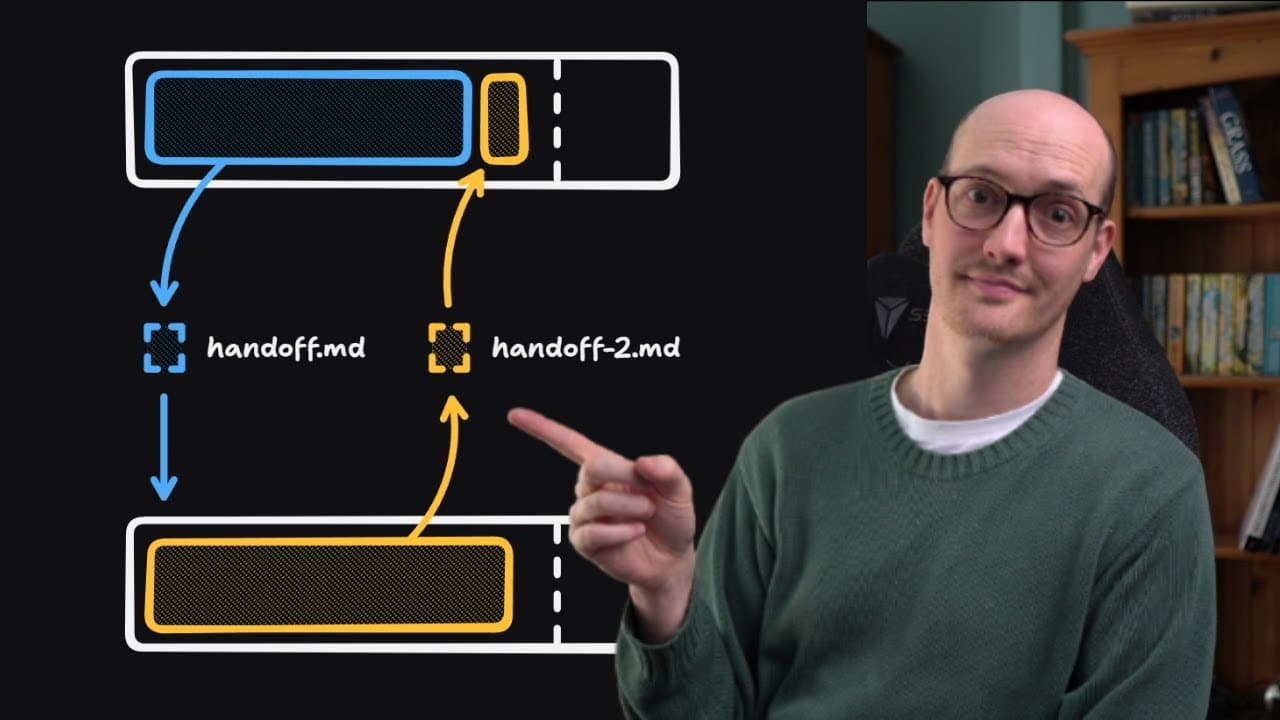
Use a handoff document to extract one focused slice of an AI coding session and continue it in a separate agent without diluting the original conversation. Unlike compaction, which summarizes an ongoing session so it can continue, handoff supports parallel tasks, prototypes, return trips to planning sessions, and workflows across different coding agents.
Transcript
A few weeks ago, I noticed myself doing something with agents that I thought was very clever, but I thought it was just too simple to require a skill. For those who don't know, I'm constantly thinking about skills. I'm constantly thinking about how to package my instincts and coding practices into reusable skills. And this has meant my skills repo ... Read More
Key Insights
- Context-window size does not guarantee consistent agent performance because attention becomes more diffuse as conversations accumulate tokens. The creator reports noticing weaker responses around 120,000 tokens, despite using a coding harness with a context window advertised as supporting up to 1 million tokens.
- Compaction is a method for summarizing a large conversation and continuing from a smaller context. It moves a session back toward the more focused part of the context window while preserving referenced files, user statements, the conversation's general tone, and the state needed to continue working.
- Repeated compaction creates layers of summarized history from earlier conversations. This accumulated context can be inefficient, but it remains useful for long-running debugging because attempted solutions can be summarized before the agent continues testing other possibilities within what is effectively one extended session.
- Handoff is designed to transfer a focused slice of context into a separate session. It avoids mixing an additional bug fix or refactoring opportunity into the current task, allowing both sessions to proceed independently without sacrificing or diluting the original session's progress.
- A focused handoff begins by stating why the task is being transferred and exactly what the resulting document should contain. In the demonstrated planning session, moving a future API change out of scope also simplified the current question and produced a document for creating a GitHub issue.
- Prototype handoffs resolve questions that cannot be answered confidently through discussion alone. During grilling, uncertain user-interface behavior or complicated logic can be assigned to a separate session, where the agent implements a prototype and generates concrete findings without consuming the planner's context window.
- Return handoffs allow a prototype session to send its nonobvious findings back to the planning session that initiated it. The demonstrated prototype grew to 169,000 tokens, yet its relevant lessons could be compressed and returned so the original session could finish PRDs and issues.
- Markdown handoff documents enable workflows across different coding agents because they do not depend on a harness-specific subagent feature. A session in Claude Code can create context for Codex, Copilot CLI, or another agent, including workflows intended to obtain an adversarial review.
Install to Summarize YouTube Videos and Get Transcripts
Explore YouTube Video Summarizer or Get YouTube Transcript Extractor
Questions & Answers
Q: How do you hand off an AI coding session to another agent?
Create a focused Markdown document that summarizes only the context needed for the next task, then pass that document to a fresh agent session. Specify why the work is being handed off and exactly what the document should cover. The described skill saves the document in the operating system's temporary directory rather than the current workspace, allowing the new session to proceed independently.
Q: What is the difference between handoff and compaction?
Compaction summarizes a large conversation so the same line of work can continue with a smaller active context. Handoff instead extracts a selected portion of the current context for a separate session. Compaction supports one long-running session, while handoff preserves the original session's focus and lets another agent handle an independent bug, refactor, prototype, or review task.
Q: Why can a large context window reduce an AI agent's performance?
A growing conversation contains more tokens and therefore more attention relationships for the agent to process. The creator describes an early smart zone where the agent focuses better and a later dumb zone where its attention becomes diffuse. Although his coding harness advertises a 1 million-token context window, he reports noticing weaker performance at roughly 120,000 tokens.
Q: When should you use compaction in an AI coding session?
Use compaction when you want to continue the same task after a conversation has grown large. It is particularly useful for long-running debugging because it can summarize the approaches already attempted and preserve the working state before further experiments. Depending on the coding harness and its settings, an automatic compaction buffer may also summarize a session near the context limit.
Q: When should you create a handoff instead of extending the current session?
Create a handoff when you discover work that matters but falls outside the current session's scope, such as a separate refactoring opportunity or bug fix. Extending the conversation would mix two goals and consume more context, while compacting would alter the current session. A handoff keeps the original task focused and gives the additional task its own context window.
Q: How can handoffs improve grilling or planning sessions?
During a grilling session, use a handoff to remove an out-of-scope topic or investigate a question that requires implementation evidence. Clearly defining the transferred task can simplify the current planning discussion because the unresolved branch no longer needs to remain active. The separate agent can create an issue, explore the design, or prototype difficult behavior while planning continues independently.
Q: How does a prototype handoff return findings to the original session?
The planning session first creates a handoff describing the difficult areas that need prototyping. After another agent builds and evaluates the prototype, that session creates a second handoff for the original planner. This return document captures lessons that are nonobvious or not already represented by the prototype itself, enabling the planning session to complete its PRDs and issues with practical evidence.
Q: Can a handoff document be used across different coding agents?
Yes. The workflow uses a Markdown document rather than relying on native subagent features from one coding harness. The creator explains that context produced in a Claude Code session can be passed to Codex, Copilot CLI, or another coding agent. This portability also supports interactions between different agents, including an adversarial review of work produced elsewhere.
Summary & Key Takeaways
-
The handoff skill compresses relevant context from a coding conversation into a focused Markdown document saved in the operating system's temporary directory. A fresh agent can use that document to continue a specific task while the original session remains dedicated to its initial goal and retains its existing progress.
-
Compaction summarizes a large conversation and places that summary at the beginning of a continued session. It is useful for long-running work such as debugging, but repeated compactions can accumulate layers of older context. Handoff differs by extracting a selected task for an independent session instead of extending the same conversation.
-
A productive workflow begins during planning or grilling: identify an out-of-scope issue or an uncertainty requiring code, hand it to another session, and build a prototype there. The prototype session can then create a return handoff containing nonobvious findings, allowing the original session to complete its planning with stronger evidence.
Read in Other Languages (beta)
Share This Summary 📚
Summarize YouTube Videos and Get Video Transcripts with 1-Click
Try YouTube Summary with ChatGPT & Claude or YouTube Transcript Generator
Explore More Summaries from Matt Pocock 📚
Summarize YouTube Videos and Get Video Transcripts with 1-Click
Try YouTube Summary with ChatGPT & Claude or YouTube Transcript Generator