How Do AI Coding Skills v1.2 Improve Workflows?
TL;DR
Skills v1.2 improves AI coding workflows through clearer documentation, easier installation, better Codex compatibility, and more focused agent interactions. Its additions simplify confusing responses, accelerate requirement interviews, improve agent-facing instructions, guide human-controlled infrastructure setup, and convert unresolved decisions into questionnaires that collaborators can answer outside the agent session.
Transcript
Skills, skills, skills. Folks, we have yet more skills for you. This is version 1.2.0, which adds a bunch of improvements to my already extremely popular engineering skills. The skills repo is now, I think, the 24th most starred repo of all time on GitHub, up to 24K stars. And as a mature project, we need some proper documentation. And so, we have ... Read More
Key Insights
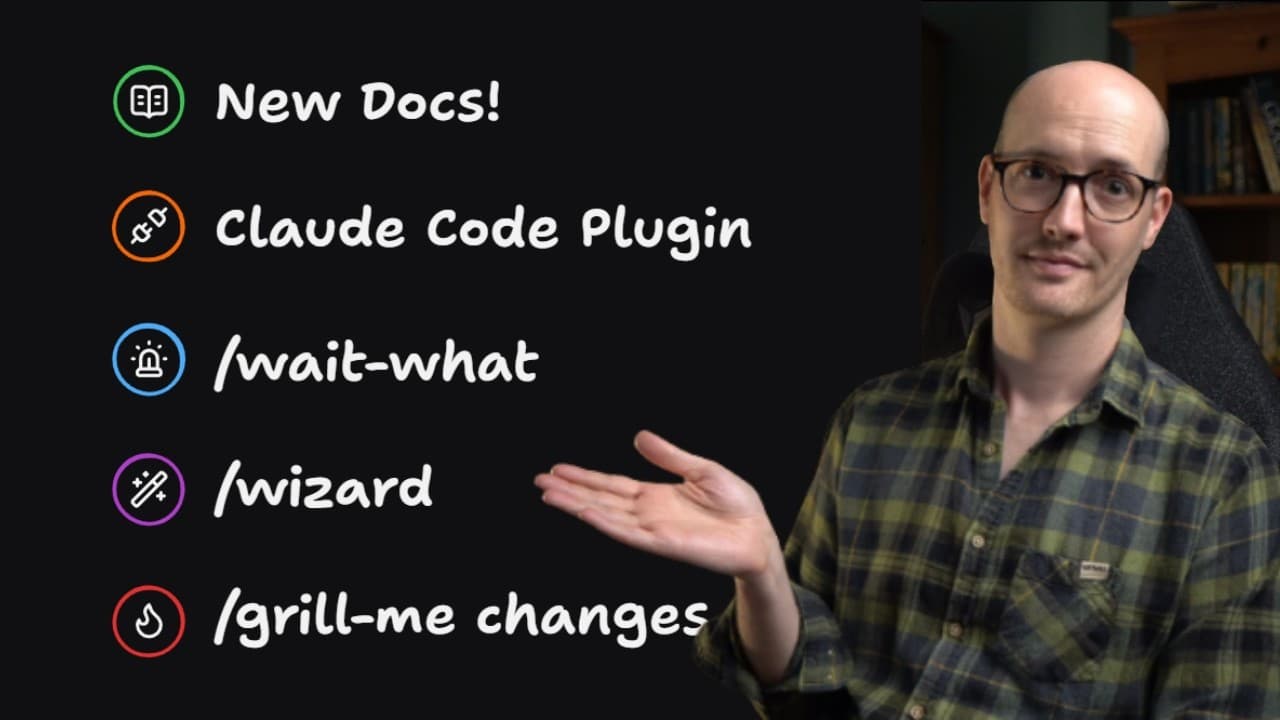
- The new documentation site is organized around a complete engineering flow, beginning with Grill with Docs and continuing through specification, ticket creation, implementation, and code review. A left-hand reference describes every skill, while linked dictionary entries provide deeper explanations of recurring AI coding concepts.
- Claude Code marketplace integration provides a direct installation path for the skills bundle. The installed bundle is read-only, requires no extra setup steps described in the presentation, and automatically receives later skill updates, making maintenance simpler for people using Claude Code.
- Codex compatibility is improved through OpenAI YAML sidecar files included with every skill. These files carry the setting that disables implicit invocation, allowing user-invoked skills to remain hidden from the agent's context window until the user deliberately calls them.
- Wait What is a clarity tool for responses that are verbose, opaque, or filled with unfamiliar model-generated phrasing. It requests clear declarative sentences using simplified technical English and grounds the rewritten response in the shared terminology recorded in context.md.
- Grill Me now treats unanswered decisions as a dependency graph rather than asking exactly one question on every turn. It presents currently answerable questions in rounds, beginning with critical blockers when necessary and expanding the available frontier as earlier dependencies are resolved.
- Writing for Agents improves documents intended to control or guide agents, including agents.md, claude.md, and skill files. It aims to make instructions more concise and predictable, and it can move material from a front-loaded agents.md file into skills that are loaded when relevant.
- Wizard generates an interactive Bash workflow for steps that only a human should perform. It can open the correct service pages, guide login and configuration tasks, accept pasted credentials locally, save required values, and progress through setup without sending those interactions through an agent.
- To Questionnaire converts unresolved decisions from a grilling session into a document that another person can review. The demonstrated workflow moves the questions into a Markdown document and then a Google Doc, supports discussion with a collaborator, and returns the completed answers to the agent.
Install to Summarize YouTube Videos and Get Transcripts
Explore YouTube Video Summarizer or Get YouTube Transcript Extractor
Questions & Answers
Q: What changed in AI coding Skills v1.2?
Skills v1.2 adds a structured documentation site, official Claude Code marketplace installation, and OpenAI YAML files that improve Codex behavior. It also introduces tools for rewriting confusing responses, writing agent-facing instructions, guiding human-controlled setup, and creating collaborative questionnaires. Grill Me is redesigned to ask several currently answerable questions per round while respecting dependencies between decisions.
Q: How does the Wait What skill clarify confusing AI responses?
Wait What asks the agent to replace confusing or overly verbose language with clear declarative sentences. It invokes ASD-STE100 simplified technical English as a signal to use simpler wording, then grounds the revision in the ubiquitous language stored in context.md. The intended result is an explanation that uses the project's own established terms instead of unfamiliar model-generated phrasing.
Q: How does the updated Grill Me skill handle question dependencies?
The updated Grill Me models unresolved questions as a graph. A critical decision can be asked alone when other questions depend on it. After the user answers, the next available questions are presented together in a new round. This approach advances the frontier of answerable questions quickly while avoiding questions whose required earlier decisions remain unresolved.
Q: Why does Grill Me ask multiple questions in each round?
Multiple questions reduce the slow final phase of a requirements interview, when many remaining choices are easy and users would otherwise answer one per turn. The user can approve several recommendations together and identify only the answers needing changes. Questions are grouped only when they are currently answerable, so the faster format still accounts for decision dependencies.
Q: How does Skills v1.2 improve Codex compatibility?
Skills v1.2 includes an OpenAI YAML sidecar file for every skill. These files carry the setting that disables implicit invocation into Codex-compatible interfaces. As a result, user-invoked skills can remain outside the agent's context until explicitly called, matching the intended behavior already available in Claude Code, Pi, and some other agent harnesses described in the presentation.
Q: What is the Writing for Agents skill used for?
Writing for Agents is designed for documents that agents read, including agents.md, claude.md, and skill definitions. It helps make those instructions concise, readable, and more predictable in their effects. It can also extract material from an overloaded agents.md file into separate skills, reducing front-loaded context and allowing instructions to be introduced through more focused skill mechanics.
Q: How does the Wizard skill help with infrastructure setup?
Wizard creates an interactive Bash script that guides a person through steps requiring direct human control. The script can open the appropriate page, prompt for login and configuration changes, accept API keys, save values into required files, and place values into GitHub secrets when needed. Because the workflow is deterministic, those interactions are not sent through an agent.
Q: How can To Questionnaire support collaborative decisions?
To Questionnaire extracts decisions from an agent-led grilling session and formats them as a Markdown document for another person to review. The example transfers that document into Google Docs so two people can discuss a shared garden-office design. Their completed answers can then be brought back to the agent, connecting human collaboration with the original planning workflow.
Summary & Key Takeaways
-
Skills v1.2 adds a documentation site at aihero.dev/skills that organizes the recommended workflow from requirements discovery through specification, tickets, implementation, and code review. It also provides a reference for every skill, answers drawn from frequently asked questions, and links to an AI coding dictionary that defines concepts such as tickets.
-
Installation and compatibility receive major improvements. Claude Code users can install a read-only bundle from the official plugin marketplace and receive updates automatically. Codex users gain OpenAI YAML sidecar files for every skill, allowing user-invoked skills to remain outside the agent context until explicitly requested through the implicit-invocation setting.
-
The release introduces Wait What, Writing for Agents, Wizard, and To Questionnaire while redesigning Grill Me. Together, these tools clarify opaque responses, optimize agent-facing documents, guide people through sensitive manual setup, transfer decisions into collaborative questionnaires, and ask independent questions in efficient rounds without ignoring dependencies between unresolved choices.
Read in Other Languages (beta)
Share This Summary 📚
Summarize YouTube Videos and Get Video Transcripts with 1-Click
Try YouTube Summary with ChatGPT & Claude or YouTube Transcript Generator
Explore More Summaries from Matt Pocock 📚
Summarize YouTube Videos and Get Video Transcripts with 1-Click
Try YouTube Summary with ChatGPT & Claude or YouTube Transcript Generator