Why Cutting Headcount for AI Is the Wrong Move
TL;DR
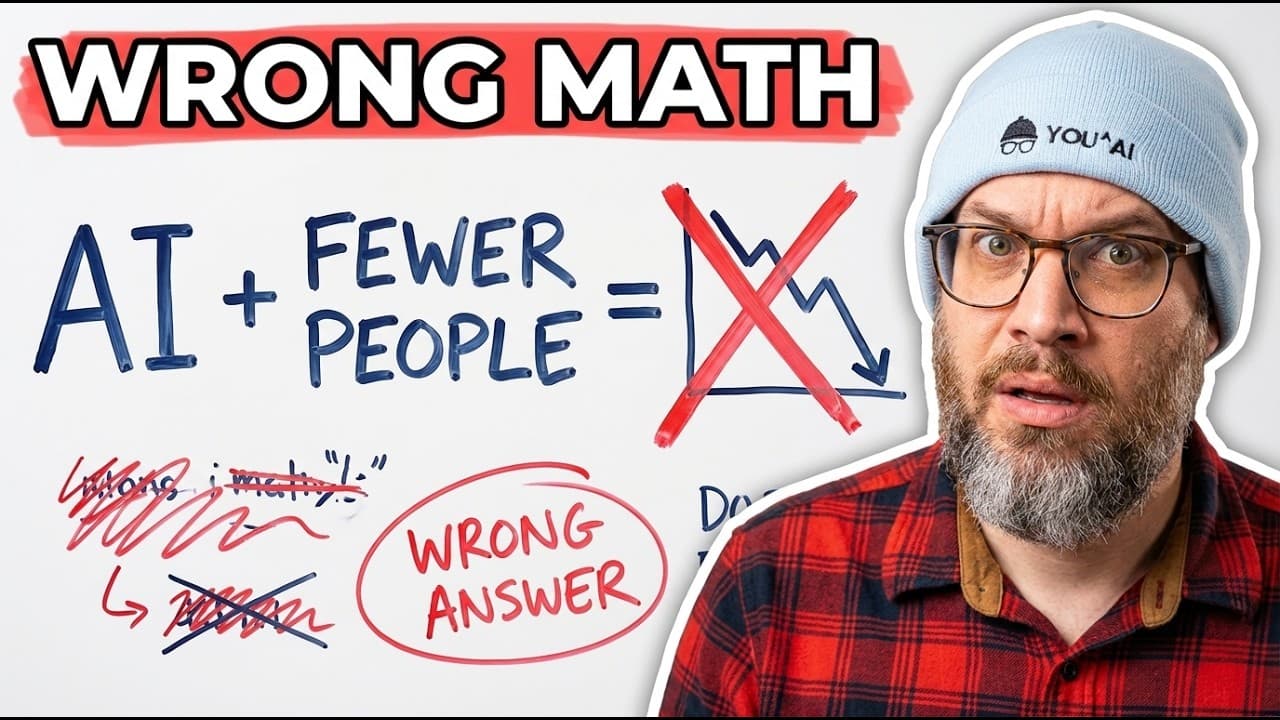
When AI drops execution costs by an order of magnitude, the winning move is expanding ambition, not cutting headcount. Whoop is hiring 600 people while investing in AI. Jevons paradox means cheaper intelligence increases demand for judgment, creativity, and domain expertise, so companies that dream bigger capture the market others ignore.
Transcript
You know, a few days ago, Whoop announced it's hiring more than 600 people, nearly doubling its 800 person workforce. Will OffEed, the CEO, said, "Right now, companies are debating whether to hire more people or just invest in AI." And we are doing both. Ahmed is making the most important strategic bet of 2026. And the boards and leadership teams I... Read More
Key Insights
- Jevons paradox states that when efficiency increases, consumption goes up, not down, because cheaper resources make new applications viable. AI is the most dramatic efficiency improvement in the history of work, so demand for insight and judgment will explode.
- The wrong question is 'how many fewer people do we need,' which optimizes capturing a fixed slice of value. The right question is what becomes possible now that execution cost dropped by an order of magnitude, expanding the whole pie.
- Whoop announced hiring more than 600 people, nearly doubling its 800-person workforce. CEO Will Ahmed said companies debate whether to hire people or invest in AI, and Whoop is doing both, calling it the most important strategic bet of 2026.
- Compressing product iteration cycles from months to days changes the mechanics of strategy. Instead of two to four bets a year, teams can run 200 learning cycles, shifting the bottleneck from 'can we build it' to the human question 'should we build it.'
- Cursor's February 2026 cloud agents update lets developers run up to 20 parallel agents on isolated cloud VMs simultaneously, each on a separate branch opening pull requests. About a third of Cursor's code and pull requests are written autonomously by agents.
- The translation layer between knowing what software should exist and building it is disappearing. Hundreds of millions of domain experts previously blocked by overloaded software teams can now build directly using platforms like Lovable, Bolt, and Replit.
- Quality software is becoming the default rather than a premium. Testing, documentation, security review, performance, accessibility, and polish are all agent-verifiable and labor-intensive tasks that agent harnesses now handle as standard procedure.
- Hope is defined as a plan without validation, so the speaker focuses instead on structural unlocks that deliver value because AI compresses the cost of intelligence. Companies breaking the doom frame first win the whole race, not just a head start.
Install to Summarize YouTube Videos and Get Transcripts
Explore YouTube Video Summarizer or Get YouTube Transcript Extractor
Questions & Answers
Q: Why is cutting headcount for AI the wrong strategic move?
Cutting headcount assumes a fixed pie of value and optimizes how efficiently you capture your slice, pocketing the savings. This ignores that the pie itself was artificially constrained by the high cost of execution. When AI drops that cost by an order of magnitude, the larger opportunity comes from expanding ambition. Companies still arguing about headcount lose customers to those that dream bigger and build what was previously impossible.
Q: What is Jevons paradox and how does it apply to AI?
Jevons paradox states that when efficiency increases, consumption goes up rather than down, because cheaper resources make new applications viable. The speaker cites steel enabling skyscrapers and railroads, and cheap computing creating the internet and mobile. Applied to AI, which is the most dramatic efficiency improvement in work history, it means total demand for insight, judgment, creativity, and domain expertise is about to explode. Evidence: software engineering jobs have increased, not decreased.
Q: Why is Whoop hiring 600 people while investing in AI?
Whoop announced hiring more than 600 people, nearly doubling its 800-person workforce. CEO Will Ahmed framed the current debate as whether to hire more people or just invest in AI, and Whoop is doing both. The speaker calls this the most important strategic bet of 2026 and says the boards and leadership teams actually making decisions, rather than performing for analysts, increasingly agree with this approach.
Q: How does faster iteration change business strategy?
When you compress a product iteration cycle from months to days, you get a different relationship between market understanding and action, not just a faster version of old strategy. Traditionally a bet takes three to six months, giving two to four options a year, which is why the dominant corporate strategy is copying competitors. Compressing cycles to days enables running 200 learning cycles a year, making exploration rational and shifting the bottleneck to human judgment about what to build.
Q: What is the translation layer and why does it matter for builders?
The translation layer is the gap between knowing what software should exist and actually making it exist as code. It is lossy, slow, and expensive, and it has locked out hundreds of millions of domain experts, like doctors, logistics managers, and teachers, who were blocked by overloaded software teams and backlogs. As AI removes this layer, these experts can describe what they need and have an agent build it in an afternoon, unlocking an entirely new class of builder.
Q: How is Cursor using AI agents to write code?
Cursor's February 2026 cloud agents update lets developers spin up to 20 parallel agents on isolated cloud VMs, or virtual machines, simultaneously. Each agent works on a separate branch, testing changes and opening pull requests autonomously. According to the speaker, about a third of Cursor's code and pull requests are already written by agents operating autonomously, and that number is going up, illustrating how iteration can now happen in a single working session.
Q: Why is quality software becoming the default rather than a premium?
Historically software has been mediocre not because engineers are bad but because teams lacked execution capacity for great testing, documentation, security review, performance optimization, accessibility, and visual polish on time and under budget. These problems are all agent-verifiable but very labor intensive, so teams deprioritized them. Now, when agent harnesses run testing, security review, and documentation as standard procedure rather than expensive add-ons, the baseline quality of all software rises dramatically and shipping polished features stops being a big deal.
Q: What mindset shift do leaders need in the age of AI?
Leaders must stop asking how many fewer people they need and instead ask what their people could build that was previously impossible. This means empowering people to go fast, be entrepreneurial, and dream bigger, giving them ambition, tools, and infrastructure rather than slapping wrists. The human role becomes bigger, not smaller, shifting toward generating good hypotheses, deep customer intuition, and contrarian insight. The hardest work ahead is not technical but figuring out what upskilling looks like.
Summary & Key Takeaways
-
The dominant AI conversation fixates on job displacement and how many fewer people companies need. This cost-reduction frame assumes a fixed pie and optimizes efficiency of capturing a slice. The ambition frame recognizes the pie was artificially constrained by execution cost, and removing that constraint creates opportunity larger than any savings.
-
History shows efficiency drives expansion: cheap steel built skyscrapers and railroads, cheap computing created the internet and mobile, cheap distribution destroyed defensive media companies. This is Jevons paradox, where increased efficiency raises consumption. AI is the most dramatic efficiency gain in work history, so demand for judgment and creativity will explode.
-
Six people-focused unlocks describe the future: learning to go fast with compressed iteration cycles, the changed builder equation letting domain experts build without coders, quality software becoming the default baseline, and more. Leaders must empower people to be entrepreneurial, dream bigger, and build against problems they uniquely understand.
Read in Other Languages (beta)
Share This Summary 📚
Summarize YouTube Videos and Get Video Transcripts with 1-Click
Try YouTube Summary with ChatGPT & Claude or YouTube Transcript Generator
Explore More Summaries from AI News & Strategy Daily | Nate B Jones 📚






Summarize YouTube Videos and Get Video Transcripts with 1-Click
Try YouTube Summary with ChatGPT & Claude or YouTube Transcript Generator