What Are Gonadocorticoids and What Do They Do?
TL;DR
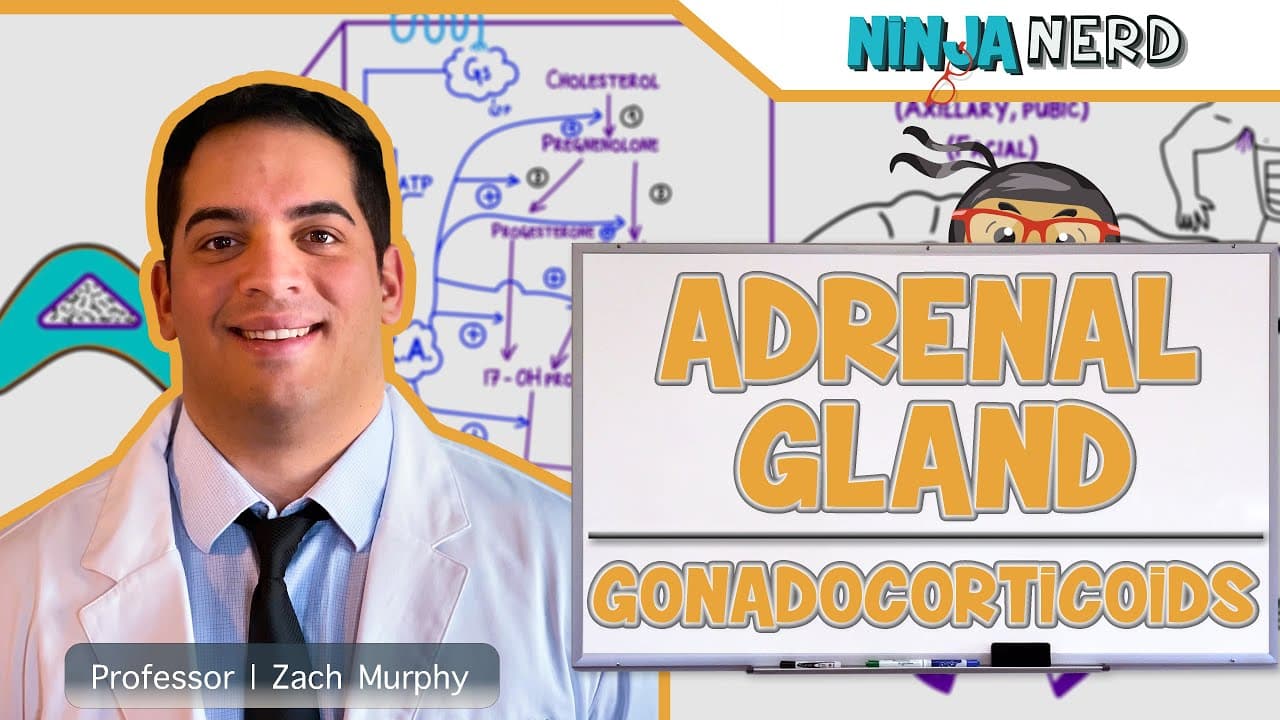
The zona reticularis of the adrenal cortex produces gonadocorticoids, weak androgens called dehydroepiandrosterone (DHEA) and androstenedione. ACTH stimulates their synthesis from cholesterol via a protein kinase A pathway. These weak sex hormones drive axillary, pubic, and facial hair growth, sebaceous skin secretions, libido, and some secondary sex characteristic development in both males and females.
Transcript
our ninja nerds in this video we're going to talk about the adrenal gland but specifically we're going to focus in on the zona reticularis if you guys haven't already seen it we already made a video specifically looking at the zona glomerulosa and its hormone the zona fasciculata and its hormone okay so first off we have the zona reticularis the zo... Read More
Key Insights
- The zona reticularis is the adrenal cortex zone that produces gonadocorticoids, distinct from the zona glomerulosa and zona fasciculata, which produce their own separate hormones. Its products are androgens, described in the lecture as very weak sex hormones.
- The control axis for gonadocorticoids starts at the paraventricular nucleus of the hypothalamus, which secretes corticotropin-releasing hormone into the hypophyseal portal system. CRH stimulates corticotropes in the anterior pituitary to produce adrenocorticotropic hormone, which acts on the zona reticularis.
- ACTH works through a G-protein coupled receptor on zona reticularis cells. The Gs protein, normally held off by bound GDP, is turned on by GTP, then activates adenylate cyclase, which converts ATP into cyclic AMP and activates protein kinase A.
- Protein kinase A drives hormone synthesis by phosphorylating multiple different enzymes involved in the cholesterol pathway. This phosphorylation stimulates the reactions that convert cholesterol step by step into the final gonadocorticoid products in the zona reticularis cell.
- Cholesterol is the required starting molecule because these hormones are steroid hormones, not protein-based or amino acid-based. Cholesterol converts to pregnenolone, which branches into either 17-hydroxypregnenolone or progesterone, opening two routes to the final androgens.
- The two gonadocorticoids produced are dehydroepiandrosterone (DHEA) and androstenedione. DHEA comes from 17-hydroxypregnenolone, while androstenedione comes from 17-hydroxyprogesterone. DHEA can also be converted directly into androstenedione, so both pathways converge on the same end product.
- In males, androstenedione is converted into testosterone in the testes, and in females these hormones lead to estrogen formation in tissues such as the thecal cells. Only very minimal amounts of testosterone and estrogen result, confirming these are weak androgens.
- The dominant effects of adrenal androgens are hair growth in the axillary, pubic, and facial regions, sebaceous secretions producing oily skin, libido in both sexes, and limited secondary sex characteristic development such as breast and mammary gland development in females.
- Overproduction of DHEA and androstenedione causes adrenal genital masculinization, marked by increased libido, excessive hair growth, increased oily secretions, and altered secondary sex characteristic development. In females this can enlarge the clitoris until it resembles a small penis.
Install to Summarize YouTube Videos and Get Transcripts
Explore YouTube Video Summarizer or Get YouTube Transcript Extractor
Questions & Answers
Q: What are gonadocorticoids and where are they produced?
Gonadocorticoids are sex steroid hormones produced by the zona reticularis, one of the layers of the adrenal cortex. They are androgens, but the lecture stresses repeatedly that they are very weak androgens compared with the sex hormones produced by the gonads themselves. The two specific gonadocorticoids covered are dehydroepiandrosterone (DHEA) and androstenedione. They are synthesized from cholesterol inside zona reticularis cells under stimulation by adrenocorticotropic hormone, and they act on both males and females, mainly influencing hair growth, skin secretions, libido, and some secondary sex characteristics.
Q: How does ACTH stimulate gonadocorticoid production in the zona reticularis?
ACTH binds to a G-protein coupled receptor on the zona reticularis cell. That receptor activates a Gs stimulatory protein, which is normally kept off while bound to GDP and turned on when it binds GTP. The activated Gs protein then stimulates the effector enzyme adenylate cyclase, which converts ATP into cyclic AMP. Cyclic AMP activates protein kinase A, and protein kinase A phosphorylates multiple enzymes involved in the cholesterol pathway. That phosphorylation drives the sequence of reactions that build DHEA and androstenedione from cholesterol.
Q: What is the biosynthetic pathway from cholesterol to DHEA and androstenedione?
Because these are steroid hormones rather than protein or amino acid based hormones, synthesis starts with cholesterol. Cholesterol is converted into pregnenolone. Pregnenolone can then go two ways: it can become 17-hydroxypregnenolone, or it can become progesterone. 17-hydroxypregnenolone can be converted into dehydroepiandrosterone or into 17-hydroxyprogesterone. Progesterone can be converted into 17-hydroxyprogesterone by the enzyme 17-hydroxylase. 17-hydroxyprogesterone is then converted into androstenedione. Additionally, DHEA itself can be converted directly into androstenedione, so the branches converge.
Q: Why are adrenal androgens called weak sex hormones?
They are called weak because the amount of active sex hormone that ultimately results from them is very small. In males, androstenedione is converted into testosterone in the testes, and in females these hormones lead to estrogen formation in tissues such as the thecal cells, but the lecture emphasizes that only very minimal amounts of testosterone and very minimal amounts of estrogen are produced by this route. Their androgenic effects are correspondingly limited, mostly confined to hair growth, sebaceous secretions, libido, and partial secondary sex characteristic development.
Q: What effects do adrenal androgens have in males?
In males, DHEA and androstenedione are largely converted into androstenedione and then into testosterone within the testes. Their observable effects include growth of axillary (armpit) hair, pubic hair, and facial hair such as hair on the chin, with facial hair being more prominent in males. They also stimulate sebaceous gland secretions, making the skin oily. They contribute to the development of certain secondary sex characteristics and have some effect on libido or sex drive, though the hair growth and skin effects dominate.
Q: What effects do adrenal androgens have in females?
In females, DHEA and androstenedione act on tissues such as the thecal cells and lead to the formation of estrogens, though only in very minimal amounts. Their effects include axillary hair growth and pubic hair growth, some contribution to libido or sex drive, and a small role in the development of secondary sex characteristics such as the breasts and mammary glands. Sebaceous secretions affecting the skin are also part of the general effect described for both sexes.
Q: What happens when the body produces too much DHEA and androstenedione?
Overproduction causes a condition described in the lecture as adrenal genital masculinization. The effects include markedly increased libido, described as sex drive coming back with a vengeance, excessive amounts of hair growth, increased oily sebaceous secretions, and disturbed development of various secondary sex characteristics. In females the consequences can be especially problematic: because these hormones influence secondary sex characteristics including the clitoris, excessive DHEA and androstenedione can cause the clitoris to enlarge until it resembles a small penis.
Q: Why does gonadocorticoid synthesis have to begin with cholesterol?
Gonadocorticoids are steroid hormones, not protein-based or amino acid-based hormones, and cholesterol is the basic building unit for all steroid hormones. The lecture makes this point explicitly when explaining why protein kinase A activation matters: the kinase does not build a peptide, it phosphorylates enzymes that carry cholesterol through successive conversions. Cholesterol becomes pregnenolone, then branches through 17-hydroxypregnenolone or progesterone, and eventually yields dehydroepiandrosterone and androstenedione as the finished gonadocorticoid products.
Summary & Key Takeaways
-
The zona reticularis is the adrenal cortex layer responsible for producing gonadocorticoids, which are very weak androgens. The pathway begins in the hypothalamus, where the paraventricular nucleus secretes corticotropin-releasing hormone into the hypophyseal portal system. CRH stimulates corticotropes in the anterior pituitary to release adrenocorticotropic hormone (ACTH), which then acts on zona reticularis cells.
-
ACTH binds a G-protein coupled receptor on zona reticularis cells, activating a Gs protein that switches from GDP to GTP. The Gs protein activates adenylate cyclase, which converts ATP into cyclic AMP, which in turn activates protein kinase A. Protein kinase A phosphorylates multiple enzymes in the cholesterol pathway to drive steroid hormone synthesis forward.
-
Cholesterol is the starting unit, converted first to pregnenolone. Pregnenolone becomes either 17-hydroxypregnenolone or progesterone. 17-hydroxypregnenolone becomes DHEA or 17-hydroxyprogesterone; progesterone becomes 17-hydroxyprogesterone via 17-hydroxylase; and 17-hydroxyprogesterone becomes androstenedione. DHEA can also be converted directly into androstenedione, making these two the final gonadocorticoid products.
-
In males, DHEA and androstenedione are largely converted into androstenedione and then into testosterone in the testes. In females, they act on tissues like the thecal cells to form estrogens. Only very minimal amounts of testosterone and estrogen come from this adrenal route, which is why these hormones are described as weak androgens.
-
The main physiological effects are axillary, pubic, and facial hair growth (facial more in males), sebaceous gland secretions that make skin oily, some secondary sex characteristic development, and libido in both sexes. Overproduction causes adrenal genital masculinization, with excessive hair growth, oily secretions, heightened libido, and in females a clitoris that can resemble a small penis.
Read in Other Languages (beta)
Share This Summary 📚
Summarize YouTube Videos and Get Video Transcripts with 1-Click
Try YouTube Summary with ChatGPT & Claude or YouTube Transcript Generator
Explore More Summaries from Ninja Nerd 📚






Summarize YouTube Videos and Get Video Transcripts with 1-Click
Try YouTube Summary with ChatGPT & Claude or YouTube Transcript Generator