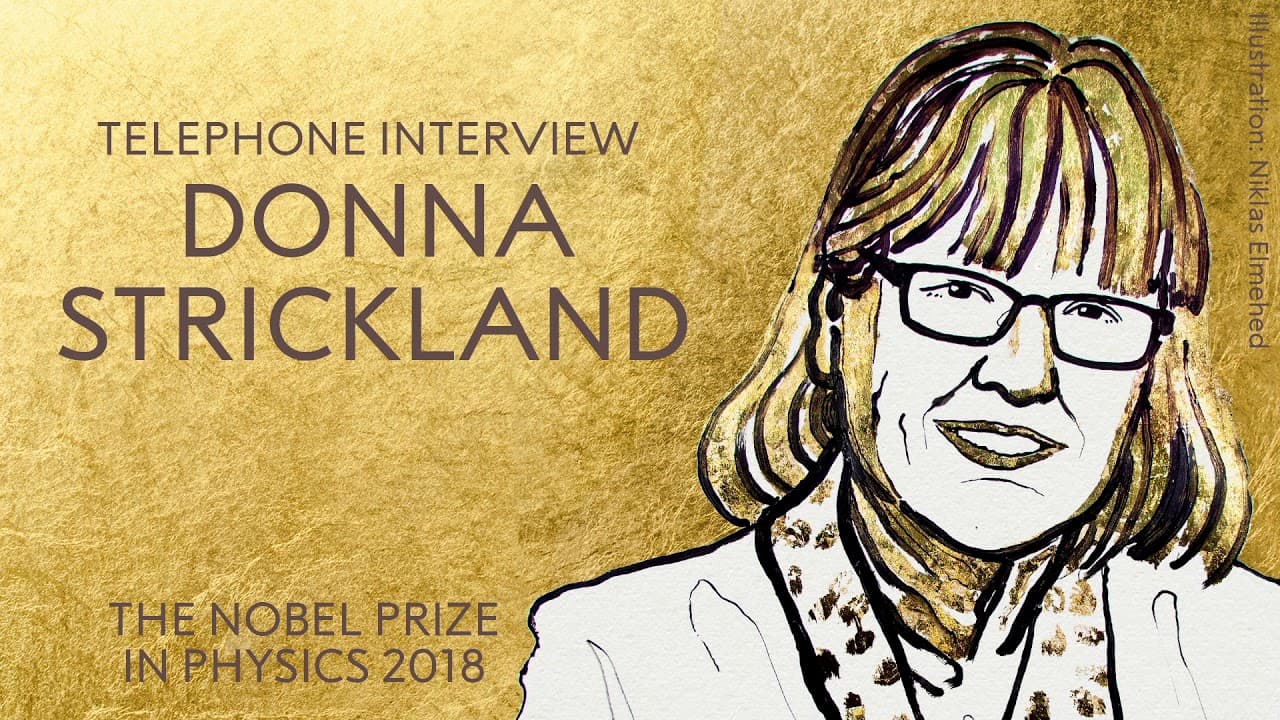
"We scientists like to puzzle as to why something is working." – Interview with Donna Strickland
TL;DR
Donna Strickland says the research behind her 2018 Nobel Prize in Physics succeeded through enjoyable, intensive experimental work with short-pulse lasers. She highlights light generation as a striking example: sufficiently short and intense pulses interacting nonlinearly with a clear medium can transform narrow-bandwidth input light into all the colors of the rainbow.
Transcript
hello hello is this Donna Strickland hi this is Adam Smith calling from nobelprize.org the official web site at the Nobel Prize in Stockholm okay hi first of all congratulations on the order the Nobel Prize thank you very much what was your immediate thought on hearing the news well obviously like I think like many people have set up we've wondered... Read More
Key Insights
- Donna Strickland's immediate response to the Nobel Prize call was suspicion that it might be a prank, although she recognized that the timing was correct and considered such a deception unusually cruel.
- Strickland's Nobel-recognized research appeared in her first scientific paper, an outcome she described as feeling like extraordinary luck rather than evidence that she had deliberately followed a path toward the prize.
- The key to Strickland's sustained laboratory effort was enjoyment, because short-pulse lasers were an exciting field, her research group was fun to work with, and those conditions made long working hours worthwhile.
- Strickland became the first female Nobel laureate in 55 years, but she did not frame her own career around watching prizes and asking why women were absent from the list.
- Maria Goeppert Mayer's 1939 research started the field of multiphoton ionization, according to Strickland, and Strickland cited that work in her thesis because it supported the first application of their laser.
- Recognition of women scientists has changed substantially, in Strickland's view, because earlier trailblazers could perform important research while struggling for paid employment or acknowledgment as scientists.
- Light generation works when sufficiently short and intense pulses interact nonlinearly with water or another clear medium, causing narrow-bandwidth input light to produce the many colors visible in a rainbow.
- Scientific curiosity is driven by puzzling over why an observed effect works, and Strickland described the long effort to understand colorful light generation as an example of that enjoyable investigative process.
Install to Summarize YouTube Videos and Get Transcripts
Explore YouTube Video Summarizer or Get YouTube Transcript Extractor
Questions & Answers
Q: How did Donna Strickland react to winning the Nobel Prize?
Donna Strickland initially wondered whether the telephone call announcing the Nobel Prize was a prank. She then recognized that it was the correct day for such a call and reasoned that a false announcement would be exceptionally cruel. Her reaction combined disbelief with surprise, especially because she had learned the news only minutes before discussing it with the interviewer.
Q: Why did Donna Strickland work long hours on laser research?
Donna Strickland worked long hours because she found the experimental research enjoyable. She described short-pulse lasers as a fun field and recalled being part of a fun research group. Rather than presenting the effort as an unpleasant sacrifice, she said that she enjoyed putting many hours into the laboratory work during the period that ultimately led to the 2018 Nobel Prize in Physics.
Q: Was Donna Strickland's first scientific paper connected to her Nobel Prize?
Donna Strickland said that the research recognized by the Nobel Prize was reported in her first scientific paper. She found this circumstance remarkable and wondered whether anyone else had received a Nobel Prize for a first paper. She characterized the result as something she had lucked into, while also describing the intensive and enjoyable experimental effort that produced the work.
Q: What did Donna Strickland say about women receiving scientific recognition?
Donna Strickland acknowledged being the first female laureate in 55 years but said she had not personally spent her career watching prize results and asking why a woman was not selected. She emphasized the importance of earlier trailblazers who struggled to obtain paid employment or recognition as scientists, and she expressed confidence that conditions had changed substantially and would continue changing.
Q: Why did Donna Strickland discuss Maria Goeppert Mayer's research?
Donna Strickland discussed Maria Goeppert Mayer as an example of a woman whose important scientific contributions preceded adequate professional recognition. Strickland said she cited Mayer's 1939 work in her thesis because it began the field of multiphoton ionization. That research was also connected to the first purpose for which Strickland's laser was used during her thesis work.
Q: How can short and intense laser pulses create rainbow colors?
Sufficiently short and intense pulses can enter water or another clear medium as light with a narrow bandwidth, then emerge with all the colors of the rainbow. Donna Strickland attributed this transformation to the nonlinear interaction between the light and the medium. She contrasted the effect with separating colors already contained in white light because the broader range is created from narrow-bandwidth input.
Q: Why does Donna Strickland call light generation remarkable?
Donna Strickland considers light generation remarkable because its visible result seems surprising: one color of light enters a clear substance, yet many rainbow colors emerge when the pulses are sufficiently short and intense. Although scientists understand the underlying nonlinear interaction, she described the demonstration as magical and especially exciting to observe, including as part of the undergraduate laboratory experience she had taken over.
Q: What does Donna Strickland say scientists enjoy about experiments?
Donna Strickland says scientists enjoy puzzling over why something works. Her example was the colorful light generated through nonlinear interaction between short, intense pulses and a clear medium. Scientists required many years to determine what was happening, and she presented that process of investigating a visually striking effect as both enjoyable scientific work and a useful demonstration of interaction between laser light and matter.
Summary
Donna Strickland, the third female laureate in the history of the Nobel Prize in Physics, discusses her thoughts and experiences after winning the prize for her work on ultra-fast lasers. She talks about her initial reaction to the news, her journey as a scientist, the influence of Marie Curie, and the significance of her achievement as a woman in science. She also addresses the potential impact of winning the Nobel Prize and shares her favorite example of what ultra-fast lasers can do.
Questions & Answers
Q: What was Donna Strickland's immediate thought on hearing the news of winning the Nobel Prize?
Donna Strickland initially wondered if it was a prank, but knowing it was the right day, she realized it would have been a cruel prank and accepted the news with excitement.
Q: As a first-time Nobel laureate, how does Donna Strickland feel about being awarded the prize for her first scientific paper?
Donna Strickland considers herself lucky and believes she stumbled upon this achievement. She acknowledges that it is unusual for someone to receive the Nobel Prize for their first scientific paper and feels grateful for the opportunity.
Q: Where does Donna Strickland think her natural talent for experimental work comes from?
Donna Strickland is unsure of where her talent for experimental work comes from. She describes her work with short pulse lasers as a fun and enjoyable experience that required many hours of dedication.
Q: What does Donna Strickland think the message is behind being the first female laureate in physics after 55 years?
Donna Strickland points out that she personally hasn't dwelled on the lack of female laureates, but acknowledges that many people have questioned the gender imbalance. She believes that sharing stories of trailblazing women like Marie Curie and Lise Meitner, who faced significant challenges in their time, can inspire change for a more inclusive future.
Q: Why does Donna Strickland believe recognition for women in science has improved?
Reflecting on Marie Curie's era, Donna Strickland expresses gratitude for the progress that has been made over the years. She highlights the groundbreaking work of Marie Curie and the role it played in shaping the field of multiphoton ionization, which revolutionized laser technology. Strickland believes that this progress indicates positive change and hopes for further advancements.
Q: How does Donna Strickland feel about the increased demand and attention she will receive after winning the Nobel Prize?
Donna Strickland admits feeling apprehensive about the demand and attention that comes with winning a Nobel Prize. She recalls a previous laureate mentioning the extensive traveling involved, which can be exhausting. Nonetheless, she recognizes the unique position she now finds herself in.
Q: What is Donna Strickland's favorite example of what ultra-fast lasers can do?
Donna Strickland mentions the phenomenon of white light passing through water or any clear substance and transforming into all the colors of the rainbow when exposed to short and intense laser pulses. She finds it fascinating to witness the creation of various colors through the nonlinear interaction with the medium.
Q: Why does Donna Strickland find the generation of different colors from a narrow bandwidth of light so remarkable?
Donna Strickland explains that scientists have known for a long time how this process works, but it still remains a fascinating phenomenon. She emphasizes the joy scientists derive from unraveling mysteries and understanding the intricate workings of nature.
Q: What does Donna Strickland think about the usefulness of frequency generation?
Donna Strickland recognizes that frequency generation has practical applications in various fields. She appreciates how this research area encompasses the interaction between laser light and matter. She believes that her work aligns well with the Nobel Prize's emphasis on laser light and matter interaction.
Q: How does Donna Strickland feel about her upcoming visit to Stockholm for the Nobel Prize ceremony?
Donna Strickland expresses her excitement about visiting Stockholm in December to attend the Nobel Prize ceremony. She looks forward to meeting the people behind the Nobel Prize and interacting with fellow scientists.
Takeaways
Donna Strickland's groundbreaking work with ultra-fast lasers not only earned her the prestigious Nobel Prize in Physics but also highlights the progress of gender equality in science. As the third female laureate in physics, she recognizes the significance of her achievement and hopes to inspire future generations. Strickland's favorite example of ultra-fast lasers creating an array of colors from a narrow bandwidth showcases the beauty and fascinating nature of scientific discoveries. Her upcoming visit to Stockholm for the Nobel Prize ceremony marks a milestone in her career and offers an opportunity to connect with the global scientific community.
Summary & Key Takeaways
-
Donna Strickland initially wondered whether the Nobel Prize call was a prank, then recognized that it came on the expected day. She described receiving the award for research reported in her first scientific paper as an extraordinary outcome and credited the enjoyable laboratory environment with motivating her to devote long hours to the work.
-
Strickland reflected on becoming the first female laureate in 55 years and discussed earlier women scientists who lacked recognition and paid positions. She cited Maria Goeppert Mayer's 1939 work in her thesis, explaining that it started the field of multiphoton ionization and supported the first use of their laser in her research.
-
Strickland presented light generation as a memorable demonstration of intense short-pulse lasers. A narrow range of light enters water or another clear material, while nonlinear interaction produces rainbow colors. Although the effect is scientifically understood and widely used, its visually surprising result captures why scientists enjoy investigating how physical processes work.
Read in Other Languages (beta)
Share This Summary 📚
Summarize YouTube Videos and Get Video Transcripts with 1-Click
Try YouTube Summary with ChatGPT & Claude or YouTube Transcript Generator
Explore More Summaries from Nobel Prize 📚



Summarize YouTube Videos and Get Video Transcripts with 1-Click
Try YouTube Summary with ChatGPT & Claude or YouTube Transcript Generator