Nobel Lecture: Emmanuelle Charpentier, Nobel Prize in Chemistry 2020
TL;DR
CRISPR-Cas9 is a groundbreaking genome editing technology that allows scientists to modify genes with precision. It uses a Cas9 protein guided by RNA to target and cut specific DNA sequences, enabling gene modification for research, medicine, and agriculture. This technology has revolutionized genetic research by providing a simple, versatile, and efficient method for editing genomes.
Transcript
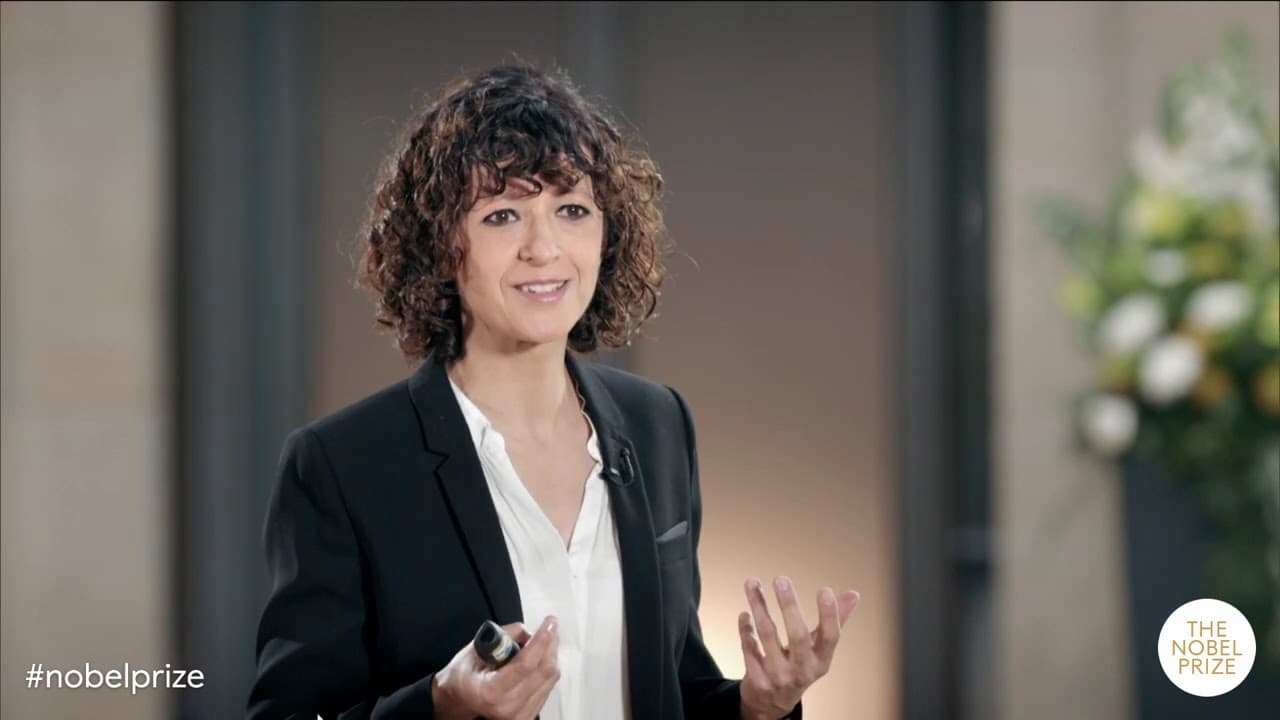
was born in 1968 in chevy cesaros in france she obtained her phd in 1995 from institute pasteur in paris and for part of her career she worked at umeo university in sweden she is now director of the max planck unit for the science of pathogens in berlin germany i now welcome you onto the stage we are very much looking forward to hearing your lectur... Read More
Key Insights
- CRISPR-Cas9 is a genome editing tool that allows precise modifications of DNA in cells and organisms.
- The Cas9 protein acts like molecular scissors, cutting DNA at specific locations guided by RNA sequences.
- CRISPR technology originated from research on bacterial immune systems against viruses.
- The programmability and simplicity of CRISPR-Cas9 make it a transformative tool in genetic research.
- CRISPR-Cas9 enables gene correction, mutation introduction, and gene replacement in various organisms.
- The technology has applications in medicine, agriculture, and fundamental biological research.
- CRISPR-Cas9 has been rapidly adopted by scientists due to its efficiency and versatility.
- Research continues to discover new CRISPR systems, expanding the potential applications of genome editing.
Install to Summarize YouTube Videos and Get Transcripts
Explore YouTube Video Summarizer or Get YouTube Transcript Extractor
Questions & Answers
Q: How does CRISPR-Cas9 edit genes?
CRISPR-Cas9 edits genes by utilizing a Cas9 protein guided by RNA to locate specific DNA sequences in a genome. Once the target DNA is located, Cas9 acts as molecular scissors to cut the DNA at the desired location. This cut allows for the removal, addition, or alteration of genetic material, facilitating precise gene editing for various applications.
Q: What are the applications of CRISPR-Cas9?
CRISPR-Cas9 has diverse applications across multiple fields. In medicine, it is used for developing gene therapies to treat genetic disorders and cancers. In agriculture, it enables the creation of crops with improved traits. Additionally, it is a vital tool in fundamental research, allowing scientists to study gene functions and interactions in cells and model organisms.
Q: Why is CRISPR-Cas9 considered a transformative technology?
CRISPR-Cas9 is transformative due to its simplicity, efficiency, and versatility in genome editing. Unlike previous methods, it allows precise, programmable modifications of DNA, enabling rapid advancements in genetic research. Its wide applicability in medicine, agriculture, and biology has revolutionized how scientists approach genetic engineering and therapy development.
Q: What is the origin of CRISPR-Cas9 technology?
CRISPR-Cas9 technology originated from the study of bacterial immune systems. Bacteria use CRISPR arrays and Cas proteins to defend against viral DNA by memorizing and targeting invading genetic material. This natural defense mechanism was harnessed and adapted into a powerful genome editing tool, enabling precise DNA modifications in various organisms.
Q: How does the CRISPR-Cas9 mechanism work?
The CRISPR-Cas9 mechanism involves a Cas9 protein guided by a specific RNA sequence to identify and bind to a complementary DNA sequence. Once bound, Cas9 cuts the DNA, creating a double-strand break. This break can be repaired through natural cellular processes, allowing for targeted gene modifications such as insertions, deletions, or replacements.
Q: What makes CRISPR-Cas9 programmable?
CRISPR-Cas9 is programmable due to its use of guide RNA (gRNA), which can be designed to match any DNA sequence of interest. By changing the sequence of the gRNA, scientists can direct the Cas9 protein to different locations within the genome, enabling precise targeting and editing of specific genes or genetic regions.
Q: What challenges does CRISPR-Cas9 face in clinical applications?
CRISPR-Cas9 faces challenges in clinical applications, including off-target effects where unintended DNA sequences are edited, potential immune responses to the Cas9 protein, and the delivery of the CRISPR components into human cells. Ongoing research aims to address these issues by improving targeting accuracy, minimizing immune reactions, and developing efficient delivery systems.
Q: How has CRISPR-Cas9 impacted genetic research?
CRISPR-Cas9 has significantly impacted genetic research by providing a powerful, accessible tool for precise genome editing. It has accelerated discoveries in gene function, enabled the development of disease models, and facilitated the exploration of genetic pathways. Its rapid adoption has led to innovative approaches in studying and manipulating genetic material across various fields.
Summary
In this lecture, the speaker discusses the CRISPR-Cas9 technology, which is a method for genome editing. They explain the transformative nature of this technology, its applications, and its origins in the study of bacteria and viruses. The speaker emphasizes the importance of continuing research in microbiology and thanks the scientists who have contributed to the development of CRISPR-Cas9.
Questions & Answers
Q: What is the CRISPR-Cas9 technology and what does it do?
The CRISPR-Cas9 technology is a method for genome editing that allows scientists to modify genes and their expression. It consists of a protein component called Cas9, represented as scissors, which can recognize a specific sequence on DNA and cleave it. The Cas9 protein is programmed by an RNA component to bring it to the desired site of interest.
Q: Why is the CRISPR-Cas9 technology considered transformative?
The field of genetics has seen various developments over the years, but the CRISPR-Cas9 technology brings a level of programmability, simplicity, and versatility that is unmatched. It allows scientists to study cells and organisms that were previously difficult to study and to perform precise genetics in an unprecedented manner. This technology has become widely adopted by the scientific community since its discovery in 2012.
Q: How did the speaker become interested in the study of bacteria and their interactions with the human host?
The speaker's research focus on bacteria and their interaction with the human host stems from their interest in understanding how Streptococcus pyogenes causes diseases in humans. Throughout their career, they have been intrigued by how bacteria adapt to their environment, cause diseases, and how the human host defends itself against bacterial infections. They have also developed genetic tools to study these mechanisms and have worked on transgenic mice to further understand the interaction between bacteria and the human host.
Q: What led the speaker to explore the CRISPR-Cas9 system?
While conducting research on small regulatory RNAs, the speaker came across an RNA called tracer RNA, which was well-expressed in bacterial cells. They found that this RNA could base pair with the repeats of CRISPR RNAs, indicating a potential regulatory role. Upon investigating further, they discovered that the tracer RNA was encoded near a gene associated with the CRISPR system, thus sparking their interest in studying CRISPR.
Q: Why are bacteria and archaea equipped with immune systems like CRISPR?
Bacteria and archaea can be infected by viruses and have evolved diverse immune systems to defend against the invasion of genetic elements, such as phages, plasmids, and transposons. These immune systems are crucial for the survival and fitness of microorganisms in their environment. The CRISPR-Cas systems are adaptive immune systems that allow bacteria and archaea to recognize and memorize viral infections, leading to immunity upon reinfection.
Q: How does the CRISPR-Cas9 system work?
The CRISPR-Cas9 system involves a two-step process of recognition and immunity. After a virus infects a bacterial cell, the CRISPR system recognizes the invading viral DNA and inserts a sequence into the CRISPR array, effectively memorizing the virus. Upon reinfection, the CRISPR RNAs guide the Cas9 protein to the invading viral DNA, which is then cleaved and rendered unable to replicate, providing immunity against the virus.
Q: How is the CRISPR-Cas9 system programmable?
The programmability of the CRISPR-Cas9 system comes from simplifying the RNA complex that guides the Cas9 protein. Previously, two RNA molecules were used, but researchers fused them into a single RNA molecule, known as the guide RNA. This simplification allows for more straightforward design choices and makes the technology more versatile and programmable.
Q: What applications does the CRISPR-Cas9 technology have?
The CRISPR-Cas9 technology has numerous applications in both fundamental research and clinical purposes. It allows scientists to better understand the mechanisms of life, study a wide range of cells and organisms, and perform precise genetics in an unprecedented manner. The technology has been applied in various fields, including medicine (treating genetic disorders and cancers), plant biology (crop improvement), and generating disease models.
Q: How has the CRISPR-Cas9 technology impacted the field of genetics?
The CRISPR-Cas9 technology has revolutionized the field of genetics by providing scientists with a powerful tool for studying cells and organisms of interest. It has simplified and accelerated the process of precise genetics, enabling researchers to perform multiple modifications and manipulations on the genome. The technology has been rapidly adopted by scientists and has been applied successfully in various organisms, including humans.
Q: What is the future of CRISPR research?
CRISPR research is ongoing, and new CRISPR systems are continually being identified as more bacterial and archaeal genomes are sequenced. The CRISPR toolbox is expanding, and scientists are developing novel applications and technologies based on CRISPR. The technology's impact is even more significant considering advancements in sequencing technologies, gene delivery, and cell culture methods. It is an exciting time for studying the evolution and diversity of the world through CRISPR research.
Takeaways
The CRISPR-Cas9 technology is a transformative method for genome editing, allowing scientists to modify genes and their expression with unprecedented precision. It simplifies the design process, offers programmability, and has found applications in various fields, such as medicine and plant biology. The origins of CRISPR-Cas9 lie in the study of bacteria and archaea, highlighting the importance of continuing research in microbiology. Overall, CRISPR research provides young scientists with powerful tools to study cells and organisms, and it complements the advancements in sequencing, imaging, and gene delivery technologies. The impact of CRISPR-Cas9 underscores the value of microbiology in developing new biotechnologies.
Summary & Key Takeaways
-
CRISPR-Cas9 revolutionizes genetic research by providing a precise, efficient tool for genome editing. It uses a Cas9 protein, guided by RNA, to target and cut DNA, allowing gene modification. This technology has vast applications in medicine, agriculture, and biology, enabling advancements in understanding and treating genetic disorders.
-
The technology originated from bacterial immune systems, where CRISPR arrays and Cas proteins defend against viral DNA. Its simplicity and programmability have made it a popular choice for researchers, facilitating rapid advancements in genetic engineering and therapy.
-
CRISPR-Cas9's impact is amplified by advancements in sequencing, imaging, and delivery technologies, enhancing its application scope. Continued research on microbial systems promises further innovations in genetic tools, underscoring the importance of microbiology in biotechnology development.
Read in Other Languages (beta)
Share This Summary 📚
Summarize YouTube Videos and Get Video Transcripts with 1-Click
Try YouTube Summary with ChatGPT & Claude or YouTube Transcript Generator
Explore More Summaries from Nobel Prize 📚


Summarize YouTube Videos and Get Video Transcripts with 1-Click
Try YouTube Summary with ChatGPT & Claude or YouTube Transcript Generator