How to Build a Self-Improving Company with AI
TL;DR
Build a self-improving company with AI by turning business knowledge into legible context and creating recursive AI loops that can learn with minimal human intervention. Each loop combines sensor data, decision policies, deterministic tools, quality gates, and a learning mechanism. The YC example shows a monitoring agent improving failed database queries overnight, so read on for the system’s components and workflow.
Transcript
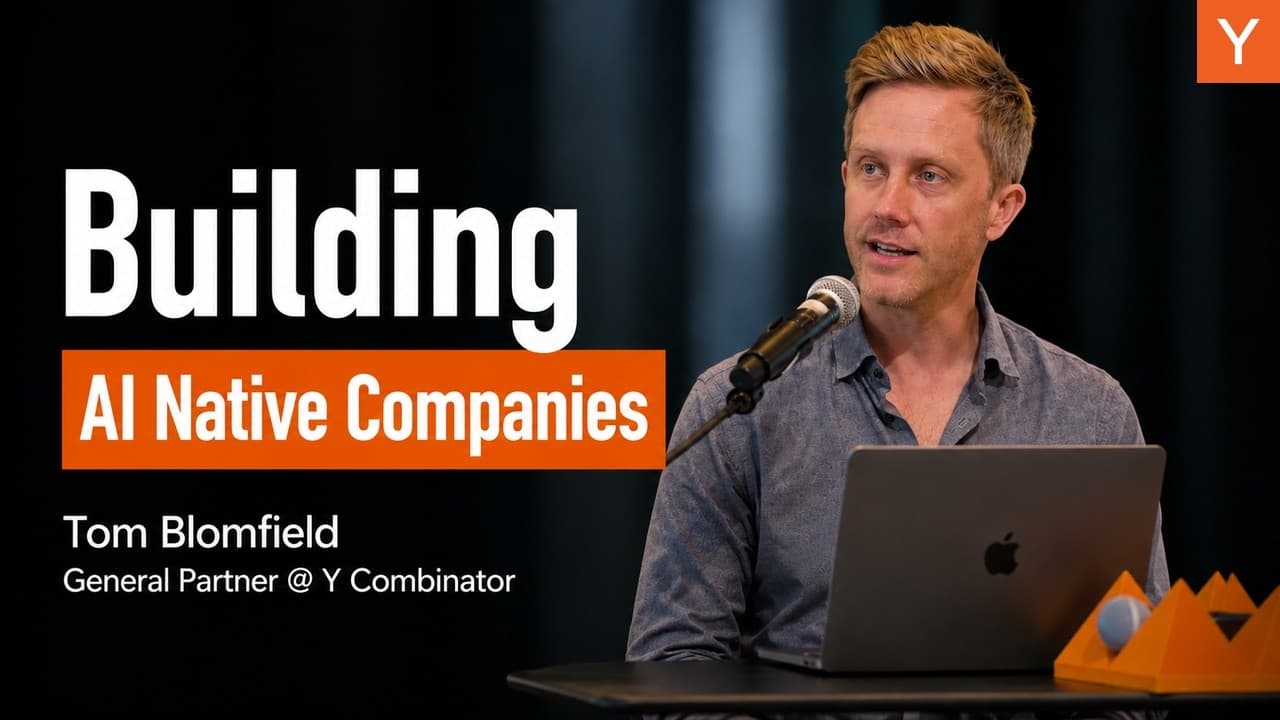
This is based a little bit off a talk Diana gave. There's a video up over the weekend which is super cool. Um Jack Dorsey was tweeting some stuff like two or three weeks ago that I thought was super cool and I've kind of um stolen a bunch of those ideas and shove them into here. This talk is like pretty conceptual and high level about thinking abou... Read More
Key Insights
- AI loops can automate company processes, enabling self-improvement without human intervention.
- Traditional hierarchical structures are outdated; AI can replace middle management by coordinating tasks.
- Recording all company interactions makes them legible to AI, allowing for better decision-making.
- AI loops consist of sensor layers, decision policies, tools, quality checks, and learning mechanisms.
- Companies can achieve higher revenue per employee by focusing on token usage rather than headcount.
- Self-improving AI loops can continuously optimize product development and customer service.
- Humans will still be needed for high-stakes, ethical, or novel situations where AI cannot yet intervene.
- The concept of ephemeral software allows for continuous regeneration and improvement of internal tools.
Install to Summarize YouTube Videos and Get Transcripts
Explore YouTube Video Summarizer or Get YouTube Transcript Extractor
Questions & Answers
Q: How do you build a self-improving company with AI?
Make the company’s domain and business knowledge legible as context or skills, then organize work as recursive self-improving AI loops. Each loop should sense real-world inputs, follow decision policies, use deterministic tools, pass quality checks, and learn from failures with minimal human intervention.
Q: What components make up a self-improving AI loop?
The loop starts with a sensor layer that receives inputs such as customer emails, support tickets, code changes, subscription cancellations, and product telemetry. It also includes a policy layer, a tool layer of deterministic APIs, quality gates, and a learning mechanism that feeds failures back into the system.
Q: Why must company knowledge be made legible to AI?
Company know-how is distributed across people’s heads, Slack messages, emails, and Notion. Extracting that knowledge into usable context or skills lets a company move from a hierarchical organization toward an intelligent AI-powered organization with AI-native software.
Q: How does AI change the traditional hierarchical company structure?
Traditional companies resemble Roman legions, with people carrying information and orders up and down nested hierarchies. The speaker argues that AI breaks this assumption by allowing companies to be reimagined as recursive, self-improving AI loops rather than existing structures with AI added on the side.
Q: What information can the sensor layer collect?
The sensor layer gathers information from the outside world. Examples in the transcript include customer emails, support tickets, code changes, subscription cancellations, and product telemetry.
Q: What does the policy layer control in an AI loop?
The policy or decision layer defines what the AI is allowed to do. It also specifies when the AI must ask a human for permission and what actions it must log.
Q: How did YC create an AI system that improves database queries overnight?
YC placed a monitoring agent above a database-query agent to examine every query made by YC employees and identify failures. When a query failed, the system considered changes such as new deterministic tools, an updated skills file, a different database view, or a new index, then wrote code, opened a merge request, reviewed it, merged it, and deployed it.
Q: How are quality and safety handled in a self-improving AI loop?
A quality gate checks the AI loop before actions proceed. The transcript gives eval-based checks, safety filters, and human review for high-risk work as possible safeguards.
Summary & Key Takeaways
-
AI can redefine company structures by replacing hierarchical models with self-improving AI loops. These loops involve sensor data collection, decision-making policies, and learning mechanisms that work autonomously. By making all company interactions legible to AI, businesses can automate and optimize processes, leading to more efficient operations and reduced need for middle management.
-
The transition to AI-powered companies involves recording every interaction to make it accessible to AI, allowing for better decision-making and self-improvement. AI loops can automate product development and customer service by continuously optimizing processes. Human roles will focus on high-stakes, ethical, and novel situations where AI cannot yet intervene.
-
Building a self-improving company requires shifting focus from traditional hierarchies to AI-driven processes. By leveraging AI loops, businesses can automate tasks, enhance efficiency, and increase revenue per employee. The concept of ephemeral software supports continuous improvement, with humans providing oversight in complex or ethical scenarios.
Read in Other Languages (beta)
Share This Summary 📚
Summarize YouTube Videos and Get Video Transcripts with 1-Click
Try YouTube Summary with ChatGPT & Claude or YouTube Transcript Generator
Explore More Summaries from YC Root Access 📚






Summarize YouTube Videos and Get Video Transcripts with 1-Click
Try YouTube Summary with ChatGPT & Claude or YouTube Transcript Generator