How Juicebox Built AI Agents for the Hiring Process
TL;DR
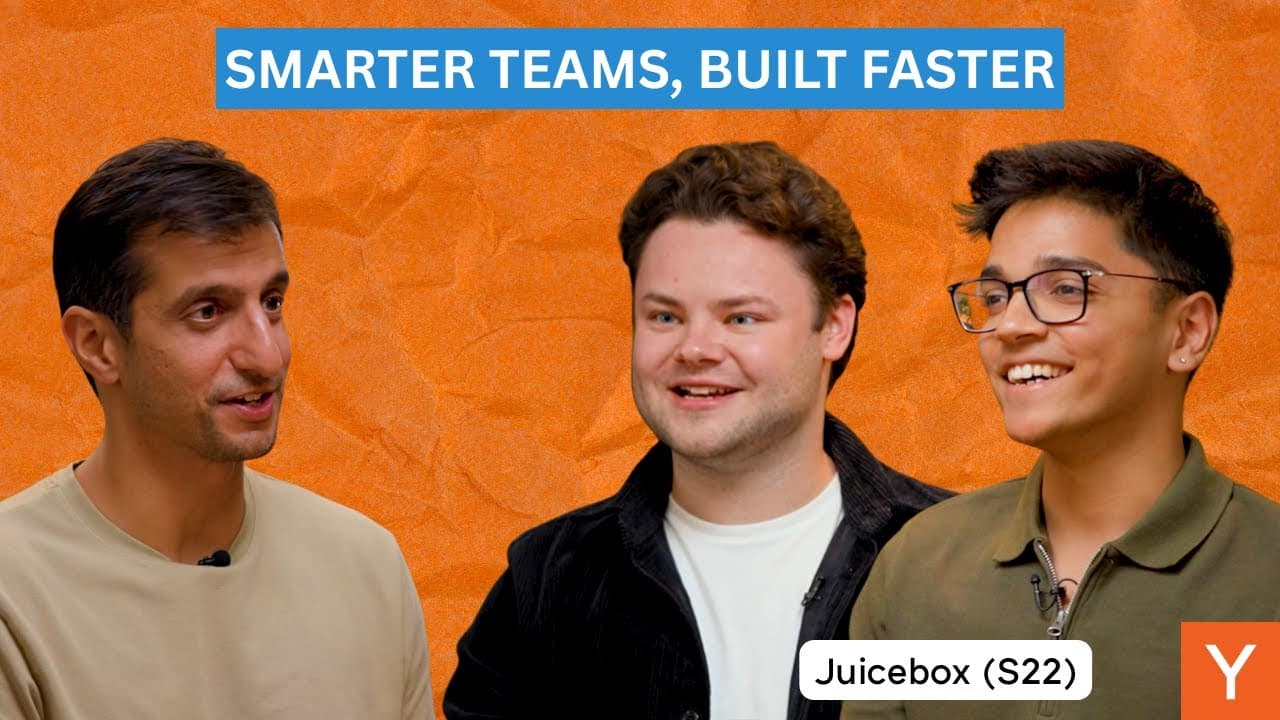
Juicebox uses LLM-powered AI agents to help companies find, evaluate, and engage candidates across the recruiting workflow. Founded by David Paffenholz and Ishan Gupta, the platform serves over 2,000 customers, including Perplexity, Ramp, and Cursor, and announced a $30 million Series A led by Sequoia Capital. Read on to see how multiple pivots and an early signal of “message market fit” led to its recruiting product.
Transcript
Today I'm joined by David and Nan, the co-founders of Juicebox, who recently just announced their series A of $30 million led by Sequoia Capital. Thanks for joining us, guys. Thanks for having us. Why don't we start by explaining what Juicebox does? So, Juicebox is an AI recruiting platform. We help companies find, engage, and evaluate talents fast... Read More
Key Insights
- Juicebox is an AI recruiting platform that helps companies find, engage, and evaluate talent faster and more efficiently using LLMs, covering the entire recruiter workflow in either an AI-assisted or fully AI-led way.
- The traditional recruiter workflow has a few steps: searching for candidates through online profile searches with filters like job title, evaluating profiles by clicking into them, and reaching out via email or LinkedIn. Evaluating profiles is the most time-intensive portion.
- Juicebox raised a $30 million Series A led by Sequoia Capital and works with over 2,000 customers, including fast-growing tech companies like Perplexity, Ramp, and Cursor, plus large recruiting agencies and some of the world's largest enterprises.
- The founders met during Covid through an online competition David organized, where the prize was meeting computer scientist Stephen Wolfram. Ishan entered to meet Wolfram but ended up joining David's music app project instead.
- The company reached product-market fit only after multiple pivots. The founders did YC in 2022 starting with a music discovery app, then pitched a merch marketplace, then a freelancer marketplace, before landing on recruiting.
- LLMs unlocked the recruiting opportunity because they can draw inference from unstructured data and extract semantic meaning from profiles, which is a huge part of what recruiters do daily when reviewing candidate profiles.
- The name Juicebox comes from the founders' music app days as a wordplay on Jukebox. They kept it for the recruiting platform the night before launch because they loved it, choosing something fun and memorable over conventional B2B SaaS naming.
- Juicebox achieved instant 'message market fit' before product-market fit. When they launched the recruiting idea, they got flooded with emails and messages from people saying recruiting was a big pain point, unlike their earlier ideas that generated no inbound demand.
Install to Summarize YouTube Videos and Get Transcripts
Explore YouTube Video Summarizer or Get YouTube Transcript Extractor
Questions & Answers
Q: What does Juicebox do in the hiring process?
Juicebox is an AI recruiting platform that helps companies find, evaluate, and engage talent faster using LLMs. It covers candidate search, profile evaluation, and outreach in either an AI-assisted or fully AI-led workflow.
Q: Which recruiting problems does Juicebox address?
Recruiters typically search online profiles using filters such as job title, open profiles to evaluate candidates, and then contact them through email or LinkedIn. Juicebox targets this entire workflow, including profile evaluation, which the founders describe as its most time-intensive portion.
Q: How many customers does Juicebox serve?
Juicebox works with over 2,000 customers. They include talent teams at Perplexity, Ramp, and Cursor, as well as large recruiting agencies and major enterprises.
Q: How much funding did Juicebox announce?
Juicebox announced a $30 million Series A led by Sequoia Capital. The announcement came as the company was serving more than 2,000 customers.
Q: How do LLMs enable Juicebox’s recruiting agents?
The founders realized that LLMs could draw inferences and extract semantic meaning from unstructured profile data. Because recruiters repeatedly perform that work while reviewing candidates, LLMs made it possible to automate or assist important parts of their workflow.
Q: What pivots did Juicebox make before becoming an AI recruiting platform?
The founders entered YC in 2022 with a music discovery app that connected to Spotify and presented 15-second song snippets. They later explored a merchandise marketplace and a freelancer marketplace before finding the recruiting opportunity after experimenting with ChatGPT and LLM APIs.
Q: What did the first Juicebox recruiting MVP do?
The first recruiting MVP launched internally at YC around December 2022 as a basic LLM-powered application. It turned common recruiter tasks into features such as structuring interview questions and quickly summarizing or assessing candidate profiles.
Q: What was Juicebox’s “message market fit” signal?
When the founders launched the recruiting concept, they were flooded with emails and messages from people describing recruiting as a major pain point. That immediate response showed message market fit, although early customers were not fully satisfied because the product was not yet reliable enough for regular use.
Summary & Key Takeaways
-
Juicebox is an AI recruiting platform using LLMs to help companies find, engage, and evaluate talent across the full recruiter workflow. Co-founded by David Paffenholz and Ishan Gupta, it recently announced a $30 million Series A led by Sequoia Capital and serves over 2,000 customers.
-
The path to product-market fit was not a straight line. The founders did YC in 2022 with a music discovery app, pivoted through a merch marketplace and a freelancer marketplace, and only found the recruiting opportunity once ChatGPT and LLM APIs demonstrated they could draw inference from unstructured profile data.
-
The very first Juicebox MVP, launched internally at YC around December 2022, turned common recruiter processes like structuring interview questions and summarizing profiles into a basic LLM-powered app. It showed promise and message market fit, but early customers were not fully satisfied because the product was not yet reliable enough for regular use.
Read in Other Languages (beta)
Share This Summary 📚
Summarize YouTube Videos and Get Video Transcripts with 1-Click
Try YouTube Summary with ChatGPT & Claude or YouTube Transcript Generator
Explore More Summaries from YC Root Access 📚





Summarize YouTube Videos and Get Video Transcripts with 1-Click
Try YouTube Summary with ChatGPT & Claude or YouTube Transcript Generator