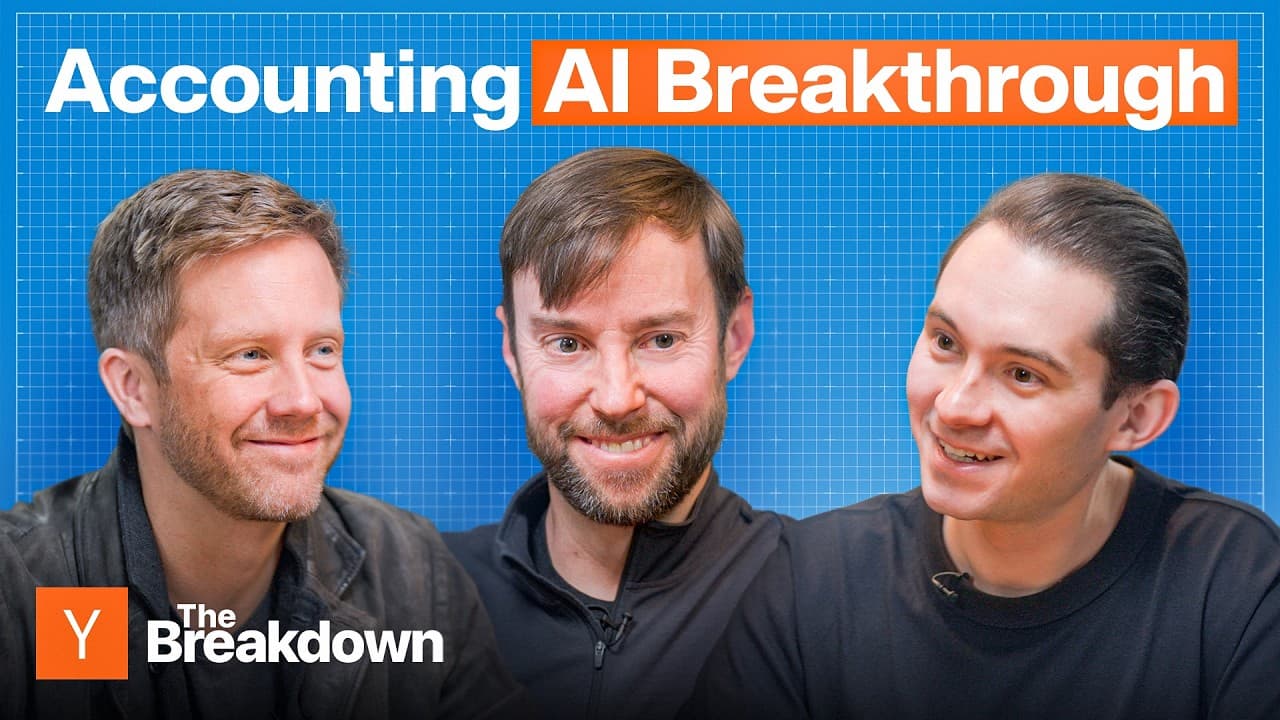
How Will AI Disrupt Accounting and Tax Work? The Breakdown With Dominic Vitucci, CEO and Founder of Onshore
TL;DR
AI will transform accounting and tax work by automating repetitive document processing, data transfer, arithmetic, and evidence review. Dominic Vitucci, CEO and founder of Onshore, explains that R&D tax credit calculations are simple, but substantiating eligible work through records such as Git issues and Jira tickets is harder. Read on to understand why document-reading AI could reshape how accounting outcomes reach customers.
Transcript
From my perspective, I understand why it's hard to imagine a post big four, a post accounting firm world. It is a foreign concept. Conversely, I don't actually think they've earned the right to maintain the reverence that they've they've been granted for all of these decades, centuries sometimes. [music] And so, if this keeps going the way that I t... Read More
Key Insights
- Accounting work is often a document-processing workflow in which junior employees copy data between records, enter it into spreadsheets, and perform formulas. This structure makes many routine tasks suitable for automation, especially when the required calculations and transformation rules can be described clearly.
- The difficult part of an R&D tax credit is substantiation, not arithmetic. A company must support claims about qualifying employee activity with contemporaneous documentation, which may include Git issues, Jira tickets, interviews, or other records showing how workers spent their time.
- R&D tax incentives encourage organizations to conduct research domestically, including creating or improving products, processes, or techniques. Eligibility analysis therefore requires identifying qualifying activities, estimating or determining employee time, and connecting those conclusions to evidence that can withstand scrutiny.
- Modern AI works beyond earlier task automation because it can interpret words and read varied documents. That capability helps automate workflows involving unstructured evidence, although the difficulty differs by business because software, manufacturing, architecture, and engineering companies may track employee activities in different ways.
- Frontier models are described by Dominic Vitucci as already outperforming junior and mid-level accounting workers in some tasks. He also believes they are approaching or exceeding certain senior technical experts, while emphasizing that current systems will continue to improve beyond their present capabilities.
- Onshore is designed to automate accounting-firm services through AI models, beginning with areas such as corporate tax and expanding toward audit and advisory work. Its stated purpose is to remove repetitive tasks while ensuring customers still receive the expertise and outcomes for which they are paying.
- Large accounting firms may mistake technology purchasing for operational transformation. Examples in the discussion include spending on robotic process automation tools, employee certification programs, and millions of dollars in Copilot licenses without establishing useful workflows or demonstrating that the tools materially changed daily accounting work.
- Software engineering capacity is essential for meaningful AI transformation inside accounting firms. The discussion describes technology initiatives with no software engineers and recounts how Grant Thornton had only one employee with a software background across its United States workforce before forming a small tax innovation team.
Install to Summarize YouTube Videos and Get Transcripts
Explore YouTube Video Summarizer or Get YouTube Transcript Extractor
Questions & Answers
Q: How will AI transform accounting and tax work?
AI can automate repetitive tasks such as copying data between documents, entering it into spreadsheets, applying formulas, and reviewing supporting records. Because newer systems can understand words and read documents, they can also assist with evidence-heavy workflows that previously required substantial human interpretation.
Q: What does an accountant do at the junior level?
Dominic Vitucci describes junior accounting work as opening spreadsheets, copying data from one type of document to another, and applying formulas to perform arithmetic. He presents these routine tasks as candidates for automation.
Q: What is the difficult part of an R&D tax credit claim?
The arithmetic is straightforward, but the difficult part is substantiating what happened. A company must provide contemporaneous documentation showing how employees spent their time on qualifying research activities.
Q: What evidence can support an R&D tax credit claim?
A software company may use Git issues and Jira tickets to show that an employee spent hours on qualifying work. Manufacturing, architecture, and engineering companies may have different levels of activity tracking, making substantiation more nuanced.
Q: What activities can qualify for the R&D tax credit discussed by Dominic Vitucci?
The discussion identifies research involving the creation of a new product, process, or technique, or the improvement of an existing product, process, or technique. The incentive encourages research to be performed domestically and can apply at the federal and state level in the United States.
Q: Why can accounting workflows be automated now when they could not be automated 5 years ago?
The discussion attributes much of the change to computers becoming able to understand words and read documents. That capability helps automate workflows where the central challenge is interpreting and proving activity, rather than merely performing arithmetic.
Q: What does Onshore use AI to automate?
Onshore uses AI to automate corporate accounting and tax work. Dominic Vitucci identifies R&D tax credits as one of its flagship products and argues that customers could receive accounting outcomes with less dependence on traditional intermediaries.
Q: How could AI change the role of accounting firms?
Dominic Vitucci predicts a functional and tectonic shift in how accounting outcomes are provided to customers. His argument is that technology could reduce the need for accountants to act as middlemen when repetitive processing and document interpretation can be automated.
Summary & Key Takeaways
-
Who: Dominic Vitucci is the CEO and founder of Onshore and appears on The Breakdown.
-
Definition: Onshore uses AI to automate corporate accounting and tax work.
-
Definition: Junior accounting work includes transferring document data into spreadsheets and applying formulas for arithmetic.
-
Number: Vitucci describes beginning junior accounting work at 22 years old after college.
-
Number: R&D tax credit interviews were scheduled for 8 hours, 30 minutes with as many client employees as possible.
-
Number: One employee first estimated 30% of his time, then agreed to 80% after prompting.
-
Number: Vitucci says he recorded responses for 20 something hours before transferring them into calculations.
-
Definition: R&D incentives cover creating or improving a product, process, or technique while encouraging domestic research.
-
Tool: Git issues and Jira tickets can provide contemporaneous documentation of qualifying software work.
-
Compare: R&D tax credit arithmetic is simple, while proving that qualifying activity occurred is the difficult part.
-
When: Compared with 5 years ago, computers can now understand words and read documents, enabling more workflow automation.
-
Compare: Software activity may be easier to document than work at manufacturing, architecture, or engineering companies with different tracking practices.
Read in Other Languages (beta)
Share This Summary 📚
Summarize YouTube Videos and Get Video Transcripts with 1-Click
Try YouTube Summary with ChatGPT & Claude or YouTube Transcript Generator
Explore More Summaries from YC Root Access 📚
Summarize YouTube Videos and Get Video Transcripts with 1-Click
Try YouTube Summary with ChatGPT & Claude or YouTube Transcript Generator