How Does Muscle Grow Bigger and Stronger?
TL;DR
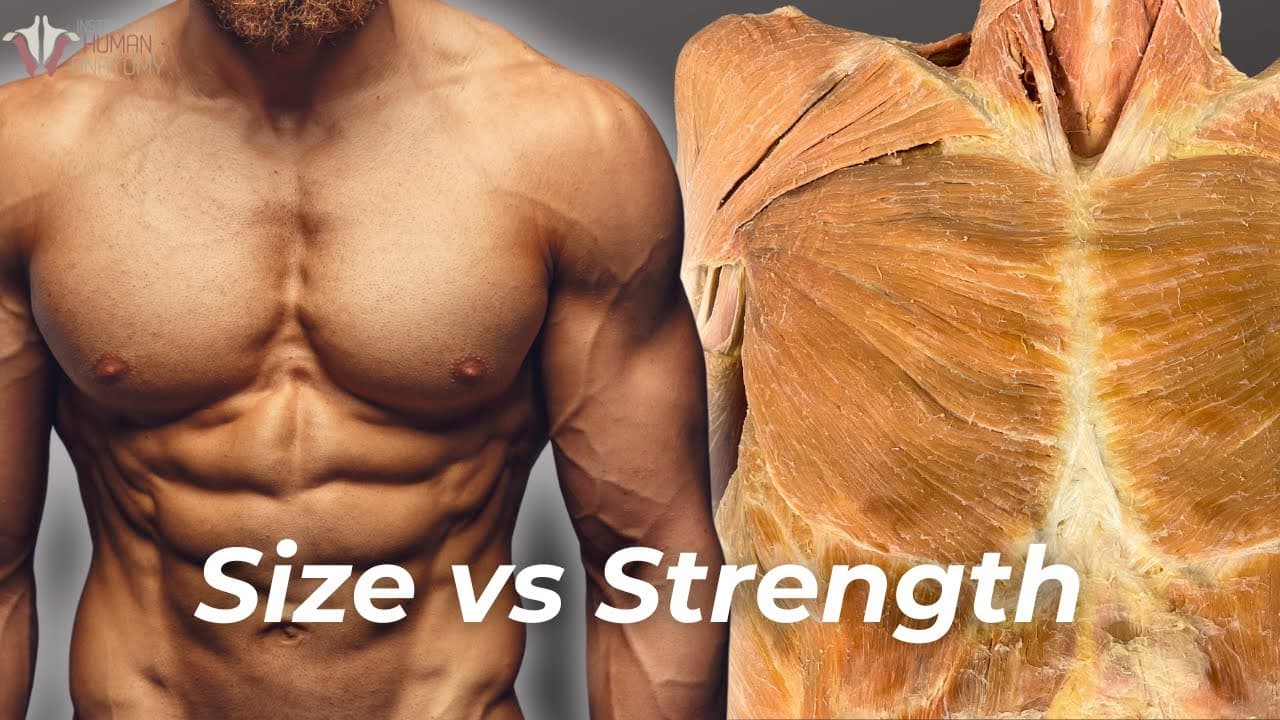
Muscles become larger through hypertrophy, which means individual muscle cells increase in size. Smooth muscle can also grow through hyperplasia, an increase in cell number, but mature cardiac and skeletal muscle cells cannot divide. Resistance training primarily targets voluntary skeletal muscle, while strength and size represent related but distinct adaptations discussed through muscle physiology and training principles.
Transcript
most of us at some point have probably wondered what it would be like to have bigger muscles and some have worked to turn that Wonder into a reality as there are people that have developed incredible increases in the size of their muscles but what is actually going on when you increase the size of a muscle and what are some important training princ... Read More
Key Insights
- The human body contains three types of muscle tissue: smooth muscle, cardiac muscle, and skeletal muscle. Each type can contract, but they differ in anatomical location, cellular structure, nervous system control, and the processes through which they become larger or stronger.
- Muscle fibers are the muscle cells that collectively form an entire muscle. A muscle such as the biceps contains thousands of these cells, so the terms muscle fiber and muscle cell refer to the same basic cellular structures in the discussion.
- Smooth muscle is found in the walls of many tubes and hollow structures, including the digestive tract, respiratory tubes, blood vessels, urinary tubes, and genital structures. Its contractions move material or influence the flow of substances inside these structures.
- Smooth muscle is controlled involuntarily through the autonomic nervous system and can also work reflexively. Its automatic control allows internal processes, such as moving material through the digestive tract, to continue without conscious decisions to contract each individual muscle.
- Smooth muscle growth can involve both hypertrophy and hyperplasia. Hypertrophy enlarges individual cells, while hyperplasia increases the number of cells through division. The uterus during pregnancy illustrates how these processes can contribute to a substantial increase in smooth muscle size.
- Cardiac muscle is found only in the heart and consists of cells that are longer and larger than smooth muscle cells. These branching cells contract involuntarily to create the heartbeat, and the tissue has a built-in pacemaker and connections to the autonomic nervous system.
- Mature cardiac muscle cells cannot divide, so cardiac cells killed during a heart attack cannot simply be replaced with equivalent contracting cells. They may be replaced by scar tissue, which prevents the heart from contracting as efficiently as it did before the damage.
- Skeletal muscle is generally attached to the skeleton and is controlled voluntarily, making it the primary muscle tissue trained during resistance exercise. Mature skeletal muscle cells cannot divide, although nearby satellite cells can fuse with damaged fibers and assist with limited regeneration.
Install to Summarize YouTube Videos and Get Transcripts
Explore YouTube Video Summarizer or Get YouTube Transcript Extractor
Questions & Answers
Q: What are the three types of muscle tissue in the body?
The three types are smooth muscle, cardiac muscle, and skeletal muscle. All three can contract, but they differ in where they are found, how they are structured, how the nervous system controls them, and how they grow. Smooth muscle lines many hollow structures, cardiac muscle forms the heart, and skeletal muscle generally moves the skeleton.
Q: What is the difference between a muscle fiber and a muscle cell?
A muscle fiber and a muscle cell refer to the same structure in this discussion. Thousands of these cells collectively make up a complete muscle, such as the biceps. Using the word fiber emphasizes the elongated form of the cell, but it does not identify a separate structure from the muscle cell itself.
Q: Where is smooth muscle found in the human body?
Smooth muscle lines the walls of many organs, particularly tubes and hollow structures. Examples named in the transcript include the digestive tract, respiratory tubes, blood vessels, urinary tubes, and several genital structures. When this muscle contracts, it moves material along or changes the flow of whatever substance is passing through the structure.
Q: How is smooth muscle controlled?
Smooth muscle operates under involuntary control and is connected to the autonomic nervous system. It can also function reflexively, so a person does not need to consciously command each contraction. This automatic activity supports continuous internal functions, including contractions that move food through the digestive tract and regulate flow through other hollow structures.
Q: What is the difference between hypertrophy and hyperplasia?
Hypertrophy is an increase in the size of individual cells, while hyperplasia is an increase in the number of cells. Smooth muscle can grow through both processes. During pregnancy, for example, the uterus becomes much larger partly because smooth muscle cells divide and increase in number, while individual smooth muscle cells can also enlarge.
Q: Why can a heart attack reduce the heart's contraction efficiency?
Mature cardiac muscle cells cannot divide, so cells killed during a heart attack, also called a myocardial infarction, cannot be replaced through ordinary cardiac cell division. The damaged area can instead be replaced with scar tissue. Because scar tissue does not contract like cardiac muscle, the heart may pump less efficiently than it did before the damage.
Q: What makes skeletal muscle different from smooth and cardiac muscle?
Skeletal muscle is primarily responsible for attaching to and moving the skeleton, and it is generally under voluntary control. A person can contract most skeletal muscles intentionally. Some exceptions to skeletal attachment exist, including facial muscles that attach to and move the skin. Skeletal muscle is also the tissue commonly targeted through resistance training.
Q: How do satellite cells help skeletal muscle recover?
Satellite cells are small stem cells positioned near larger, mature skeletal muscle cells. Unlike mature skeletal muscle fibers, they retain the capacity to fuse with one another or with damaged muscle fibers, which can support regeneration. Their contribution is limited, however, because they cannot create enough new skeletal muscle cells to compensate for significant damage or degeneration.
Summary & Key Takeaways
-
The body contains smooth, cardiac, and skeletal muscle tissue, and all three types can contract. They differ in location, structure, nervous system control, and growth mechanisms. Smooth muscle lines many hollow organs, cardiac muscle forms the heart, and skeletal muscle generally attaches to and moves the skeleton under voluntary control.
-
Smooth muscle is controlled involuntarily by the autonomic nervous system and helps influence movement or flow through structures such as the digestive tract, respiratory tubes, blood vessels, urinary tubes, and genital structures. It can become larger through hypertrophy of existing cells and hyperplasia, which increases the total number of cells.
-
Cardiac and mature skeletal muscle cells cannot divide like smooth muscle cells. Cardiac damage may therefore leave scar tissue that reduces contraction efficiency. Skeletal muscle growth from resistance training primarily involves changes within existing muscle fibers, while satellite cells can fuse with damaged fibers but cannot fully compensate for major muscle damage or degeneration.
Read in Other Languages (beta)
Share This Summary 📚
Summarize YouTube Videos and Get Video Transcripts with 1-Click
Try YouTube Summary with ChatGPT & Claude or YouTube Transcript Generator
Explore More Summaries from Institute of Human Anatomy 📚

Summarize YouTube Videos and Get Video Transcripts with 1-Click
Try YouTube Summary with ChatGPT & Claude or YouTube Transcript Generator