Why Is Greenland Becoming Strategically Important?
TL;DR
Greenland is becoming strategically important because retreating Arctic ice is opening access to shipping routes, resources, and geopolitical influence. Most of the island lies within the Arctic Circle at the gateway to the Arctic Ocean, while its potential rare earth deposits and territorial claims beyond the North Pole add economic and political value. Read on to see how climate change, military history, and major-power competition converge there.
Transcript
(dramatic music) - [Johnny] Whoever controls the oceans has the power, and here in the high north, a new ocean is being born. (tense music) - I am wandering through a graveyard of American military equipment, on the largest island in the world. Like what I'm seeing here is just a bunch of American military infrastructure that was set up during Worl... Read More
Key Insights
- Arctic warming is changing the geopolitical value of the high north because its ocean is becoming less frozen and more accessible. The region is heating four times faster than the rest of the planet, opening possibilities for shipping, resource extraction, military activity, and political influence.
- Greenland is a gateway to the Arctic Ocean because most of its territory lies within the Arctic Circle. Its position near emerging shipping lanes gives governments seeking influence in the newly accessible Arctic a strategically located platform for transportation, surveillance, territorial claims, and military operations.
- The United States used Greenland as a major Arctic defense platform during World War II and the Cold War. Its infrastructure included airbases, radar systems designed to warn of a Soviet attack from the north, and, for a time, nuclear weapons.
- United States interest in Greenland declined after the Soviet Union collapsed because the Arctic appeared peaceful, frozen, and strategically less urgent. American facilities were abandoned, one former military town was sold back to Greenland’s government for $1, and the embassy in the capital was eventually closed.
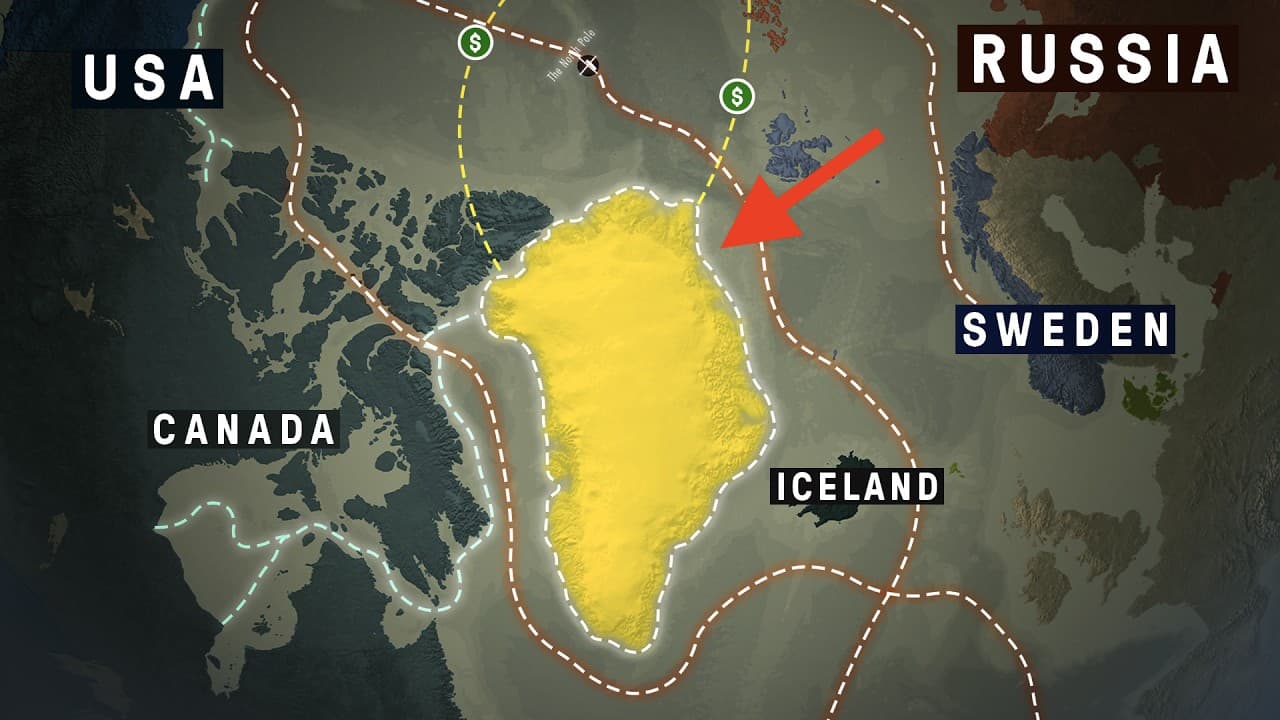
- Greenland’s territorial position is increasingly valuable because its surrounding waters contain resources and its theoretical claims extend beyond the North Pole. Those claims overlap with claims by Russia and Canada, connecting Greenland directly to emerging disputes over control of the Arctic Ocean.
- Rare earth elements increase Greenland’s economic importance because they are needed for modern electronics. The transcript identifies cell phones, computer hard drives, and electric vehicles as products that depend on these materials, making potential Greenlandic deposits attractive to powers seeking resources and industrial influence.
- Major powers are expanding their Arctic activity through territorial claims, military infrastructure, ships, and investments. Russia operates bases and claims ocean territory, Canada claims the Northwest Passage, the United States is spending over a billion dollars on icebreakers, and China is investing across the Nordic region.
- Climate change is creating competition in an ocean that powerful navies historically could not access. As liquid water replaces persistent ice, countries are seeking control over new routes, oil and gas, minerals, and strategic positions, placing Greenland at the center of a broader struggle for Arctic influence.
Install to Summarize YouTube Videos and Get Transcripts
Explore YouTube Video Summarizer or Get YouTube Transcript Extractor
Questions & Answers
Q: Why is Greenland becoming strategically important?
Retreating Arctic ice is making the surrounding ocean more accessible for shipping, resource extraction, military activity, and political influence. Greenland sits at the gateway to the Arctic Ocean, has potential rare earth deposits, and carries territorial claims extending beyond the North Pole.
Q: How does Arctic warming increase Greenland’s value?
The high north is warming four times faster than the rest of the planet, transforming a historically frozen and inaccessible ocean. As the ice retreats, Greenland becomes a more useful position for reaching emerging shipping routes, resources, and areas of strategic influence.
Q: Why did the United States build military facilities in Greenland?
Greenland provided the United States with a strategic Arctic platform during World War II and the Cold War. Its airbases and radar chain helped detect a possible Soviet attack approaching from the Arctic, and the United States also kept nuclear weapons there for a time.
Q: What happened to United States facilities in Greenland after the Cold War?
United States activity declined after the Soviet Union collapsed and the frozen Arctic appeared less strategically urgent. Facilities were abandoned, and one former military town with all its buildings was sold back to Greenland’s government for $1.
Q: Which countries are competing for influence in the Arctic?
Canada, Russia, the United States, and China are increasing their Arctic attention and activity. Their efforts include territorial claims, military bases, ships, investments, and attempts to influence emerging routes and resource-rich areas.
Q: What resources make Greenland attractive to major powers?
Greenland may hold rare earth elements used in cell phones, computer hard drives, and electric vehicles. Its surrounding waters and the wider Arctic also offer potential access to oil, gas, minerals, and other resources as retreating ice makes the region more accessible.
Q: How do Greenland’s territorial claims affect Arctic competition?
Greenland’s theoretical claims extend through its surrounding waters beyond the North Pole. Because those claims overlap with claims by Russia and Canada, Greenland is directly connected to disputes over control, resources, and influence in the Arctic Ocean.
Q: Why was the Arctic historically less contested by major powers?
The Arctic Ocean was historically frozen, desolate, and inaccessible to powerful navies seeking influence. After the Soviet Union collapsed, it also appeared peaceful and strategically less important, but retreating ice is now changing that calculation.
Summary & Key Takeaways
-
Climate change is transforming the Arctic from a largely frozen, inaccessible ocean into a region with emerging shipping routes, resources, and strategic opportunities. As the ice retreats and the high north warms four times faster than the rest of the planet, Canada, Russia, the United States, and China are increasing their attention and activity there.
-
Greenland occupies a pivotal position because most of the island lies within the Arctic Circle at the gateway to the Arctic Ocean. Its location previously supported polar expeditions, United States airbases, Cold War radar networks, nuclear weapons, and surveillance of the Soviet Union. Its strategic relevance declined after the Soviet threat disappeared.
-
Renewed competition is making Greenland valuable again. Major powers see proximity to emerging shipping lanes, resource-rich territorial waters, claims extending beyond the North Pole, and possible deposits of rare earth elements used in electronics and electric vehicles. This growing value helps explain why the proposal to purchase Greenland attracted international attention.
Read in Other Languages (beta)
Share This Summary 📚
Summarize YouTube Videos and Get Video Transcripts with 1-Click
Try YouTube Summary with ChatGPT & Claude or YouTube Transcript Generator
Explore More Summaries from Johnny Harris 📚






Summarize YouTube Videos and Get Video Transcripts with 1-Click
Try YouTube Summary with ChatGPT & Claude or YouTube Transcript Generator