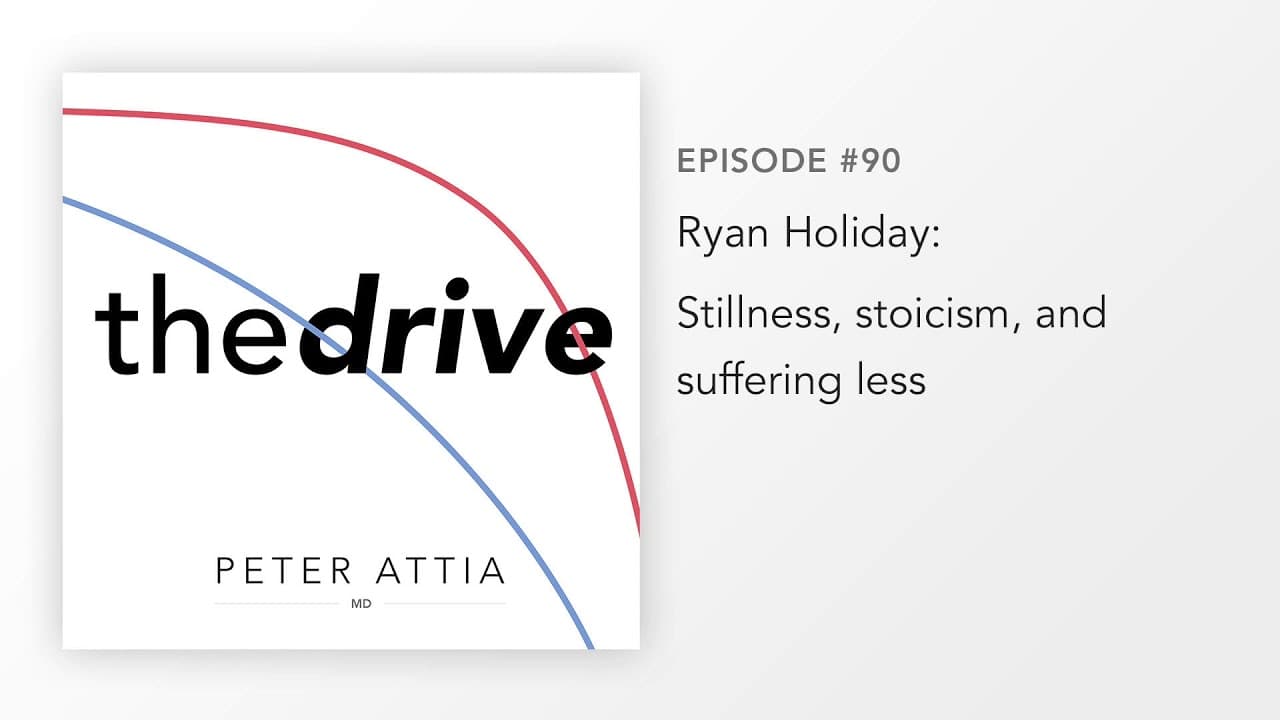
Ryan Holiday on Stoicism and Finding Stillness
TL;DR
Stillness can reduce unnecessary suffering by creating distance from distraction, ego, jealousy, anger, and compulsive reactions. Ryan Holiday connects this practice with Stoic philosophy, deliberate disconnection, acceptance of mortality, and attention to the present, while arguing that confidence, meaningful work, and modern technology need not be abandoned when they are kept within healthy limits.
Transcript
Hey, everyone. Welcome to the Drive podcast. I'm your host, Peter Attia. This podcast, my website, and my weekly newsletter all focus on the goal of translating the science of longevity into something accessible for everyone. Our goal is to provide the best content in health and wellness, full stop, and we've assembled a great team of analysts to m... Read More
Key Insights
- Constant connectivity can transform freedom into obligation. Holiday recalls that early mobile email initially reduced the need to rush home, but carrying email and social platforms everywhere eventually created an expectation of continuous access and made those tools feel more intrusive.
- Deliberate disconnection can create artificial silence. Holiday values unreliable internet and limited cellular coverage on his property because they reduce calls and interruptions, while he still recognizes that smartphones provide practical benefits such as directions and emergency communication.
- Technology is most useful when its availability has limits. Holiday does not argue that smartphones or social platforms should disappear; he describes the challenge as recovering an earlier balance in which helpful tools were accessible without occupying every place and moment.
- Familiarity with death can make mortality feel more present. Holiday’s experiences with chickens and geese show that keeping animals involves repeated encounters with predation, injury, and loss, experiences that modern human life often keeps at a greater distance.
- Animals respond to danger and loss without elaborate human narratives. Holiday observes that surviving geese appeared to continue as a smaller group after one goose died, which he contrasts with people’s tendency to add extended stories, fears, and self-pity to painful events.
- Stoic philosophy provides a framework for suffering less. The discussion connects Stoicism with living in the present, recognizing limited time, managing anger and jealousy, and responding to difficult realities without allowing destructive emotional states to direct behavior.
- Ego is different from genuine confidence. The episode examines how ego reveals itself and how it can drive achievement through craving, comparison, or a desire to prove others wrong, while also imposing personal costs on success and legacy building.
- Stillness is a practical response to a world organized around stimulation. Holiday treats it as related to, but not identical with, meditation, and connects it with reducing distraction, examining emotional reactions, and creating enough internal space to act deliberately.
- More videos with Ryan Holiday:
Install to Summarize YouTube Videos and Get Transcripts
Explore YouTube Video Summarizer or Get YouTube Transcript Extractor
Questions & Answers
Q: What is Stoicism according to Ryan Holiday?
Stoicism is presented as a practical philosophy for meeting reality without adding avoidable suffering through ego, anger, jealousy, or self-pity. Its application includes remembering that time is limited, paying attention to the present, accepting what cannot be controlled, and choosing deliberate responses instead of allowing difficult emotions or external events to dictate behavior.
Q: How can stillness help people suffer less?
Stillness can create distance between an experience and the story or emotional reaction attached to it. That space makes it easier to notice anger, jealousy, ego, craving, and distraction before acting on them. Holiday connects stillness with living more deliberately in the present, accepting mortality, and resisting a modern environment that continually encourages stimulation and connectivity.
Q: How can someone create more stillness in daily life?
A practical approach is to place deliberate limits on connectivity and create periods when calls, email, and social platforms are not constantly available. Holiday’s weak cellular service and unreliable internet produce an artificial silence on his property. The broader principle is to keep useful technology while preventing continuous access from occupying every setting, activity, and moment.
Q: Why can constant connectivity make life worse?
Constant connectivity can turn tools that once increased freedom into sources of continuous obligation. Holiday recalls that mobile email initially meant he did not need to rush home to check messages. Once email, Twitter, and Facebook became permanently available in his pocket, however, they were always present, increasing interruptions and making the experience substantially worse for him.
Q: Should people stop using smartphones to become still?
Holiday does not advocate eliminating smartphones altogether. He points to genuine benefits, including directions and the ability to call for help, while questioning their constant presence. His preferred goal is a better balance: preserve the useful functions of modern devices, but recreate some of the earlier separation that existed before email and social platforms followed people everywhere.
Q: What does living with animals teach about mortality?
Living with chickens and geese repeatedly exposes people to vulnerability, injury, predation, and death. Holiday describes losing animals to a bobcat, a raccoon, an aquatic predator, and a neighbor’s dog. These experiences make mortality more immediate and recall a time when human beings encountered death more directly within ordinary family and household life.
Q: How are ego and confidence different?
The discussion treats ego and confidence as distinct, even though people may confuse them. Ego can appear when achievement depends on craving, comparison, proving others wrong, or building a legacy at significant personal cost. Confidence does not require the same destructive motivation. Recognizing the difference helps a person pursue writing, business, or success without becoming governed by external validation.
Q: How do personal stories increase emotional suffering?
Stories and self-narratives can help people understand experience, but they can also prolong distress by adding interpretation, fear, grievance, or self-pity to events. Holiday contrasts this tendency with animals that respond directly to danger and loss. Stillness and Stoic reflection can help separate what actually happened from the additional narrative a person constructs around it.
Summary & Key Takeaways
-
Modern connectivity offers freedom and practical benefits, but constant access can turn that freedom into an obligation to remain available. Holiday describes poor internet and weak cellular service on his property as an artificial silence that reduces interruptions, illustrating how deliberate limits can restore a healthier relationship with useful technology.
-
Life around animals exposes people to death, vulnerability, and the limits of control. Holiday contrasts human storytelling and self-pity with animals’ direct responses to danger and loss. This familiarity with mortality supports a Stoic focus on accepting reality, living in the present, and remembering that available time is not unlimited.
-
Stoic practice seeks to reduce suffering caused by ego, jealousy, anger, distraction, and harmful self-narratives. Stillness is presented as a practical condition that can be cultivated rather than a rejection of ambition or technology. Confidence, writing, business, and success become healthier when they are not governed by craving or constant self-proving.
Read in Other Languages (beta)
Share This Summary 📚
Summarize YouTube Videos and Get Video Transcripts with 1-Click
Try YouTube Summary with ChatGPT & Claude or YouTube Transcript Generator
Explore More Summaries from Peter Attia MD 📚

Summarize YouTube Videos and Get Video Transcripts with 1-Click
Try YouTube Summary with ChatGPT & Claude or YouTube Transcript Generator