How Efficient Are 15-Amp Peltier Coolers for Freezing Water?
TL;DR
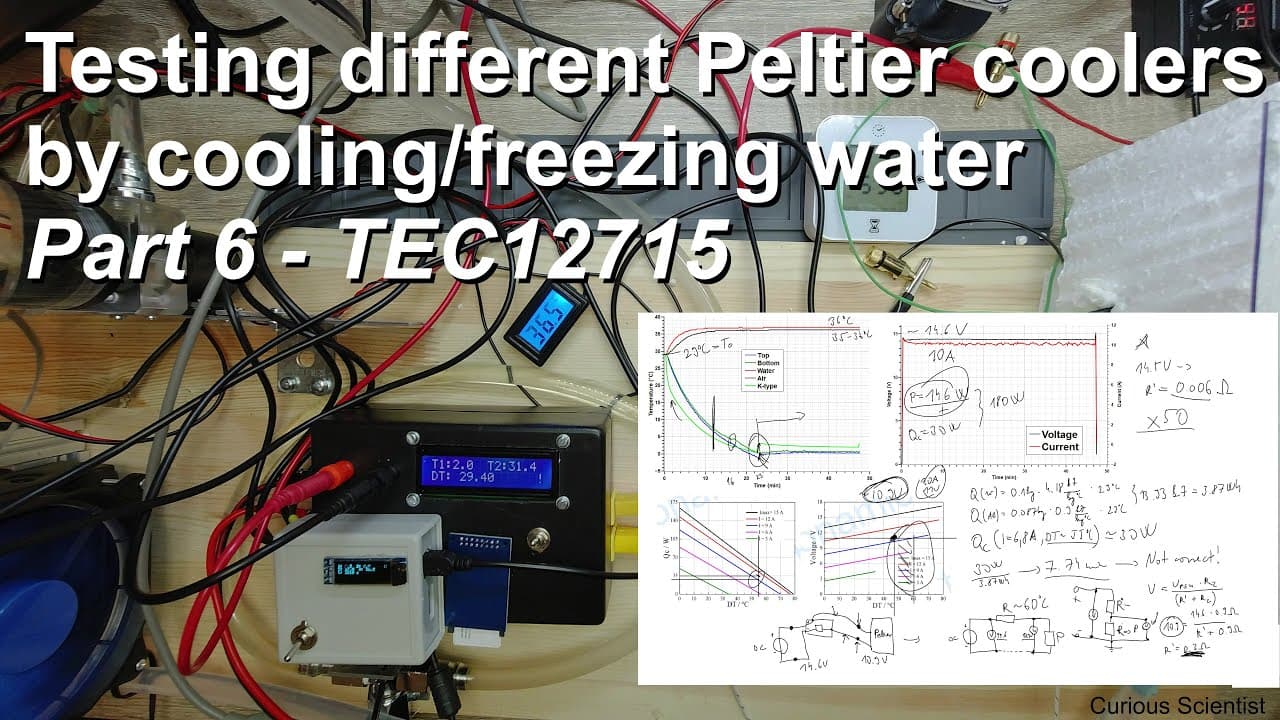
The 15-amp Peltier cooler struggled to cool water to 0 degrees Celsius, often running above that temperature despite maximum current. High resistance in wiring contributed to heat generation and voltage drops, indicating the need for improved cooling systems to handle higher amperage requirements effectively.
Transcript
welcome everyone this is the last video of the test series where I tells the Dec 12 7:15 unit so this is the 15 ampere unit and what I'm going to do is similar to the previous experiments so I have this polystyrene box here and inside that there is a particular which is cooled by water you can see the hoses here and the water-cooled Pangea cooler s... Read More
Key Insights
- 😎 The cooling unit struggled to reach the target temperature of 0 degrees Celsius, with measurements consistently above that mark.
- ⚡ High resistance in wiring can lead to increased heat and voltage drops, negatively affecting overall cooling capability.
- 😎 The setup highlighted the need for better cooling systems to effectively handle higher amperage units, as they produce more heat alongside cooling demands.
- 🥶 Observations showed ice formation in the water, but it was insufficient for reliable performance, emphasizing inefficiencies in the cooling process.
- 😎 The experiment demonstrated that theoretical calculations of cooling capacity can differ significantly from practical applications due to external factors.
- 😎 The importance of monitoring equipment and ensuring effective cooling components is vital when working with high-current devices to avoid overheating.
- 😎 The outcomes indicated that higher amperage doesn't inherently guarantee better performance; proper cooling mechanisms must match the unit's power output.
Install to Summarize YouTube Videos and Get Transcripts
Explore YouTube Video Summarizer or Get YouTube Transcript Extractor
Questions & Answers
Q: What is the purpose of the experiment in the video?
The purpose of the experiment is to test the cooling efficiency of a 15-ampere unit by cooling an aluminum container filled with water. The goal is to see how effectively the unit can bring the temperature down to 0 degrees Celsius over a set period.
Q: What were the initial conditions of the experiment?
The initial conditions included a water temperature of approximately 28 degrees Celsius in an aluminum container weighing 87 grams. The setup involved a polystyrene box, cooling hoses, and multiple thermometers to monitor temperature changes throughout the experiment.
Q: What challenges did the cooling unit face during the experiment?
The cooling unit faced significant challenges in reaching 0 degrees Celsius, with measured temperatures hovering just above that mark even after prolonged operation. High electrical resistance in the wires also led to unexpected heat, affecting the unit's overall efficiency.
Q: What is suggested about higher amperage units compared to lower ones?
The experiment suggests that while higher amperage units, like the 15-ampere unit, should theoretically provide better cooling, they require more efficient cooling systems. Without sufficient cooling, these units can generate excess heat, undermining their performance when compared to lower amperage units.
Q: Why did the experiment conclude even though the water didn’t freeze?
The experiment was concluded due to persistent high temperatures and the realization that the current setup was producing more heat than the cooling system could handle. This resulted in inefficiencies that warranted ending the experiment to prevent potential damage and high costs.
Q: What observations were made regarding the thermometers during the experiment?
Multiple thermometers provided various readings; one specific k-type thermocouple consistently indicated higher temperatures than the digital thermometers, showcasing discrepancies due to positioning and thermal lag in readings.
Q: How does wire resistance affect the experiment's outcome?
As the wires heated up, their resistance increased, contributing to voltage drops in the circuit. This created a complex scenario of reduced current efficiency, impacting the cooling performance of the unit due to inadequate power reaching the cooling mechanism.
Summary & Key Takeaways
-
The experiment involves cooling a water-filled aluminum container using a 15-ampere cooling unit, aiming for 0 degrees Celsius.
-
Measurements are taken using various thermometers, and the results show that the unit struggles to achieve the desired temperature despite running at maximum current.
-
The video concludes with insights on the unit's performance and recommendations for better cooling systems for higher amperage devices.
Read in Other Languages (beta)
Share This Summary 📚
Summarize YouTube Videos and Get Video Transcripts with 1-Click
Try YouTube Summary with ChatGPT & Claude or YouTube Transcript Generator
Explore More Summaries from Curious Scientist 📚






Summarize YouTube Videos and Get Video Transcripts with 1-Click
Try YouTube Summary with ChatGPT & Claude or YouTube Transcript Generator