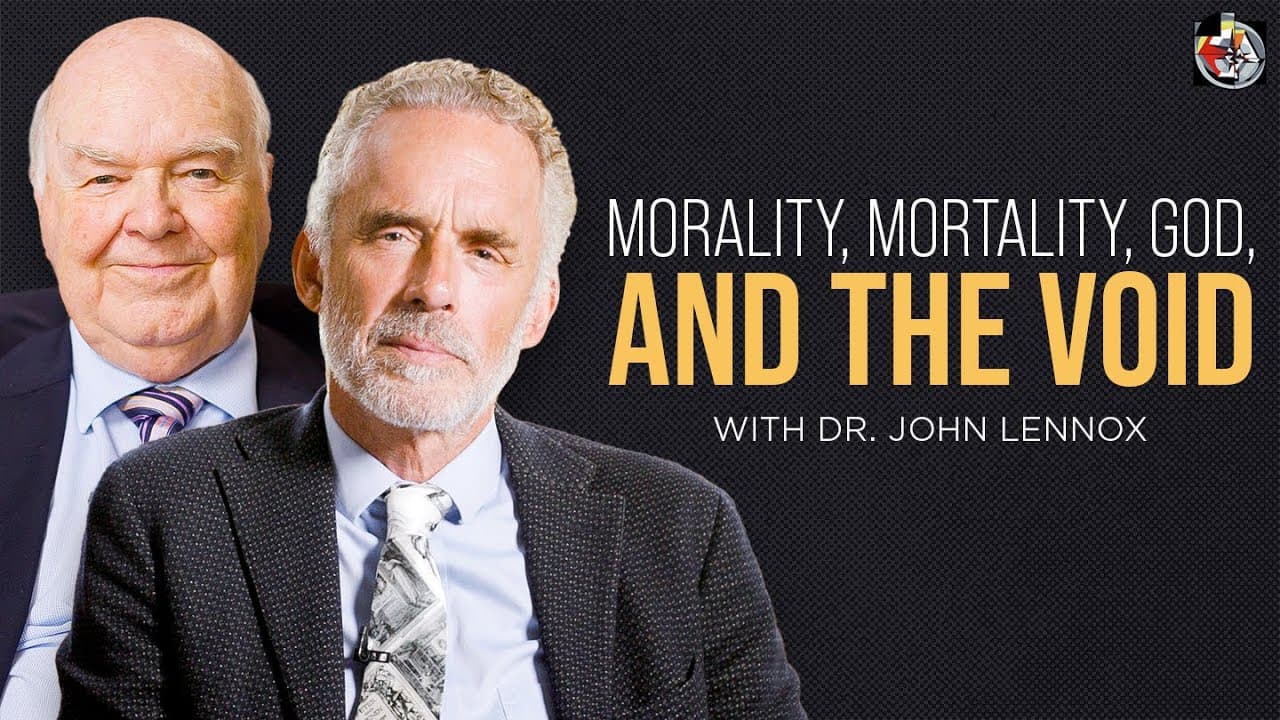
How to reconcile science and faith with Lennox
TL;DR
Science and faith can align when the universe is viewed as intelligible by design and humans pursue knowledge as a moral good. Lennox argues that a biblical worldview underpins scientific inquiry and that revelation complements empirical study, while atheism often clashes with this stance. The conversation clarifies why science emerged within Christian culture and how logos and personality relate to reality.
Transcript
one of the most interesting things is we're told we're made in the image of God but it was God that told human beings to do biology name the animals that's taxonomy it's the fundamental intellectual discipline I'm not going to do it for you you do it for yourself and so the capacity of human beings to think in that sense whatever it really means se... Read More
Key Insights
- Science relies on an intelligible universe, which Lennox links to a Creator and intelligent design.
- The notion that inquiry is good follows from the belief that creation is ordered and purposeful.
- There is a historical argument that Western science emerged from monastic and biblical traditions.
- The concept of the logos connects reason, language, and the personal nature of the Creator.
- Lennox asserts that science and Christianity sit comfortably together, whereas atheism often clashes with this view.
- Transhumanism is discussed as having dangerous aims when it undermines ethical and theological foundations.
- The relationship between microcosm and macrocosm is used to discuss how life mirrors the cosmos.
- Revelation is presented as a source of knowledge that complements empirical evidence and human reason.
- More videos from this channel:
- More from this channel: Jordan B Peterson
Install to Summarize YouTube Videos and Get Transcripts
Explore YouTube Video Summarizer or Get YouTube Transcript Extractor
Questions & Answers
Q: How can science and faith be reconciled according to Lennox?
Lennox argues that science and faith are compatible because the universe is intelligible by design and because human reason is a reflection of a rational Creator. He suggests that the belief in a lawgiver underpins the scientific attitude, and that revelation and empirical inquiry can complement each other rather than conflict. This view places morality and purpose at the center of inquiry.
Q: What axiom does Lennox say is necessary before scientific work begins?
He states that one axiom is the universe being intelligible, which enables the creation of scientific theories and models. A second axiom is that investigating this intelligibility is good and beneficial, aligning with a Creator who designed creation as orderly and worthy of exploration. These axioms fuel the scientific enterprise.
Q: How does Lennox describe the origin of science in relation to the biblical worldview?
Lennox contends that science emerged from a Christian context because the belief in a rational Creator makes the natural world legible to human reason. He cites historical figures associated with faith, like Galileo and Newton, as examples of how belief in God underpins the expectation of laws in nature and in human intellect.
Q: What is the role of revelation in Lennox’s framework of knowledge?
Revelation provides a source of knowledge that complements empirical science. Lennox emphasizes that, in addition to observing the natural world, humans also have access to divine revelation which informs understanding and ethical considerations. This dual source of knowledge helps bridge gaps between reason, faith, and empirical inquiry.
Q: What is the relationship between the logos and the personal Creator in Lennox’s view?
Lennox links the concept of the logos to both rational understanding and a personal Creator. He suggests that the ability to formulate laws and comprehend the universe reflects a Creator who designed intelligible reality and who desires a personal relationship with humanity, hence science and faith can be harmoniously integrated.
Q: Why does Lennox bring up the idea that humanity is made in the image of God in this discussion?
The image of God is presented as a cornerstone of civilization, grounding human dignity, rationality, and the drive to seek understanding. This premise supports the idea that humans are capable of scientific inquiry and moral reasoning, which in turn fuels a culture that values knowledge and ethical exploration.
Q: What critique does Lennox offer of atheism in the context of science?
Lennox argues that atheism undermines the sense that the universe is intelligible and that human inquiry has inherent value. He claims that the biblical worldview provides the groundwork for consistent science, whereas atheistic worldviews may conflict with the premise that existence is grounded in a rational, purposeful Creator.
Q: How does the conversation address transhumanism?
The dialogue identifies transhumanism as a concern when it pursues lofty goals without adequate ethical grounding. Lennox and Peterson discuss the need to balance scientific advancement with moral and theological considerations, warning against the dangerous aims of redefining human nature without recognizing a personal and purposeful Creator.
Summary & Key Takeaways
-
Science rests on the belief that the universe is intelligible and governed by laws, a view Lennox ties to a biblical Creator.
-
Human inquiry is seen as a moral good, stemming from an ordered creation that invites understanding.
-
The dialogue argues that revelation complements observation, shaping how we interpret science and ethics.
Read in Other Languages (beta)
Share This Summary 📚
Summarize YouTube Videos and Get Video Transcripts with 1-Click
Try YouTube Summary with ChatGPT & Claude or YouTube Transcript Generator
Explore More Summaries from Jordan B Peterson 📚



Summarize YouTube Videos and Get Video Transcripts with 1-Click
Try YouTube Summary with ChatGPT & Claude or YouTube Transcript Generator