How to use context engineering to automate AI work
TL;DR
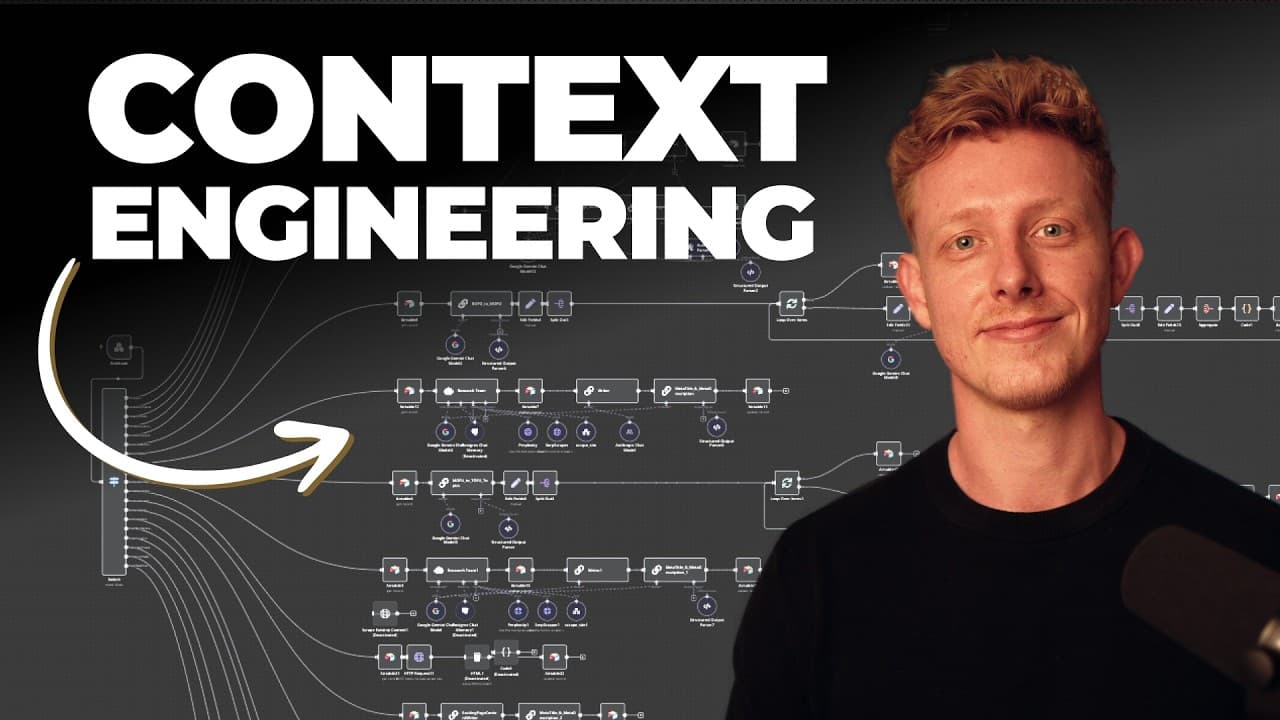
Context engineering is the key to reliable AI outputs. It involves defining the outcome, mapping the required steps, assembling a context dataset, designing the context window, and iteratively testing and optimizing prompts. This approach enables productized AI services and scalable automation across knowledge tasks like content creation and SEO.
Transcript
Most ChatGpt users and 95% of AI automation templates produce generic outputs because they lack one fundamental skill, context engineering. So in this video, I'll explain what it is, why it is key to get good outcomes from AI, and why it is behind almost every successful AI product, give you a simple framework on how to apply it efficiently today, ... Read More
Key Insights
- Context engineering is the deliberate act of filling the context window with the right information to achieve quality AI outputs.
- The six step framework begins with defining outcomes, then detailing the process, preparing a context data set, designing the context window, testing prompts, and finally packaging the system for reuse.
- A big opportunity exists in automating service processes and knowledge work, rather than only general knowledge tasks, to deliver high ROI for businesses.
- Productized AI services emerge by combining domain expertise with context engineering and AI automation skills, enabling scalable solutions sold to multiple clients.
- Effective automation requires planning the process and context for each step before building, not just issuing generic prompts.
- Context windows should be tailored per step, with system prompts crafted to guide behavior and output quality at each stage.
- Non-intelligent tasks need less context, while end-to-end workflows like newsletters or ad creative require detailed, domain-specific context.
- Testing and iteration are essential to refine prompts, context variables, and overall process for reliability and consistency.
Install to Summarize YouTube Videos and Get Transcripts
Explore YouTube Video Summarizer or Get YouTube Transcript Extractor
Questions & Answers
Q: What is context engineering and why does it matter for AI outputs?
Context engineering is the process of loading a language model with the right, relevant information so that it can generate high quality outputs. It matters because without proper context, even powerful AI can produce generic or inconsistent results. By defining the outcome, mapping the steps, assembling a context data set, and tuning prompts, you achieve reliable, repeatable results that align with business goals.
Q: How many steps are in the context engineering framework and what is the first step?
The framework has six steps. The first step is to define the outcome, which requires clarifying what a successful result looks like for the specific task. This sets the direction for all subsequent steps and guides the collection of context data and the design of prompts.
Q: What role does the context dataset play in automation?
The context dataset provides the necessary information about the business, user, ICP, and external tools that influence the task. It ensures that outputs reflect real-world requirements and constraints, enabling the AI to act with domain relevance and produce actionable results rather than generic text.
Q: Why is planning the process important before building automation?
Planning the process helps you map out the exact steps the assistant should follow, identify where context is needed at each step, and define the required inputs and outputs. Without this foresight, automation projects risk inconsistent results, wasted effort, and a failure to scale across different clients or workflows.
Q: What kinds of tasks benefit most from context engineering?
End-to-end workflows that involve creative or knowledge work benefit the most, such as writing newsletters, designing ads, or crafting outreach copy. These tasks require specific knowledge and structured guidance, so providing the right context at each step yields reliable, high quality outputs.
Q: How does one test and optimize context engineering implementations?
Testing involves evaluating prompts, context variables, and the overall process, then making iterative adjustments based on feedback and results. Optimization aims to improve reliability, consistency, and output quality, ensuring the system performs well across multiple runs and realistic variations in input.
Q: What is the business opportunity highlighted for context engineering?
The opportunity lies in automating and productizing service processes and knowledge work, where domain expertise is scarce and valuable. By combining context engineering with AI automation, companies can offer scalable, repeatable AI-powered services to hundreds of clients and potentially reach significant ARR milestones.
Q: What example does the video give for a successful productized AI system?
The video describes an AI SEO system that was packaged with context and domain expertise into an automation platform. This system was sold to over 100 businesses and helped achieve over $1 million in annual revenue, illustrating how context engineering enables repeatable, marketable AI solutions.
Summary & Key Takeaways
-
Context engineering is defined as the art of filling the context window with the right information to onboard an AI like a smart intern, ensuring outputs are useful and aligned with business goals.
-
The six step framework starts with identifying the desired outcome and ends with testing and optimization, enabling reliable automation and potential resellable AI products.
-
The opportunity lies in automating service processes and knowledge work, where domain expertise and context engineering together unlock high ROI and scalable AI productization.
Read in Other Languages (beta)
Share This Summary 📚
Summarize YouTube Videos and Get Video Transcripts with 1-Click
Try YouTube Summary with ChatGPT & Claude or YouTube Transcript Generator
Explore More Summaries from Ben AI 📚





Summarize YouTube Videos and Get Video Transcripts with 1-Click
Try YouTube Summary with ChatGPT & Claude or YouTube Transcript Generator