What Are Agentic Workflows and How Do They Improve AI?
TL;DR
Agentic workflows enhance AI performance by employing iterative and collaborative processes similar to human revision techniques. Key design patterns, including reflection, planning, and multi-agent collaboration, significantly boost results, often outperforming traditional methods. Fast token generation is essential for maximizing the effectiveness of these workflows and supports more iterations.
Transcript
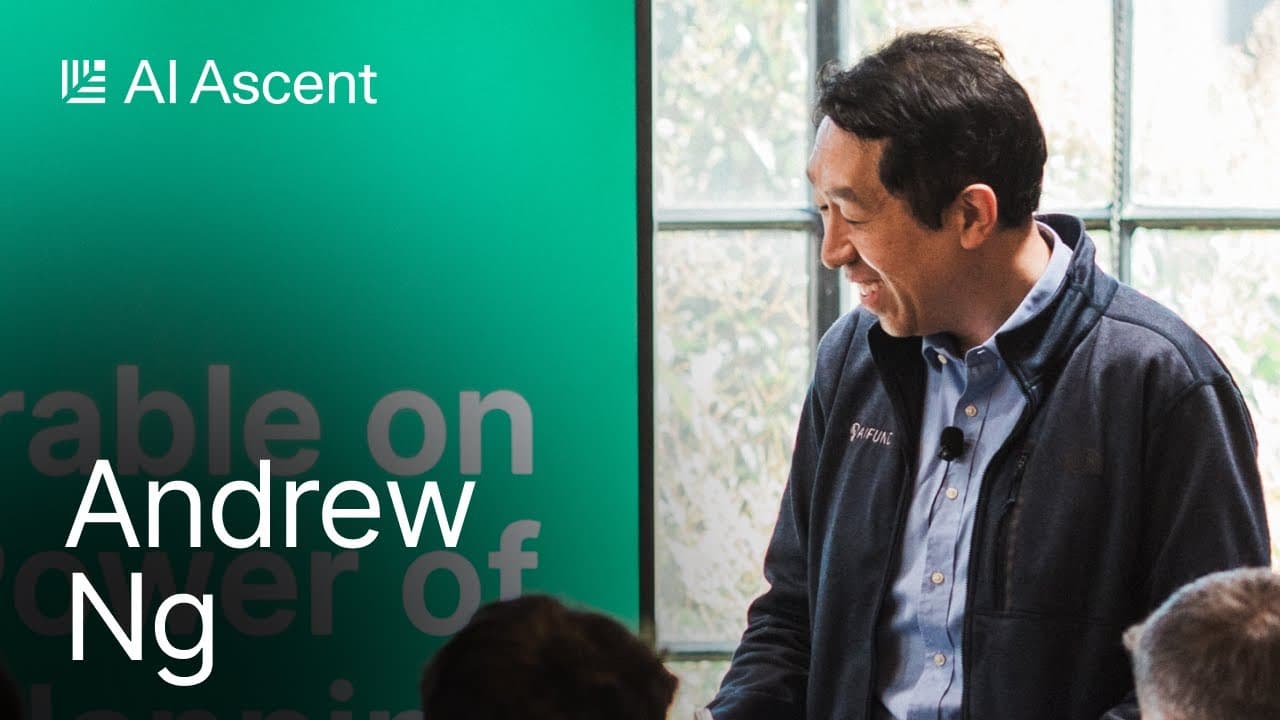
all of you uh know Andreu in as a famous uh computer science professor at Stanford was really early on in the development of neural networks with gpus of course a creator of corsera and popular courses like deeplearning.ai also the founder and Creator uh and early lead of Google brain uh but one thing I've always wanted to ask you before I hand it ... Read More
Key Insights
- 🚚 Agentic workflows, where AI models engage in iterative processes, deliver remarkably better results compared to non-agentic workflows.
- 🎨 Reflection, planning, tool utilization, and multi-agent collaboration are design patterns that enhance the performance of AI models in agentic workflows.
- 🪛 The expansion of AI capabilities this year is expected to be driven by agentic reasoning and workflows.
- ⌛ AI developers may need to adjust their expectation of immediate responses from AI models, as agentic workflows may require more time for generation and refinement.
- 💨 Fast token generation, even from slightly lower-quality models, can produce good results in agentic workflows due to the increased number of iterations.
- ▶️ Agentic workflows represent a step forward in the journey towards AGI, offering incremental improvements in AI capabilities.
Install to Summarize YouTube Videos and Get Transcripts
Explore YouTube Video Summarizer or Get YouTube Transcript Extractor
Questions & Answers
Q: What is an agentic workflow in AI?
An agentic workflow in AI refers to a process where AI models engage in iterative and collaborative steps, similar to human workflows. It involves tasks such as writing code, revising drafts, and incorporating feedback to improve performance.
Q: How does an agentic workflow improve the performance of language models?
By involving iterative processes, agentic workflows allow language models to revise and improve their output. This iterative approach often leads to better results compared to traditional non-agentic workflows that generate answers directly without revision.
Q: How does reflection play a role in agentic workflows?
Reflection involves prompting an AI model to review and evaluate its own output. By having the model carefully analyze its own code or text, it can identify errors, inefficiencies, and areas for improvement, leading to the generation of better versions.
Q: How can multiple AI agents collaborate in an agentic workflow?
In a multi-agent collaboration, different AI agents perform various roles, such as coding, code review, designing, or testing. By prompting these agents to work together and have extended conversations, complex tasks, like developing a game, can be accomplished with surprising effectiveness.
Summary & Key Takeaways
-
Agentic workflows involve AI models engaging in an iterative process, similar to how humans revise and improve their work, resulting in remarkably better results.
-
Reflection, planning, various tools, and multi-agent collaboration are key design patterns in agentic workflows that can enhance AI performance.
-
Fast token generation is crucial for efficient agentic workflows, allowing for more iterations and potentially overcoming limitations of lower-quality models.
Read in Other Languages (beta)
Share This Summary 📚
Summarize YouTube Videos and Get Video Transcripts with 1-Click
Try YouTube Summary with ChatGPT & Claude or YouTube Transcript Generator
Explore More Summaries from Sequoia Capital 📚


Summarize YouTube Videos and Get Video Transcripts with 1-Click
Try YouTube Summary with ChatGPT & Claude or YouTube Transcript Generator