Why Is OpenAI Shutting Down the Sora App?
TL;DR
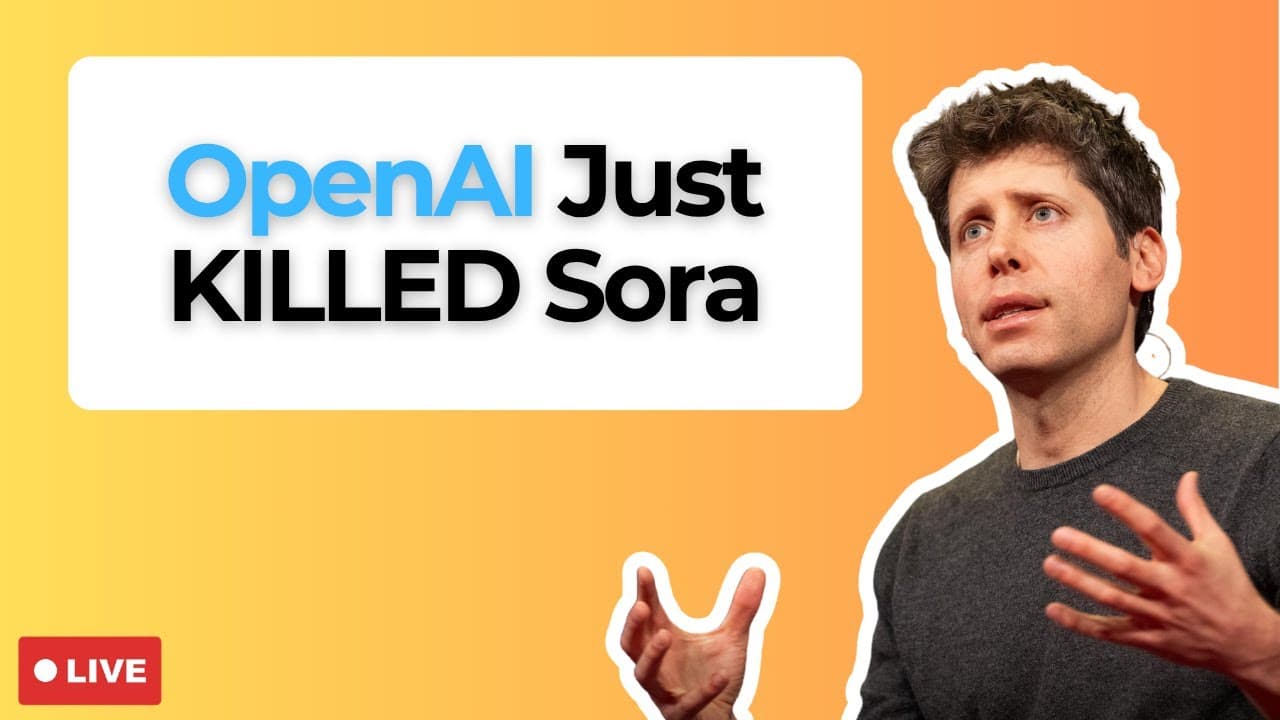
OpenAI is shutting down the Sora app, according to the livestream, while the host argues that removing direct video sharing had already weakened its appeal. He also tests a locally running model described as an Opus 4.6 distillation, discusses rumors about a possible OpenAI model code-named Spud, and outlines plans to connect the OpenClaw agent to Even Realities G2 smart glasses.
Transcript
We have breaking news into the AI news office. Open AI is shutting down Sora, their video generation platform. Is this the end of AI slop? We are going to cover it here. Is there a new open AI model about to drop called Spud? We are going to cover that here. Also, right after that, I might have Claude Opus 4.6 6 running locally. I might have it. We... Read More
Key Insights
- OpenAI is shutting down the Sora app, according to the host's breaking-news discussion. He treats the closure as unsurprising because his own interest disappeared after the app removed the ability to send generated videos directly and instead required posting them to its feed.
- Sora was most useful to the host as a tool for creating personalized meme videos featuring friends. He says the direct-send workflow made those creations easy to share, while the later posting requirement removed the feature that had made the application valuable to him.
- Spud is presented as an unconfirmed code name for a possible new OpenAI model. The host says he has heard that it may be considered for the GPT-6 name and could be described as AGI, but the transcript provides no demonstration or official confirmation.
- A unified OpenAI application is another reported possibility discussed during the stream. The host says he has heard that Atlas, Codex, and ChatGPT may be merged, yet he questions whether combining specialized tools would improve the focused experience he currently values in the Codex desktop app.
- The locally demonstrated model is described as a distilled version of Opus 4.6, not a locally downloaded copy of the original proprietary model. The host says it was distilled by Qwen 3.5 and runs on his Mac Studio 2 with 128 gigabytes available.
- Open-source software is the host's preferred foundation for autonomous AI agents. He argues that agent systems need extensive customization, support for different models, and connections to different tools, which is why he favors OpenClaw over more controlled alternatives such as Perplexity Computer.
- Even Realities G2 glasses are central to the host's planned wearable-agent experiment. He chose them because he believes they are more hackable than Meta glasses, include a text display, connect to a phone, provide an SDK, and use a ring for interaction.
- The proposed wearable workflow is designed to make OpenClaw continuously accessible without taking out a phone. The host imagines issuing spoken commands while walking, driving, or exercising so that his agent, which he calls Henry, can build applications, add features, or complete other computer tasks.
Install to Summarize YouTube Videos and Get Transcripts
Explore YouTube Video Summarizer or Get YouTube Transcript Extractor
Questions & Answers
Q: Why is OpenAI shutting down the Sora app?
The transcript reports that OpenAI is shutting down Sora, but it does not provide an official reason for the decision. The host focuses instead on his personal experience, saying the app lost its appeal when direct video sharing was removed. He had used Sora primarily to make personalized meme videos for friends, and requiring those creations to be posted on a feed ended that convenient workflow.
Q: What made the Sora app useful before its shutdown?
Sora was useful to the host because it let him create custom meme videos involving his friends, download the results, and send them directly. He describes that private, personalized sharing experience as the application's strongest feature. Once direct sending was removed and users had to publish videos to a feed, he stopped using Sora and deleted the app because its main benefit had disappeared for him.
Q: What is the rumored OpenAI model called Spud?
Spud is described by the host as the code name of a rumored new OpenAI model. He says the model is expected to be excellent, may potentially be characterized as AGI, and might receive the GPT-6 name. These statements are presented only as information heard through the host's sources, and the supplied transcript includes no official announcement, technical specifications, release date, or model demonstration.
Q: Are Atlas, Codex, and ChatGPT being merged into one app?
The host says he is hearing that Atlas, Codex, and ChatGPT will be merged into one application, but the transcript does not establish this as an officially confirmed plan. He is also uncertain that such consolidation would benefit users. He likes Codex as a focused desktop coding application and questions whether adding several other tools and functions would improve that experience.
Q: Can Claude Opus 4.6 run locally on a Mac Studio?
The host does not claim to be running the original Claude Opus 4.6 model locally. He repeatedly clarifies that he downloaded and launched a distilled version that was reportedly produced using Qwen 3.5. He runs this derivative model on a Mac Studio 2 with 128 gigabytes available and plans to test whether its responses resemble Opus 4.6, but no complete evaluation appears in the provided transcript.
Q: Why does the host prefer OpenClaw for autonomous AI work?
The host prefers OpenClaw because he believes autonomous AI agents should be open source and fully customizable. In his view, an effective agent must support different models, connect to different tools, and perform varied tasks across a computer. He acknowledges that Perplexity Computer is interesting, but he favors a system he can modify extensively and adapt to his own workflows.
Q: How does the host plan to use OpenClaw with smart glasses?
The host plans to connect OpenClaw to Even Realities G2 glasses through their available SDK and phone connection. His goal is to speak commands to his agent, Henry, without repeatedly taking out a phone. He imagines requesting application development, feature additions, and other tasks while walking, driving, or exercising, with information displayed as text inside the glasses and interaction supported by a ring.
Q: Why did the host choose Even Realities G2 glasses?
The host chose the Even Realities G2 because he believes they are more hackable than Meta glasses and can support custom applications through an SDK. The glasses pair with a phone, show text on an internal display, and include a ring for controlling the interface. He also likes that they lack cameras, although he expresses little interest in their standard calendar, messaging, or teleprompter functions.
Summary & Key Takeaways
-
The host reports that OpenAI is shutting down Sora and reflects on how he previously used it to create personalized meme videos for friends. He says he stopped using the app after direct sharing was removed and users had to post generated videos to a public feed instead.
-
The livestream discusses unconfirmed reports about an OpenAI model code-named Spud, which the host says could potentially become GPT-6. He also mentions hearing that Atlas, Codex, and ChatGPT may be merged into one application, although he questions whether users actually want several distinct tools combined into a single interface.
-
The host demonstrates a locally running model that he describes as a distilled version of Claude Opus 4.6, not the original model. He also introduces plans to connect OpenClaw to Even Realities G2 smart glasses, using their software development kit, phone connection, display, and control ring to issue agent commands while moving around.
Read in Other Languages (beta)
Share This Summary 📚
Summarize YouTube Videos and Get Video Transcripts with 1-Click
Try YouTube Summary with ChatGPT & Claude or YouTube Transcript Generator
Explore More Summaries from Alex Finn 📚


Summarize YouTube Videos and Get Video Transcripts with 1-Click
Try YouTube Summary with ChatGPT & Claude or YouTube Transcript Generator