14. The Trolley Problem
TL;DR
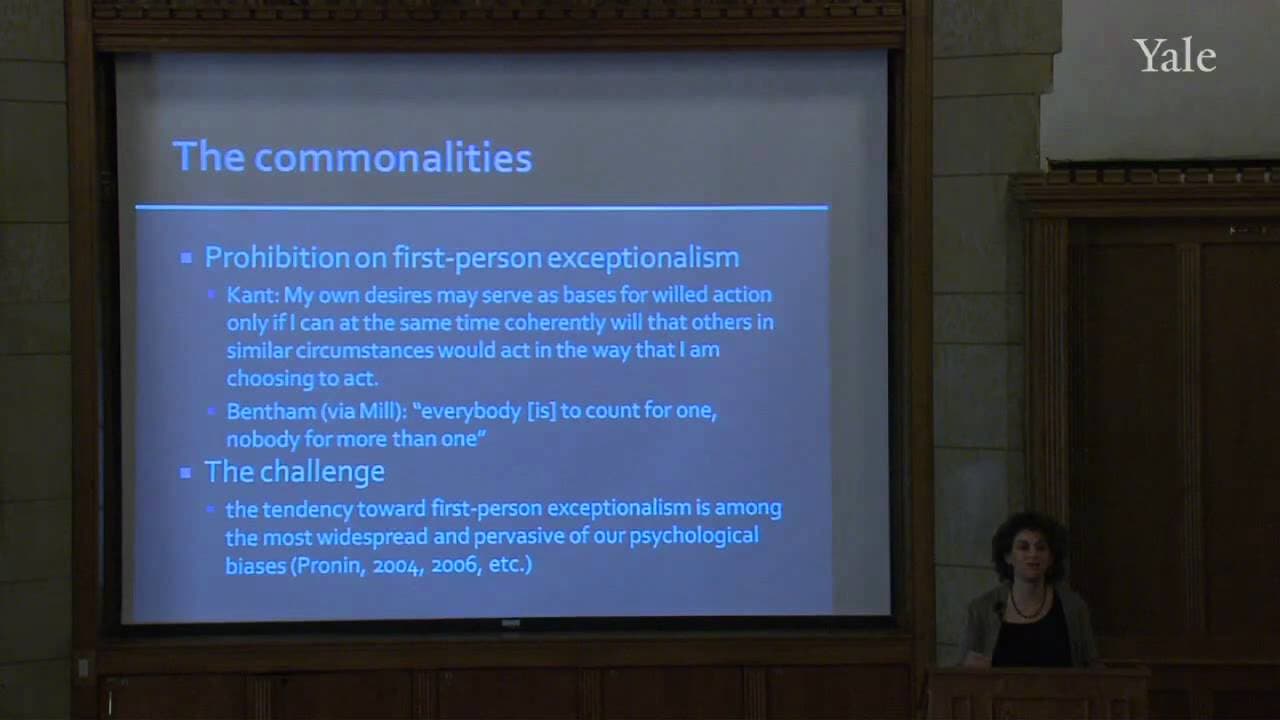
The Trolley Problem presents a moral dilemma where individuals must make a choice between killing one person to save five. Kant's moral theory emphasizes treating humanity as an end and never merely as a means.
Transcript
PROFESSOR: So there's two things that we need to do in today's lecture. The first is to finish up our discussion of deontology, which was necessarily quite rushed. We're trying to do Kant in roughly a lecture. But I do want to get to the end of that discussion. And the second, which will allow you to use your clickers and express your opinions, is ... Read More
Key Insights
- ❤️🩹 Kant's moral theory emphasizes the importance of acting from duty and treating humanity as an end rather than merely as a means.
- ❓ The concept of maxims and their role in determining the moral worth of an action is essential in Kant's philosophy.
- 🚎 The trolley problem illustrates the challenge of making moral decisions that involve choosing between different actions with varying consequences.
- 💌 Intuitions about killing and letting die in different scenarios can be complex and may not always align with Kant's moral principles.
Install to Summarize YouTube Videos and Get Transcripts
Explore YouTube Video Summarizer or Get YouTube Transcript Extractor
Questions & Answers
Q: What determines the moral worth of an action, according to Kant?
The moral worth of an action is determined by whether it is done from duty, not just in keeping with duty. It must be performed for the sake of being in keeping with duty, rather than for any other goal or outcome.
Q: How does Kant define duty?
Duty is the necessity of an action done out of respect for the law. Kant argues that individuals must recognize the moral law as morally binding upon them and act in accordance with it because it is what rationality demands.
Q: What is the categorical imperative?
The categorical imperative is a principle that guides moral actions. According to Kant, it states that one should "act only in accordance with that maxim through which you can, at the same time, will that it become a universal law." In other words, individuals should only act in ways that they believe could be applied universally.
Q: What is the difference between killing and letting die?
Killing refers to actively causing someone's death, while letting die involves allowing someone to die without intervening. These distinctions are important in moral decision-making, as seen in the trolley problem and other ethical dilemmas.
Summary & Key Takeaways
-
The lecture begins with a discussion of Kant's deontology and his three claims about moral worth.
-
The concept of duty and the distinction between doing something in keeping with duty and doing something from duty are explained.
-
Kant's famous formulation of the categorical imperative is introduced, which emphasizes acting in accordance with maxims that can become universal laws.
Read in Other Languages (beta)
Share This Summary 📚
Summarize YouTube Videos and Get Video Transcripts with 1-Click
Try YouTube Summary with ChatGPT & Claude or YouTube Transcript Generator
Explore More Summaries from YaleCourses 📚



Summarize YouTube Videos and Get Video Transcripts with 1-Click
Try YouTube Summary with ChatGPT & Claude or YouTube Transcript Generator