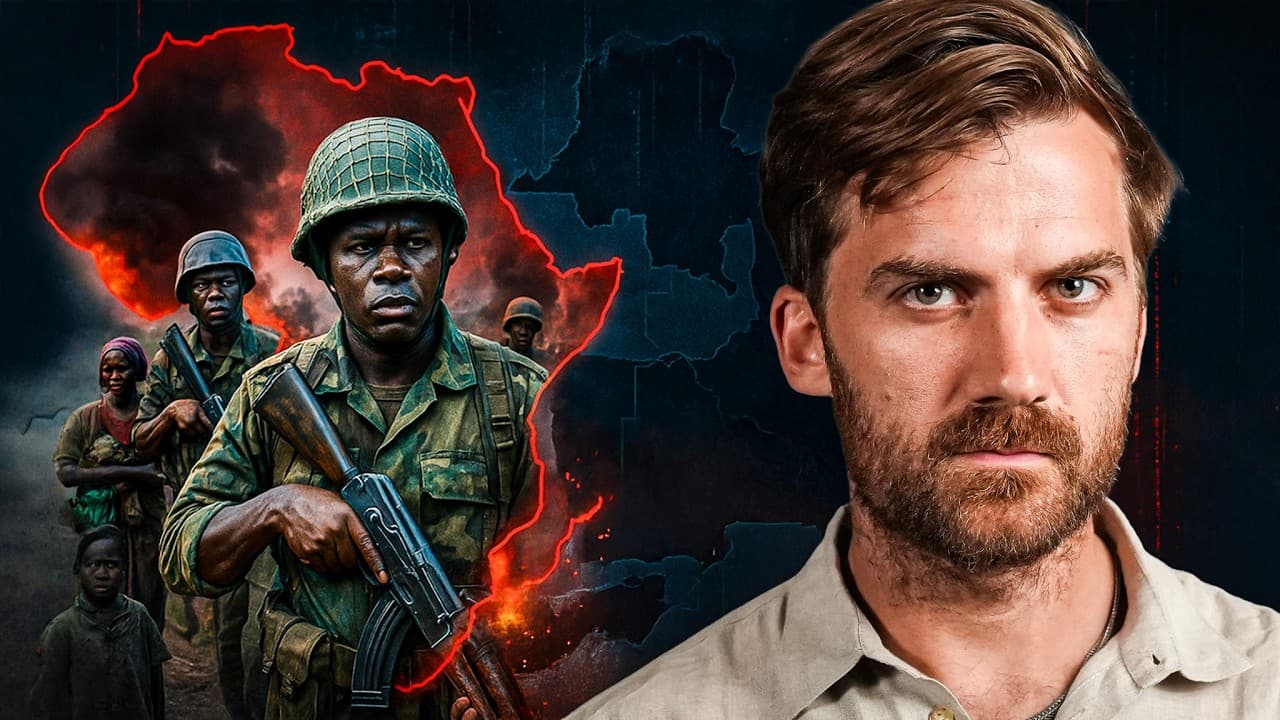
Why Is the Congo War the World’s Most Ignored Conflict?
TL;DR
The Congo war is driven by hundreds of armed groups fighting for minerals and local control, not a single political takeover. Fragmentation, shifting alliances, and village level self defense militias sustain a long running conflict that shapes regional economics. Power and resources fuel a violence economy that affects ordinary Congolese.
Transcript
(intriguing orchestral music) (reporter speaking foreign language) (protestors clamoring) (bullets sputtering) - This place, the Democratic Republic of the Congo, one of the most complex, longest running conflicts in the world, and you're probably not hearing about it much on the news, but it is important, and it is connected to the entire world. I... Read More
Key Insights
- The DRC hosts hundreds of armed groups with constantly changing frontlines.
- The war is funded by minerals, extortion, and illegal taxes, not just ideology or state power.
- In 2025 the Congo discussed mineral deals with military support in Washington, linking national interests to external powers.
- The government does not have a monopoly on violence and is part of the conflict’s fragmentation.
- Self defense militias emerged as local responses to state collapse, acting like community police forces.
- The conflict’s goal is extracting value from the land rather than capturing the government.
- Congo is as large as Western Europe and holds vast mineral wealth.
- The crisis is fractal and more common than traditional civil wars, complicating efforts to resolve it.
- More videos from this channel:
- More from this channel: Johnny Harris
Install to Summarize YouTube Videos and Get Transcripts
Explore YouTube Video Summarizer or Get YouTube Transcript Extractor
Questions & Answers
Q: What makes the Congo conflict different from typical civil wars?
The Congo conflict is not primarily about one side trying to seize the state, but about hundreds of armed groups battling for territory, resources, and influence. This fragmentation creates shifting alliances and makes the war resemble a fractal system rather than a single battle for political control. Local self defense militias also fill gaps left by a weak state.
Q: Why do self defense militias exist in Congo?
Self defense militias formed because the state had collapsed and villages needed some form of protection. These groups function as local police or community guards, filling security gaps and sometimes aligning with larger armed factions. Their existence sustains a landscape where security is fragmented and violence persists at a local level.
Q: What role do minerals play in this conflict?
Minerals act as a core driver by creating incentives to control land and extraction routes. The war is funded through mining revenues, illegal taxes, and extortion, turning resources into power. This creates a feedback loop where control of mineral-rich areas finances further violence and instability.
Q: How does the colonial history influence today’s conflict?
Colonial practices established a legacy of resource extraction and divided governance, building a pipeline from mines to ports rather than pathways between cities. This history seeded ethnic divisions and a state structure that prioritized resource exploitation over public services, contributing to today’s fragmented security environment.
Q: What is unique about Congo’s size and resources?
Congo is described as a continent sized country with vast, untapped mineral wealth including copper, cobalt, diamonds, tungsten, tantalum, and tin. This scale and richness create powerful incentives for various actors to control land and people, reinforcing the ongoing conflict economy and external interest.
Q: How does the current conflict relate to global politics?
The video notes that global actors and governments engage with Congo through deals and security arrangements, illustrating how international interests intersect with local violence. For example, discussions in Washington about mineral-backed military support show how external powers influence Congo’s internal dynamics.
Q: What does the term fractal conflict imply in this context?
Fractal conflict describes a complex, multi layered war where many small actors coexist, merge, split, and re align across villages and regions. Unlike a linear war with clear fronts, the Congo conflict is a network of interdependent struggles that continually reorganize, making it hard to map and resolve with traditional strategies.
Q: Why is public awareness of the Congo war important beyond Africa?
Understanding the Congo war matters because it reveals how a resource driven economy of violence can persist and affect regional stability and global supply chains. The interconnectedness of minerals, local militias, and international deals shows that conflicts far from home can have ripple effects on world markets and security policies.
Summary & Key Takeaways
-
The video explains that the Congo war is a fractal, multi actor conflict where frontlines constantly shift and groups merge or split, making it hard to map. It emphasizes that this is not a traditional state versus rebels war but a network of warlords and militias exploiting resources.
-
The narrative connects colonial extraction to modern violence, showing how mining, roads, and ports were built as resource pipelines that seeded long term instability and ethnic divisions, persisting into today’s fragmented security landscape.
-
The video concludes that the underlying driver is value extraction from land and people, a pattern that sustains conflict for decades and draws in international actors and interests beyond Congo’s borders.
Read in Other Languages (beta)
Share This Summary 📚
Summarize YouTube Videos and Get Video Transcripts with 1-Click
Try YouTube Summary with ChatGPT & Claude or YouTube Transcript Generator
Explore More Summaries from Johnny Harris 📚



Summarize YouTube Videos and Get Video Transcripts with 1-Click
Try YouTube Summary with ChatGPT & Claude or YouTube Transcript Generator