How to Transform a Mealy Machine into a Moore Machine
TL;DR
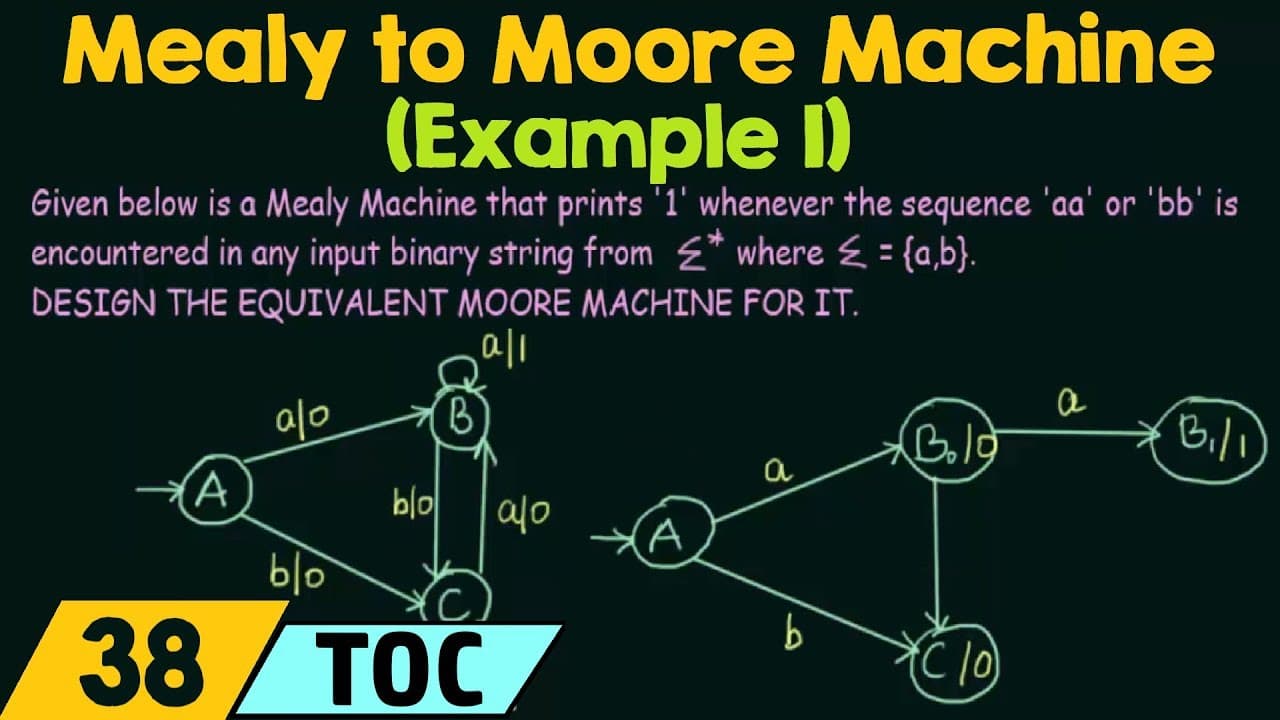
Transforming a Mealy machine into a Moore machine involves designing it so that outputs are associated with states instead of transitions. This video showcases the step-by-step process for creating a Moore machine that outputs '1' when sequences 'aa' or 'bb' are detected in an input binary string.
Transcript
in the last lecture we have studied how to convert milling machine to more machine and in this lecture we will see another example of conversion of milling machine to more machine okay so here is our example given below is some milling machine that prints one whenever the sequence a a or b b is encountered in any input binary string from sigma star... Read More
Key Insights
- 🎰 Converting a milling machine to a Moore machine involves assigning outputs to states based on specific inputs.
- 💝 The aim of the conversion in this video is to print 1 whenever the sequence "aa" or "bb" is encountered in an input binary string.
- ❓ Additional states are created to avoid conflicts in associating outputs when transitioning between states.
Install to Summarize YouTube Videos and Get Transcripts
Explore YouTube Video Summarizer or Get YouTube Transcript Extractor
Questions & Answers
Q: What is the purpose of converting a milling machine into a Moore machine?
The conversion allows for better output control and enables the machine to generate 1 whenever the specified sequences are encountered in input binary strings.
Q: How are the inputs and outputs defined in the conversion process?
The inputs are represented by letters "a" and "b," while the outputs are represented by 0s and 1s. The aim is to print 1 whenever the sequence "aa" or "bb" is found in the input string.
Q: Why are additional states created in the conversion process?
Additional states, such as B1 and C1, are created to avoid conflicts in associating outputs. Since the state B already has output 0 associated with it, a new state B1 is needed to associate output 1.
Q: Why does the starting state "a" not have an output associated with it?
The starting state "a" does not have an output because there are no incoming edges to this state in the milling machine. The desired output of 0 or 1 is only printed in states associated with the sequence "aa" or "bb."
Key Insights:
- Converting a milling machine to a Moore machine involves assigning outputs to states based on specific inputs.
- The aim of the conversion in this video is to print 1 whenever the sequence "aa" or "bb" is encountered in an input binary string.
- Additional states are created to avoid conflicts in associating outputs when transitioning between states.
- The starting state "a" does not have an output associated with it as there are no incoming edges, ensuring that the output is only printed when the desired sequence is encountered.
Summary & Key Takeaways
-
The video demonstrates how to convert a milling machine into a Moore machine by associating outputs to states based on the given inputs.
-
The milling machine in question prints 1 whenever the sequence "aa" or "bb" is encountered in any input binary string.
-
The process involves creating additional states and assigning outputs to ensure the functionality of the Moore machine.
Read in Other Languages (beta)
Share This Summary 📚
Summarize YouTube Videos and Get Video Transcripts with 1-Click
Try YouTube Summary with ChatGPT & Claude or YouTube Transcript Generator
Explore More Summaries from Neso Academy 📚






Summarize YouTube Videos and Get Video Transcripts with 1-Click
Try YouTube Summary with ChatGPT & Claude or YouTube Transcript Generator