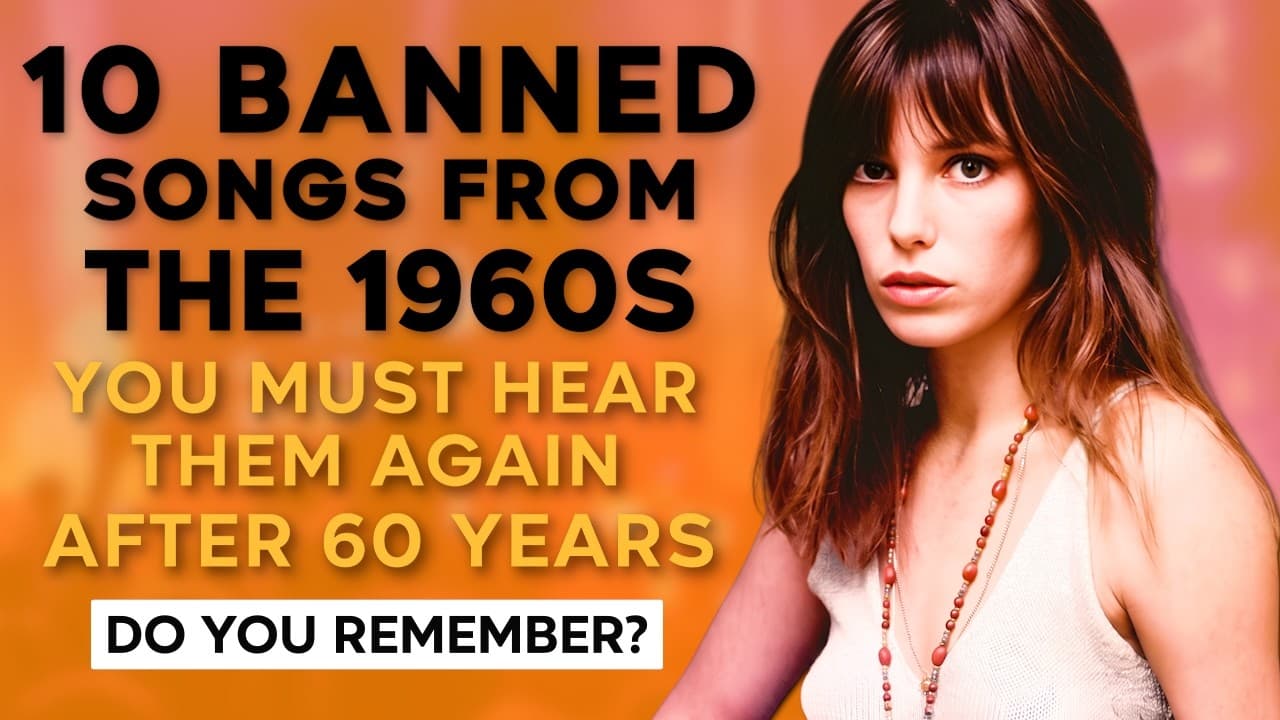
Why Were Popular 1960s Songs Banned From Radio?
TL;DR
Popular 1960s songs were often banned because broadcasters perceived references to death, drugs, sex, politics, race, disability, or religious impropriety, even when artists denied those interpretations. Restrictions frequently failed to suppress demand: several disputed records still reached high chart positions, showing that controversy could coexist with major commercial success.
Transcript
The 1960s were a decade when radio stations, the BBC, and government agencies decided that certain songs were simply too dangerous to let the public hear. Some were banned for politics, some for sex, some for drug references, and at least one because the FBI spent 2 years investigating the lyrics and still couldn't figure out what was being said. T... Read More
Key Insights
- • "Tell Laura I Love Her" was restricted because its fatal stock car racing story was believed to encourage tragic death among young listeners. Ray Peterson's recording still reached number seven on the Billboard Hot 100, while Ricky Valance's British cover reached number one in the UK.
- • "Louie Louie" triggered obscenity concerns because Jack Ely's one-take vocal was extremely difficult to understand. The FBI investigated the recording for more than two years and concluded in May 1965 that its lyrics were unintelligible at any speed, yet stations still banned it.
- • "Puff the Magic Dragon" was interpreted by some broadcasters as a coded endorsement of marijuana use. Peter, Paul and Mary consistently rejected that reading, describing the composition as a melancholy story about a child growing up and abandoning belief in an imaginary dragon.
- • "The House of the Rising Sun" faced resistance because its narrative concerned a person ruined by a New Orleans brothel. The BBC also objected to the commercial practicality of its nearly four-and-a-half-minute runtime, although the recording reached number one in both the United Kingdom and United States.
- • "Eve of Destruction" was banned by the BBC for political negativity and its perceived potential to cause despondency. Its criticism of the Vietnam War, segregation, racial violence, nuclear proliferation, and political hypocrisy did not stop it from reaching number one on the Billboard Hot 100.
- • "My Generation" was briefly banned by the BBC because Roger Daltrey's deliberate stutter might offend people with stuttering disorders. Public demand weakened the restriction, and the song reached number two in the United Kingdom, the highest domestic chart position The Who achieved according to the transcript.
- • "God Only Knows" was rejected by some Southern American radio stations because they considered the use of the word "God" in a rock song improper or blasphemous. It reached number two in the UK but only number 39 on the Billboard Hot 100.
- • "Society's Child" faced radio rejection for portraying an interracial teenage relationship and because some broadcasters considered Janis Ian too young for the subject. Written when she was 14 and released when she was 16, it reached number 14 after national television exposure.
Install to Summarize YouTube Videos and Get Transcripts
Explore YouTube Video Summarizer or Get YouTube Transcript Extractor
Questions & Answers
Q: Why was "Tell Laura I Love Her" banned from radio?
Numerous American stations refused to play "Tell Laura I Love Her" because its story ends with a young man dying in a stock car crash after entering the race to earn money for an engagement ring. Broadcasters believed the narrative encouraged tragic death among young listeners. The BBC also banned Ricky Valance's cover, but that version reached number one in the UK, while Ray Peterson's original reached number seven in America.
Q: What did the FBI conclude about "Louie Louie"?
The FBI opened an investigation into The Kingsmen's recording in February 1964 after listeners alleged that its difficult-to-understand vocal concealed obscene lyrics. After studying the song for more than two years, the agency concluded in May 1965 that the words were unintelligible at any speed. Its report still did not determine whether the recording was obscene, and multiple radio stations banned it despite that inconclusive result.
Q: Was "Puff the Magic Dragon" written about marijuana?
The transcript presents "Puff the Magic Dragon" as a melancholy story about a boy who grows older and stops believing in the magical dragon from his childhood. Some stations nevertheless treated words such as "Puff" and "dragon" as coded drug references. Peter, Paul and Mary consistently denied that interpretation, and Peter Yarrow called it sloppy and slanderous in multiple interviews.
Q: Why did broadcasters object to "The House of the Rising Sun"?
Several American stations declined to play The Animals' recording because its narrator describes being ruined by life connected to a New Orleans brothel. The BBC's concerns were more complicated and focused partly on whether a nearly four-and-a-half-minute single was commercially practical when most pop songs lasted about two minutes. The recording still reached number one in both the United States and United Kingdom.
Q: Why was "Eve of Destruction" considered controversial?
"Eve of Destruction" directly criticized the Vietnam War, segregation, racial violence, nuclear proliferation, and politicians who sent young men to war even though those men could not legally vote on the policies. The BBC banned it for political negativity and its supposed potential to cause general despondency, while numerous American stations also rejected it. Nevertheless, it reached number one on the Billboard Hot 100 in September 1965.
Q: Why did the BBC briefly ban "My Generation"?
The BBC objected to Roger Daltrey's intentional stutter because officials thought it might offend people who genuinely had stuttering disorders. The restriction lasted only briefly because public demand made it difficult to maintain. The song subsequently reached number two on the UK singles chart, described in the transcript as The Who's highest chart position in their home country, although it reached only number 74 in the United States.
Q: Why did some radio stations reject "God Only Knows"?
Some Southern American radio stations considered the word "God" inappropriate in the title of a rock song. They treated the combination of religious language and popular music as blasphemous or at least improper, so they declined to broadcast it. The song reached number two in the United Kingdom but number 39 on the Billboard Hot 100, with American radio reluctance identified as part of the reason for that weaker performance.
Q: How did "Society's Child" become a hit despite radio bans?
Radio stations resisted "Society's Child" because it portrayed a white girl's relationship with a Black boy and showed the relationship ending under pressure from her mother and community. Some broadcasters also thought Janis Ian was too young to address the subject. More than 20 labels rejected the song before Verve Records released it. Exposure through a Leonard Bernstein-produced television documentary in 1967 helped it reach number 14 on the Billboard Hot 100.
Summary & Key Takeaways
-
Broadcasters restricted 1960s songs for widely different reasons, from tragic narratives and alleged obscenity to drug interpretations, political criticism, interracial romance, and religious language. Some objections concerned presentation rather than subject matter, including a deliberate vocal stutter and the unusual length of The Animals' recording of a traditional folk song.
-
The bans often depended on speculation or local standards rather than confirmed meanings. The FBI studied The Kingsmen's unintelligible recording of "Louie Louie" for more than two years, while Peter, Paul and Mary repeatedly denied that "Puff the Magic Dragon" contained coded marijuana references. Nevertheless, broadcasters continued restricting both songs.
-
Radio resistance repeatedly failed to prevent commercial success. "Tell Laura I Love Her," "Louie Louie," "Puff the Magic Dragon," "The House of the Rising Sun," "Eve of Destruction," "My Generation," and "Society's Child" all achieved notable chart positions despite controversy, while "God Only Knows" performed more strongly in the UK than America.
Read in Other Languages (beta)
Share This Summary 📚
Summarize YouTube Videos and Get Video Transcripts with 1-Click
Try YouTube Summary with ChatGPT & Claude or YouTube Transcript Generator
Explore More Summaries from Nostalgic Tune 📚



Summarize YouTube Videos and Get Video Transcripts with 1-Click
Try YouTube Summary with ChatGPT & Claude or YouTube Transcript Generator