What Lies Beneath New Guinea's Rainforests?
TL;DR
New Guinea’s dense rainforests and towering highlands conceal shrinking tropical glaciers, rarely observed animals, and territory that remains unexplored or uncharted. Its immense size, difficult terrain, and former land connection to Australia help explain both its unusual biodiversity and continued discoveries, including species once considered extinct and thousands of newly described organisms since 2010.
Transcript
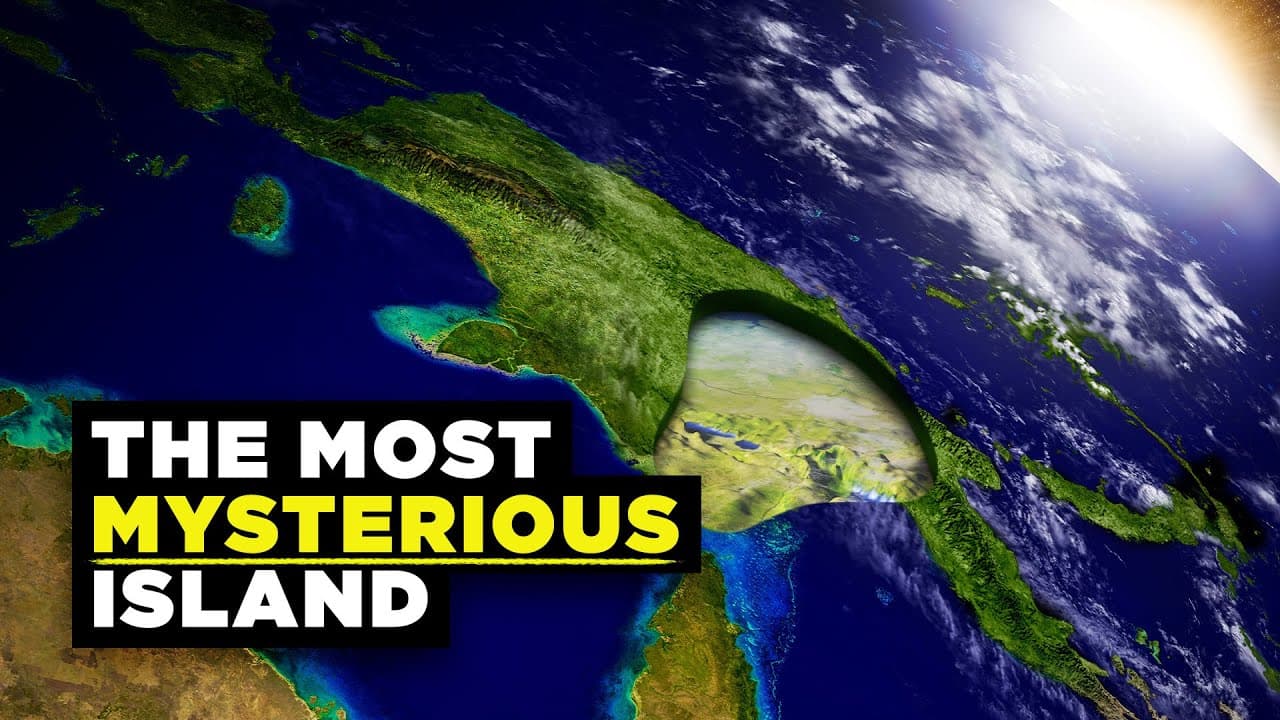
This is New Guinea, the most fascinating and mysterious island in the world. Because it's located very near to the equator, most two-dimensional world maps based on the Mercer projection warp New Guinea size and make it appear a lot smaller than it really is. In reality, New Guinea is the second largest island in the world, only behind Greenland, a... Read More
Key Insights
- New Guinea is the second-largest island in the world, behind Greenland, and is roughly triple the size of Great Britain. Common two-dimensional maps using the Mercator projection make the equatorial island appear substantially smaller than it actually is.
- Rainforest covers as much as 80% of New Guinea, forming the planet’s third-largest rainforest behind the Amazon and Congo rainforests. Dense vegetation combined with severe mountainous terrain has left considerable territory unexplored and uncharted into the 21st century.
- The New Guinea Highlands are roughly comparable to North America’s Rocky Mountains in size, elevation, and scale. They contain the highest peaks found between the Himalayas and Andes, making them the highest and most imposing mountains located on any island.
- Tropical glaciers survive near Puncak Jaya in western New Guinea because temperatures fall sharply at high elevations. Abundant precipitation becomes snow, which has compacted on the mountain into glacial ice that has persisted for at least several thousand years.
- New Guinea’s glaciers declined by more than 97% between 1850 and 2018. A study published in March 2025, using 2024 data, found only 0.165 square kilometers remaining, a 67% decline from the surviving area recorded in 2018.
- New Guinea and Australia were joined within the larger continent called Sahul when Ice Age sea levels were lower. Rising seas separated them around 8,000 to 10,000 years ago, while their long connection helped produce substantial overlap in animal life, including marsupials.
- New Guinea is second only to the Amazon in the rate at which modern science discovers and describes new species. Thousands have been formally described since 2010, although most were smaller organisms such as plants, insects, spiders, and related creatures.
- Large animals can remain undetected or be rediscovered in New Guinea’s remote interior. Examples include the subalpine woolly rat photographed in nature in 2025, the Wondiwoi tree kangaroo photographed alive in 2018, and Attenborough’s long-beaked echidna recorded on video in 2023.
Install to Summarize YouTube Videos and Get Transcripts
Explore YouTube Video Summarizer or Get YouTube Transcript Extractor
Questions & Answers
Q: How large is New Guinea compared with other places?
New Guinea is the second-largest island in the world, surpassed only by Greenland, and the two are described as almost the same size when directly overlaid. It is roughly three times the size of Great Britain. Across Europe, it would extend from England and northern France nearly to Romania and the Black Sea, illustrating how common maps understate its scale.
Q: Why does New Guinea remain so difficult to explore?
New Guinea combines dense rainforest with extremely rugged mountains. As much as 80% of its territory is rainforest, while the central New Guinea Highlands are roughly comparable to the Rocky Mountains in size, elevation, and scale. This harsh combination limits access and visibility, leaving substantial territory unexplored and uncharted even deep into the 21st century.
Q: Why are there glaciers near the equator in New Guinea?
New Guinea’s glaciers formed at exceptionally high elevations, where temperatures fall enough to turn the island’s abundant rainfall into snow. That snow compacted along the mountain face into glacial ice over at least several thousand years. The glaciers are near Puncak Jaya, whose summit reaches 4,884 meters and is the highest point on any island in the world.
Q: How quickly are New Guinea’s glaciers disappearing?
The glaciers covered about 19.3 square kilometers in 1850, but had lost nearly two-thirds of that area by 1972. By 2018, more than 97% of their 1850 extent had disappeared, leaving half a square kilometer. A March 2025 study based on 2024 data measured only 0.165 square kilometers, with total disappearance expected around 2030 if the decline continues.
Q: How was New Guinea once connected to Australia?
During the last Ice Age, lower sea levels joined New Guinea and Australia within a larger landmass called Sahul. The two regions had been intermittently connected for millions of years and became separated by rising seas around 8,000 to 10,000 years ago. New Guinea also sits on the Australian tectonic plate, reinforcing its geological relationship with Australia rather than the islands to its west.
Q: What recently rediscovered animals live in New Guinea?
The Wondiwoi tree kangaroo, a roughly 20-pound tree-dwelling marsupial, was discovered in the 1930s, went unseen for decades, and was photographed alive in 2018 after being classified as extinct. Attenborough’s long-beaked echidna, previously known from one specimen collected in 1961, was recorded alive on video in the Cyclops Mountains in 2023.
Q: What new wildlife discoveries have researchers made in New Guinea?
Thousands of species have been formally described in New Guinea since 2010, although most are plants, insects, spiders, and other small organisms. Larger findings also occur. In 2025, a Czech Academy of Sciences biologist captured the first photographs of a subalpine woolly rat in its natural environment, documenting a fluffy rodent more than two and a half feet long and over four pounds.
Q: Could animals thought extinct still survive in New Guinea?
New Guinea’s enormous size, dense rainforest, mountainous interior, and remaining unexplored territory make continued rediscoveries possible. The return of the Wondiwoi tree kangaroo in 2018 and Attenborough’s long-beaked echidna in 2023 shows that relatively large animals can escape scientific observation for decades. The transcript therefore presents the survival of other supposedly extinct species as a possibility, not a confirmed fact.
Summary & Key Takeaways
-
New Guinea is the world’s second-largest island, with roughly 80% of its territory covered by dense rainforest. A central mountain chain comparable in size, elevation, and scale to the Rocky Mountains creates exceptionally difficult terrain, leaving substantial areas unexplored and allowing unusual geography and wildlife to remain hidden.
-
The island’s western mountains contain rare tropical glaciers near Puncak Jaya, the highest point on any island. Their area declined from about 19.3 square kilometers in 1850 to 0.165 square kilometers in 2024. If the recent decline continues, the glaciers are expected to disappear around 2030.
-
New Guinea’s past connection to Australia within Sahul helps explain its marsupials and other shared animals. Modern expeditions continue finding new species and rediscovering animals thought extinct, including the Wondiwoi tree kangaroo and Attenborough’s long-beaked echidna, demonstrating how effectively the rugged rainforest can conceal wildlife.
Read in Other Languages (beta)
Share This Summary 📚
Summarize YouTube Videos and Get Video Transcripts with 1-Click
Try YouTube Summary with ChatGPT & Claude or YouTube Transcript Generator
Explore More Summaries from RealLifeLore 📚


Summarize YouTube Videos and Get Video Transcripts with 1-Click
Try YouTube Summary with ChatGPT & Claude or YouTube Transcript Generator