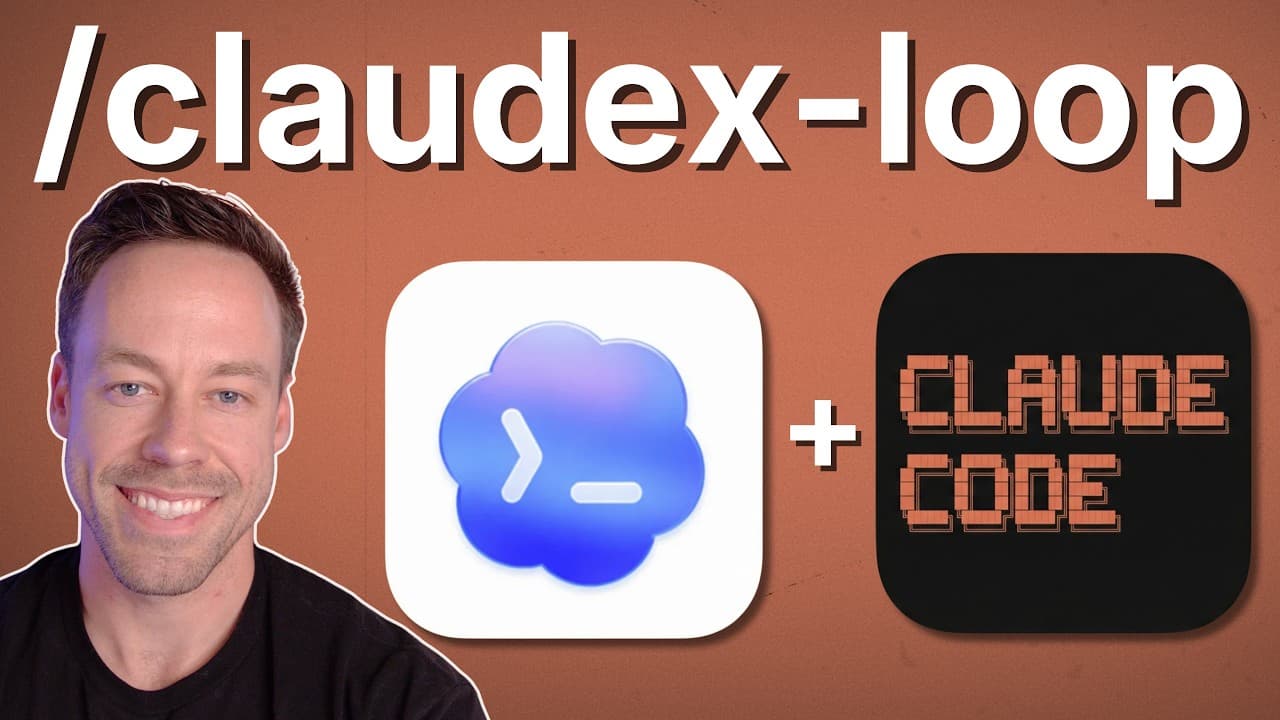
How to Review Claude Code Plans with Codex
TL;DR
Use a second AI model to review the first model’s plans and implementation before approving major steps. ClaudeX Loop combines research, detailed questioning, iterative plan review, and post-build inspection, with configurable round limits that prevent endless feedback cycles while allowing users to extend a deadlock when unresolved issues remain.
Transcript
You cannot trust Claude to grade its own work, which is a huge problem, but one that this skill solves. It's called ClaudeX Loop, and the premise is simple. Instead of having Claude be responsible for planning, executing, and grading its own work, why don't we bring in Codex to also take a look at the plan and the execution of Claude and say, "Hey,... Read More
Key Insights
- AI self-evaluation is unreliable because a model tends to judge its own plans and completed work favorably. ClaudeX Loop reduces this weakness by assigning review duties to a second model that can identify flaws and request changes before the workflow advances.
- ClaudeX Loop is organized into research, interrogation, review, and build phases. The sequence gathers external information, clarifies requirements, tests the proposed plan through cross-model criticism, and reviews the resulting implementation instead of treating the first generated answer as final.
- The research phase offers standard web research or deeper research. Claude proposes the research prompt and questions first, covering project-specific areas such as integrations, domain pitfalls, and technology choices, so the user can approve or edit the investigation before it begins.
- The assumptions ledger is a documented list of project expectations inferred by Claude after research. Users can confirm those assumptions or correct choices involving the technology stack, reminders, and other behavior before those decisions become part of the implementation plan.
- The interrogation phase separates load-bearing functional questions from cosmetic choices. Important questions include recommendations and allow further explanation, while lower-impact visual decisions are grouped so users can approve them together or request targeted changes without slowing the entire process.
- The planning review works through an iterative exchange between Claude and Codex. Codex inspects plan.md in a read-only sandbox, approves it or lists revisions, and sends its verdict back to Claude, which can accept, reject, or address the proposed corrections.
- Review limits are safeguards against endless feedback cycles and unnecessary token consumption. The demonstrated configuration permits five planning rounds and two build-review loops, but users can modify those settings or authorize additional rounds when the models reach the initial limit without agreement.
- Implementation can be assigned to Claude or Codex after the plan is accepted. Whichever model performs the build, the other model reviews what was created, extending independent evaluation from planning into actual code and reducing reliance on a single model’s assessment.
Install to Summarize YouTube Videos and Get Transcripts
Explore YouTube Video Summarizer or Get YouTube Transcript Extractor
Questions & Answers
Q: How does ClaudeX Loop improve AI coding workflows?
ClaudeX Loop improves an AI coding workflow by separating creation from evaluation. Claude can research requirements, question the user, prepare a plan, and build the project, while Codex independently reviews the plan and implementation. The models exchange revisions until they agree or reach a configured round limit, giving major decisions a second inspection before work proceeds.
Q: What are the four phases of ClaudeX Loop?
ClaudeX Loop uses four broad phases: research, interrogation, review, and build. Research looks for relevant answers on the web or through deeper investigation. Interrogation clarifies assumptions and important requirements. Review sends Claude’s plan to Codex for criticism and revision. Build assigns implementation to a model, then has the other model inspect the completed work.
Q: What happens during the research phase of ClaudeX Loop?
During research, Claude investigates whether useful answers already exist and lets the user choose between a standard web search and deeper research. It first presents a proposed research prompt and the questions it intends to investigate. In the demonstrated scheduling project, those questions covered Google Calendar, Google Meet, scheduling pitfalls, and the planned technology stack.
Q: What is the assumptions ledger in ClaudeX Loop?
The assumptions ledger records what Claude believes the user wants after completing its research. The user can confirm the full list or revise individual decisions before planning continues. Examples mentioned include changing the technology stack, reminder behavior, or other project expectations. Confirmed assumptions are then incorporated into the later questions and implementation plan.
Q: How does Codex review a plan created by Claude Code?
Claude Code creates a standard plan.md file after research and questioning are complete. Codex reads that plan inside a read-only sandbox and returns either an approval or a list of issues and requested revisions. Claude then considers the feedback, makes changes or disputes suggestions, and sends the updated plan back for another review round.
Q: Why does ClaudeX Loop limit the number of review rounds?
ClaudeX Loop limits review rounds to prevent the models from entering an endless disagreement that continually consumes tokens. The demonstrated setup allows up to five plan-review rounds and two build-review loops. These values are configurable. If unresolved issues remain at the limit, the user can stop, accept the deadlock, or extend the review by additional rounds.
Q: What happens if Claude and Codex do not agree after five rounds?
If Claude and Codex remain in disagreement after five planning rounds, the workflow pauses and presents choices instead of continuing indefinitely. The user can stop, retain the current plan, accept the deadlocked state, or extend the discussion. In the demonstration, the user added two rounds, and the models reached agreement after seven total rounds.
Q: Who can build the project after the plan is approved?
After Claude and Codex agree on the plan, the user can choose which model performs the implementation. Claude can build while Codex reviews, or Codex can build while Claude reviews. Some projects may also present a tandem option. Regardless of the builder, the second model examines the created work before the workflow moves forward.
Summary & Key Takeaways
-
ClaudeX Loop addresses the problem of AI models evaluating their own output too favorably. It separates planning and execution from evaluation by asking Claude and Codex to inspect each other’s work. Major decisions proceed only after a second model reviews the plan or implementation and identifies necessary revisions.
-
The workflow begins with web research or deeper research, followed by an assumptions ledger and an interrogation phase. Users answer important functional questions before reviewing cosmetic decisions. Claude then creates a plan.md file, which Codex examines inside a read-only sandbox and either approves or returns with specific requested changes.
-
Plan reviews are limited to five rounds by default, while build reviews are limited to two loops. Users can adjust these limits or extend a deadlock, as demonstrated when the sample project required seven planning rounds. After approval, either Claude or Codex can build while the other model reviews the result.
Read in Other Languages (beta)
Share This Summary 📚
Summarize YouTube Videos and Get Video Transcripts with 1-Click
Try YouTube Summary with ChatGPT & Claude or YouTube Transcript Generator
Explore More Summaries from Chase AI 📚


Summarize YouTube Videos and Get Video Transcripts with 1-Click
Try YouTube Summary with ChatGPT & Claude or YouTube Transcript Generator