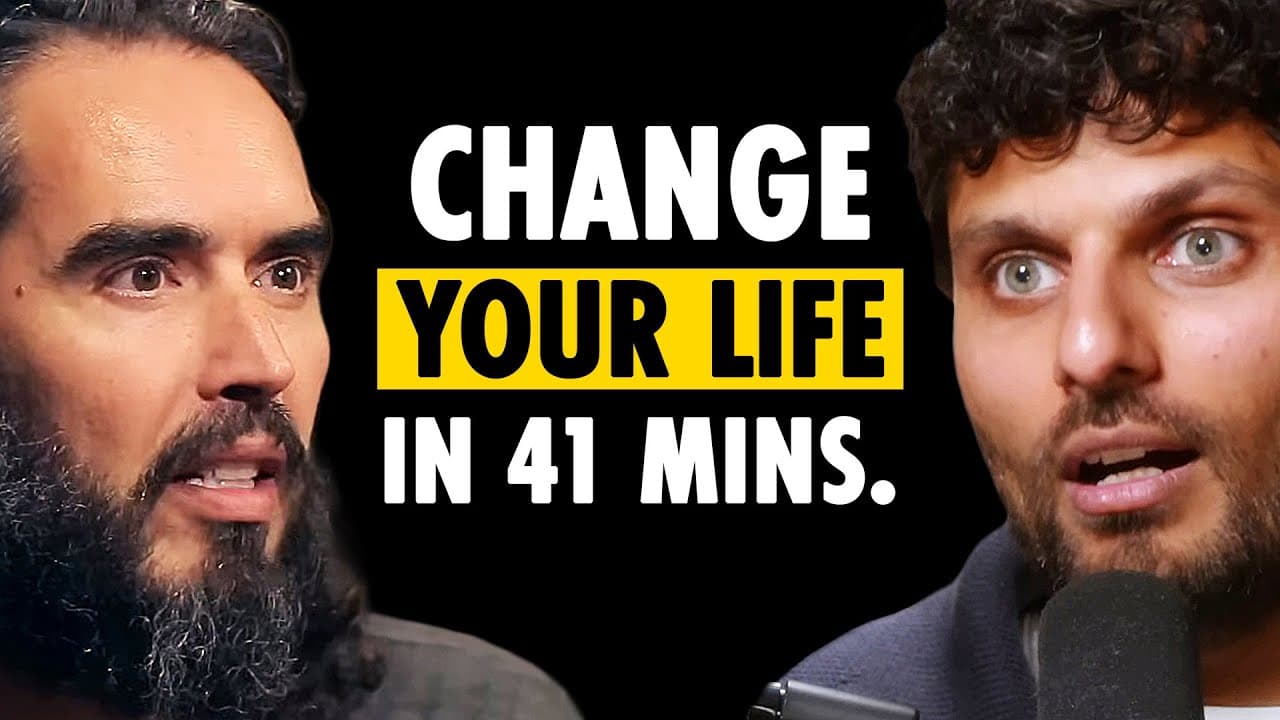
Russel Brand Shares The SECRET For Finding HAPPINESS & PURPOSE IN LIFE | Jay Shetty
TL;DR
Real happiness comes from unstructured connection and play rather than chasing wealth, fame, sex, or social power, which Russell Brand calls hollow forms of 'emulating social power.' After 14 years sober, he reorganizes life around parenting and only takes work that does not disrupt family, treating play, mischief, and presence as the actual sources of meaning.
Transcript
and this same lesson has been taught to me in many ways through drugs or sex economic success is emulating social power it's the idea of oh like what what can we infer from the wealth of carly jenner is it kylie kylie jenner he's an actor activist comedian and someone who i truly believe is a amazing thinker in the realms of philosophy spirituality... Read More
Key Insights
- Chasing wealth, fame, sex, and economic success is a form of emulating social power that Brand says he learned is empty, having pursued it through drugs, sex, and status without finding lasting fulfillment.
- Parenting became Brand's central life priority, so he now only accepts work, films, or podcasts if they do not interfere with his connection to his children and family time like his daughter's bath time.
- Play is essential to a meaningful adult life, and Brand argues adults lose the unstructured, invented connection that children demonstrate naturally through imaginative play with no respect for material reality.
- Fame is an amplification of ordinary human experience, since everyone knows what it is like to be gossiped about, disliked, or attacked, but the famous experience these things magnified by degree.
- Becoming famous costs a kind of privacy and sense of self that, as broadcaster Jonathan Ross told Brand, you lose and never get back once you enter public life.
- The illusion of a public figure can become more powerful than the truth, and Brand's journey has been about relinquishing the impossible desire to control his own narrative and what others think.
- Brand's current life reflects a transition where his once atomized, insular, solitary past is coalescing with his future as different friend groups and worlds begin to meet and overlap.
- Sexuality in a healthy relationship should carry an air of playfulness, an idea Brand credits to his friend Emma Kenny, who describes sex as a form of adult play worth aspiring to.
Install to Summarize YouTube Videos and Get Transcripts
Explore YouTube Video Summarizer or Get YouTube Transcript Extractor
Questions & Answers
Q: What does Russell Brand say is the secret to finding happiness and purpose?
Brand locates happiness in unstructured connection, play, and presence rather than in wealth, fame, sex, or economic success, which he calls forms of emulating social power. Having pursued those hollow rewards through drugs, sex, and status, he now finds meaning in parenting, family time, mischief, and performance, only doing work that does not disrupt his connection to his children and loved ones.
Q: Why does Russell Brand prioritize parenting over his career?
Brand says that almost as soon as he stopped being a child he wanted children, and after a long period of life without being a parent, fatherhood became everything for him. He now weighs every job against whether it is as enjoyable as his daughter's bath time, and only takes on films or podcasts if they do not get in the way of parenting or his family connection.
Q: How does Russell Brand describe the role of play in adult life?
Brand argues that play is vital and that adults lose the unstructured connection children show most clearly through play, where they freely invent situations with no respect for how reality is configured. He values comedians and performers because performance requires play, embraces mischief as harmless risk, and cites his friend's idea that sexuality in a healthy relationship should carry an air of playfulness.
Q: What does Russell Brand say about the cost of becoming famous?
Brand recounts that broadcaster Jonathan Ross told him you lose something when you become famous and never get it back, namely a kind of privacy and sense of who you are. Early on Brand did not value privacy because he liked being famous and performing while single, but he came to feel fame creates a distinction and separation from yourself, as if part of you gets taken away.
Q: How does Russell Brand view fame compared to ordinary experience?
Brand describes fame as simply an amplification of what everyone already experiences. Everyone knows what it is like to be gossiped about, to have people dislike them and attack them, and in fame these things happen in amplification. So while fame can feel very alien, it is also very ordinary, differing from normal experience only by degree rather than in fundamental kind.
Q: What transition is Russell Brand going through in his life?
Brand describes a transition where his past is coalescing with his future and different groups of his friends are starting to meet, whereas before things were atomized and he was insular, solitary, and protective. He gives the example of filming a children's movie in County Wicklow, Ireland, where friends, family, his father, and teacher Radhanath Swami gathered, worlds colliding to demonstrate a new integrated life.
Q: How has Russell Brand dealt with having his life documented by the media?
Brand says the illusion can become more powerful than the truth, and at times it has been frustrating and challenging because he wanted to control his own narrative and what others think, which is impossible. His journey as a public figure has been one of relinquishing that control, accepting the terms of fame, and trying to renegotiate so he can be somehow useful in that role.
Q: Why does Russell Brand admire comedians and performers?
Brand says he has always enjoyed people and likes comedians because you can start talking about something while knowing it is not really real, inhabiting a role together. As a performer and entertainer himself, he sees play as vital, valuing the energy that none of this is real and that you should not take it too seriously, an energy he finds in playful, mischievous deities like Krishna.
Summary
This video features an interview with Russell Brand, where he discusses his journey through fame, reinvention, and spirituality. He talks about the challenges of having his life documented by the media and the importance of discernment and judgment. Russell also discusses the role of mentors in his life and how they have helped him navigate his various reinventions. The conversation delves into topics such as happiness, authenticity, and the importance of breaking free from societal pressures.
Questions & Answers
Q: How has fame affected Russell Brand's sense of privacy and self?
Russell explains that fame has caused a sense of distinction and separation from himself. He talks about losing privacy when he first became famous and how it affected his sense of self. He also talks about the challenges of controlling his own narrative and what others think of him.
Q: How does Russell Brand navigate the process of reinventing himself?
Russell discusses how reinvention has been more of a crisis that felt out of his control rather than a deliberate choice. He explains that he has always known that these manifestations of fame are temporary and has kept a healthy dialogue with that understanding. He also talks about the process of shedding his old self and energy in order to explore new avenues.
Q: Did Russell Brand always dream of being a father?
Russell admits that as soon as he stopped being a child, he wanted children. He expresses his love for children and their unstructured play, which brings him happiness. He talks about how his daughter's imaginative play has influenced his own perspective on reality and the importance of playfulness in his life.
Q: Has Russell Brand always had a spiritual curiosity?
Russell explains that his journey into spirituality stemmed from his experience with drugs, particularly hallucinogens. He talks about how these experiences made him question his own identity and led him to wonder about the bigger picture. He also discusses the role of mentors and spirituality in his life, and how they have contributed to his exploration of self.
Q: How does Russell Brand differentiate between imitation and emulation?
Russell emphasizes the importance of discernment and judgment when it comes to emulation. He explains that while it can be beneficial to model oneself after someone they admire, it is crucial to ensure that the emulation is aligned with one's own essence. He highlights the need to avoid merely mimicking others and instead engage with one's own truth and essence.
Q: How does Russell Brand approach the idea of happiness?
Russell believes in the possibility of happiness and encourages embracing that possibility. He suggests that many people assume that life is inherently miserable and that happiness is not attainable. He emphasizes the importance of recognizing that there is a problem or something that one wants to change, believing in the possibility of change, and accepting help and guidance in the pursuit of happiness.
Q: How does Russell Brand handle societal pressures and the pursuit of happiness?
Russell discusses the need to let go of societal pressures and materialistic desires in order to pursue true happiness and connection. He references Gandhi's idea of breaking down societal constructs and finding autonomy in individual villages. He also asserts that exposing oneself to higher energy and aligning beliefs with higher truths can lead to a greater sense of fulfillment.
Q: How does Russell Brand approach reinvention and authenticity?
Russell believes that reinvention is often a response to crises or circumstances that feel beyond one's control. He emphasizes the importance of maintaining a healthy dialogue with oneself and recognizing that manifestations of fame are temporary. He also highlights the role of authenticity and staying connected to one's essence while exploring different avenues of self-expression.
Q: How does Russell Brand view the pursuit of happiness in relation to drugs and sex?
Russell shares his experiences with drugs and the realization that they do not bring true happiness. He discusses the fleeting nature of pleasure and the dangers of relying on substances for satisfaction. He also addresses the potential risks of mimicking the behavior of others without considering the long-term consequences.
Q: What role do mentors play in Russell Brand's life?
Russell explains that mentors have been instrumental in his journey, especially during times of reinvention and self-discovery. He shares examples of mentors he has had, ranging from recovering drug addicts to spiritual teachers, and how they have influenced his path. He stresses the importance of discernment and accepting guidance in order to achieve personal growth.
Takeaways
Russell Brand's journey through fame, reinvention, and spirituality offers valuable insights. He emphasizes the need to discern between external pressures and one's true essence, and the importance of embracing the possibility of happiness. Reinvention should stem from crises and not be fueled by societal expectations. Authenticity and staying connected to oneself while exploring different avenues are key. Mentors and guidance play a crucial role in personal growth and development. Ultimately, the pursuit of happiness requires breaking free from societal pressures and materialistic desires and aligning oneself with higher truths and experiences.
Summary & Key Takeaways
-
Russell Brand reunites with Jay Shetty a year after their recovery broadcast that over two and a half million people saw. He reflects on how his life has shifted so that work only happens when it does not disrupt parenting or his connection to family.
-
Brand describes children's play as an unstructured, joyful collage of influence, comparing it to hip-hop as a post-modern art form. He values play, mischief, and performance as vital, drawing on figures like Krishna, and sees sexuality as a form of adult play in healthy relationships.
-
On fame, Brand explains it strips away privacy and a sense of self, amplifying ordinary experiences of gossip and attack. His journey has been about accepting the terms of fame, relinquishing control over his narrative, and trying to be useful in that public role.
Read in Other Languages (beta)
Share This Summary 📚
Summarize YouTube Videos and Get Video Transcripts with 1-Click
Try YouTube Summary with ChatGPT & Claude or YouTube Transcript Generator
Explore More Summaries from Celebrities 📚





Summarize YouTube Videos and Get Video Transcripts with 1-Click
Try YouTube Summary with ChatGPT & Claude or YouTube Transcript Generator