What Are the Key Features of C and How to Write Your First Program
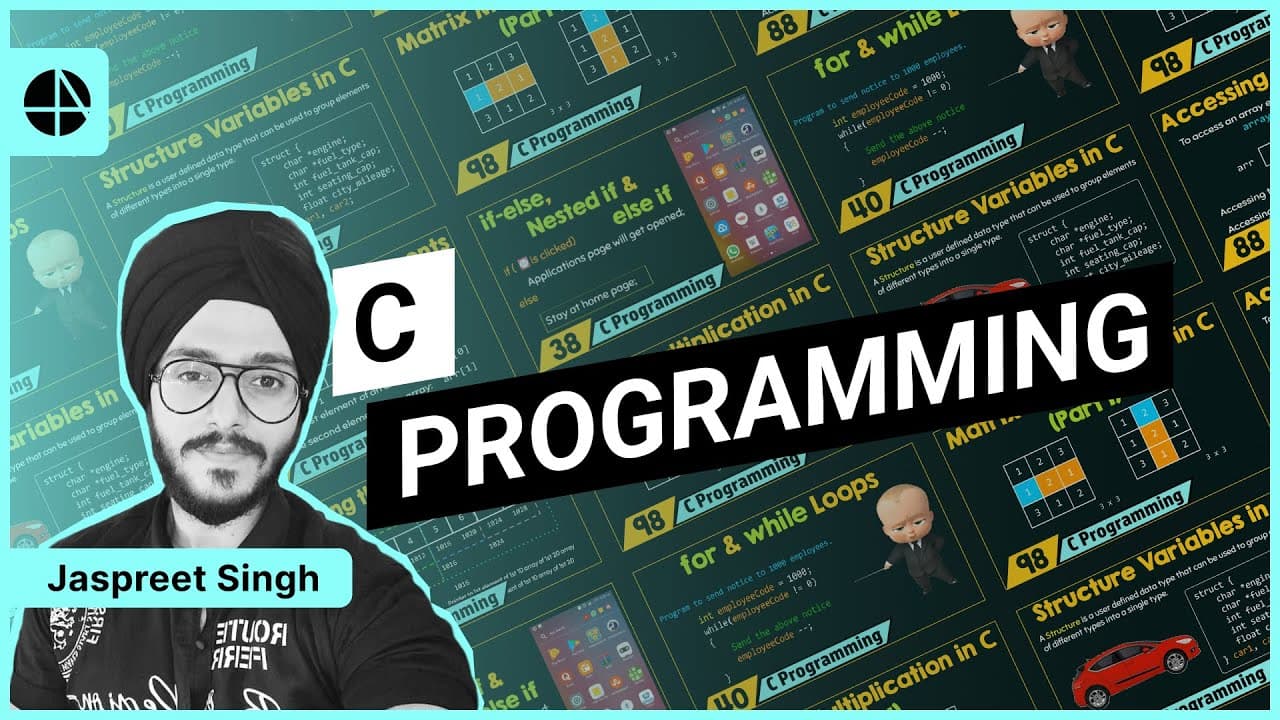
TL;DR
C’s key features are its procedural structure and middle-level balance: programs are divided into smaller functions, while pointers, bitwise operators, and embedded assembly provide access to system-level capabilities. A first C program typically uses #include with stdio.h, begins execution in main, calls printf to display output, and uses return 0 to indicate success. Read on for a line-by-line explanation of these elements.
Transcript
If you remember in our previous lesson that is Introduction to programming and Data Structures we had talked about most important features of C programming Those were Portability and less lines of code. Let's explore some more features of C programming. Have you ever wondered, why a company like Google for example has separate departments for car... Read More
Key Insights
- C is a procedural language, meaning a large program is divided into much smaller programs called procedures or functions so they are easier to work with. Everything in C is essentially a set of functions, which is its main feature.
- Abstraction means hiding system-level details. High abstraction gives more user friendliness and less effort because you do not worry about internal workings, while low abstraction demands knowledge of every internal computer detail.
- C is called a middle-level language because it makes programming simpler for humans yet still allows access to system-level features such as direct memory access through pointers, bit manipulation using bitwise operators, and writing assembly code within C code.
- C's unique features made it a popular choice for both system-level applications like kernels, device drivers, and operating systems, and for software applications like games, editors, and graphic-rich applications.
- A preprocessor directive like #include runs before compilation, replacing text following the hash symbol with the actual file content, producing an expanded source code that is then sent to the compiler.
- stdio.h is the standard input output header file containing declarations of functions like printf, which prints content inside its parentheses, and scanf, which takes user input at run time.
- The main function is the predefined entry point where computation begins, and its name cannot be changed. Its return type int means it returns an integer, and return 0 signals successful completion.
- printf needs only a semicolon and no curly brackets when called because it is already defined in the C standard library, so programmers call functions instead of redefining them repeatedly.
Install to Summarize YouTube Videos and Get Transcripts
Explore YouTube Video Summarizer or Get YouTube Transcript Extractor
Questions & Answers
Q: What are the key features of C programming?
C is a procedural, middle-level language that divides large programs into smaller procedures or functions. It simplifies programming while retaining system-level capabilities such as direct memory access through pointers, bit manipulation with bitwise operators, and writing assembly code within C code.
Q: What does it mean that C is a procedural language?
A procedural language divides a large program into much smaller programs called procedures or functions. This makes a complex task easier to manage by allowing its smaller parts to be worked on separately.
Q: Why is C called a middle-level language?
C makes programming simpler for people while also providing access to system-level features. These include pointers for direct memory access, bitwise operators for bit manipulation, and the ability to write assembly code within C code.
Q: What is abstraction in programming languages?
Abstraction means hiding system-level details. A higher degree of abstraction requires less effort from the user, while a lower degree requires the user to understand more of the computer’s internal details.
Q: What types of applications can C be used to develop?
C became a popular choice for system-level applications such as kernels, device drivers, and operating systems. It was also used for software applications including games, editors, and other graphic-rich applications.
Q: What are the main parts of a basic first C program?
The demonstrated program contains a comment, an #include directive for stdio.h, and a main function. Inside main, printf displays “Neso Academy” in the console, and return 0 indicates successful completion.
Q: What does #include do in a C program?
#include is a preprocessor directive that is handled before compilation begins. The preprocessor replaces the directive with the actual content of the specified file, creating expanded source code that is then sent to the compiler.
Q: What are the roles of stdio.h, main, printf, and return 0?
stdio.h contains declarations for standard input and output functions such as printf and scanf, while main is the predefined entry point where computation begins. printf displays the content placed inside its parentheses, and return 0 signals that execution completed successfully.
Summary & Key Takeaways
-
C is a procedural, middle-level language whose main feature is dividing a large program into smaller functions or procedures. This mirrors how companies split a big job into departments and how effective studying is spaced into shorter sessions, making complex tasks easier to manage.
-
Languages differ by degree of abstraction, which hides system-level details. High-level languages like COBOL, FORTRAN, C++, and Pascal are user-friendly, assembly is low-level, and C sits in the middle by simplifying programming while allowing pointer memory access, bitwise manipulation, and embedded assembly code.
-
A basic C program uses comments (ignored by the compiler), the #include preprocessor directive to pull in header files like stdio.h, and a main function as the entry point. Inside, printf prints output such as Neso Academy, and return 0 indicates successful execution.
Read in Other Languages (beta)
Share This Summary 📚
Summarize YouTube Videos and Get Video Transcripts with 1-Click
Try YouTube Summary with ChatGPT & Claude or YouTube Transcript Generator
Explore More Summaries from Neso Academy 📚
Summarize YouTube Videos and Get Video Transcripts with 1-Click
Try YouTube Summary with ChatGPT & Claude or YouTube Transcript Generator