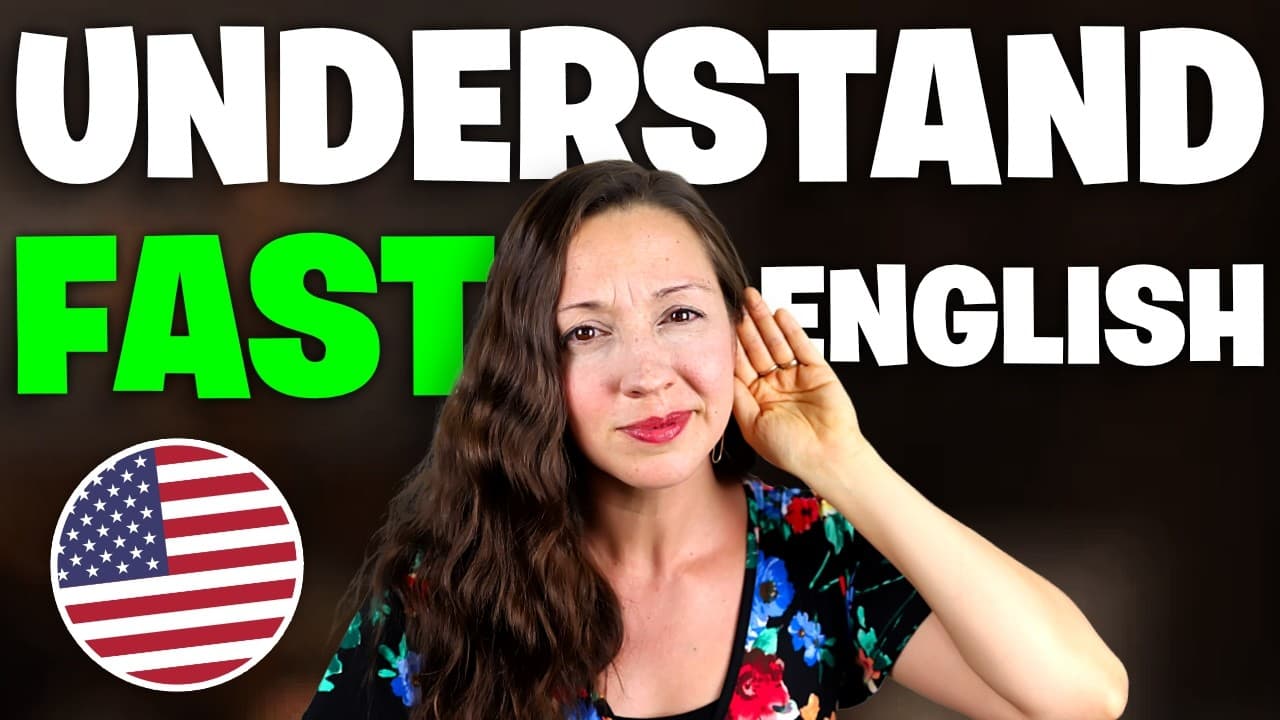
How to Understand Fast English Without Subtitles
TL;DR
Use a four-step method: hear a real conversation at normal speed, replay a slowed version, transcribe the fast version, then compare your writing word for word with the transcript. Reviewing vocabulary and answering open-ended comprehension questions also helps reveal missed phrases, clarify context, and turn passive listening into active practice.
Transcript
Have you ever watched an English TV show or movie and thought, "Oh, they're speaking so fast. How will I ever be able to understand what people are saying without subtitles?" Well, you have come to the right lesson. In today's lesson, you are going to learn how to understand fast English conversations so that you can easily watch movies and TV show... Read More
Key Insights
- • The four-step listening method is a progression from normal-speed exposure to slower listening, active transcription, and word-for-word transcript comparison. Each stage helps learners notice more of a real English conversation and identify exactly which words or phrases they initially missed.
- • The first listening exercise is a 20-second unscripted conversation played once at normal speed without subtitles. Learners are encouraged to test their ears, accept that complete understanding may be difficult, and focus initially on whatever general meaning or individual words they can recognize.
- • The slowed version is designed to make each word clearer after the difficult first exposure. Listening to the same material at a reduced speed gives learners another opportunity to detect language before returning to the original fast recording for a more demanding attempt.
- • Active transcription is the third step, requiring learners to write every word they hear in the fast conversation. Pausing, replaying, and correcting are allowed because the purpose is to replace passive listening with close attention to the exact sounds and wording of natural speech.
- • Open-ended comprehension questions are used to test overall understanding after transcription. The questions ask what participants receive, how long they speak, how spontaneous speaking feels, what selected phrases mean, and why an uncomfortable speaking activity can still be valuable.
- • A Toastmasters participant receives a topic or prompt and gives a one-to-two-minute speech in front of the group. The speech includes an introduction like a normal speech, but the participant must begin without preparation, making the activity especially uncomfortable and challenging.
- • “Off the cuff” means speaking spontaneously with no planning. In the sample conversation, the phrase describes receiving a subject and immediately delivering a short speech, rather than preparing the content in advance or relying on a previously written presentation.
- • Transcript comparison is the fourth step and brings the earlier work together. Learners check the conversation word for word against what they wrote, identify missed expressions such as “off the cuff,” and connect accurate word recognition with vocabulary, context, and nuance.
Install to Summarize YouTube Videos and Get Transcripts
Explore YouTube Video Summarizer or Get YouTube Transcript Extractor
Questions & Answers
Q: How can I understand fast English without subtitles?
Use the four-step listening method presented in the lesson. First, hear a short real conversation once at normal speed without subtitles. Second, listen to a slowed version and notice additional words. Third, replay the fast version and write down exactly what you hear. Fourth, compare your writing word for word with the transcript, checking missed phrases and reviewing their meanings in context.
Q: What are the four steps for practicing fast English listening?
The first step is listening once to a real, unscripted conversation at normal speed. The second is hearing the same clip in a slowed-down form. The third is returning to the fast recording and transcribing every word possible, with pauses and replays when needed. The fourth is comparing that transcription with the complete transcript to locate errors, missed expressions, and gaps in understanding.
Q: Why should I write down what I hear in an English conversation?
Writing down the conversation changes listening from a passive activity into an active test of word recognition. It requires you to focus on the exact language instead of relying only on the general idea. When you later compare your writing with the transcript, you can see which words and phrases you caught, which ones you missed, and where further listening practice is needed.
Q: Why should fast English practice begin at normal speed?
Beginning with the normal-speed recording tests what your ears can understand before receiving extra support. The lesson uses a 20-second real conversation and asks learners to listen once without subtitles. Even if they recognize only the general idea or a few words, this first attempt creates a useful reference point before slower listening, transcription, vocabulary review, and transcript comparison.
Q: What does “off the cuff” mean in English?
“Off the cuff” means spontaneous or completed without planning. In the sample conversation, a Toastmasters participant receives a topic or prompt and must stand in front of the group to give a one-to-two-minute speech immediately. The participant has no preparation time, so the speech is described as being delivered off the cuff rather than from a prepared script.
Q: What does “bound to” mean in the sample conversation?
“Bound to” means definitely in the lesson’s explanation of the phrase. The comment “That’s bound to terrify anybody” means that giving an unprepared speech in front of a group will definitely frighten people. The lesson distinguishes this meaning from the physical use of “bound,” such as describing someone or something that has been tied to another object.
Q: What happens during the Toastmasters speaking activity?
A participant receives either a topic or a prompt, stands in front of the group, and gives a one-to-two-minute speech off the cuff. The speech has an introduction like a normal speech, but it is spontaneous and unplanned. Nathan describes this as the most uncomfortable part of the meeting while also saying it is where participants grow the most.
Q: Why can uncomfortable speaking practice improve English skills?
The lesson argues that challenging, spontaneous activities create opportunities for growth. Nathan says the most uncomfortable part of the Toastmasters meeting is where participants grow the most, and Vanessa applies that idea to English learning. If learners never leave their comfort zone, have an English conversation, attend an English meeting, or try something new, they do not create the same opportunity to develop.
Summary & Key Takeaways
-
The lesson introduces a four-step method for understanding fast, natural English in movies, television shows, and conversations. Learners first hear a 20-second unscripted exchange at normal speed without subtitles. The initial attempt tests their ears and establishes how much of the general idea and individual wording they can recognize.
-
The same exchange is played more slowly so learners can identify words they missed at normal speed. They then hear the fast version again and write down every word they can detect, pausing and replaying when necessary. Open-ended questions test comprehension of the topic, speech length, emotional reaction, and learning benefit.
-
The conversation describes a Toastmasters activity in which participants receive a topic or prompt and give a one-to-two-minute speech without preparation. Vocabulary review explains that “off the cuff” means spontaneous and that “bound to” means definitely likely to happen. Finally, learners compare their transcription word for word with the provided transcript.
Read in Other Languages (beta)
Share This Summary 📚
Summarize YouTube Videos and Get Video Transcripts with 1-Click
Try YouTube Summary with ChatGPT & Claude or YouTube Transcript Generator
Explore More Summaries from Speak English With Vanessa 📚





Summarize YouTube Videos and Get Video Transcripts with 1-Click
Try YouTube Summary with ChatGPT & Claude or YouTube Transcript Generator