How to Check if Vectors Are Linearly Independent
TL;DR
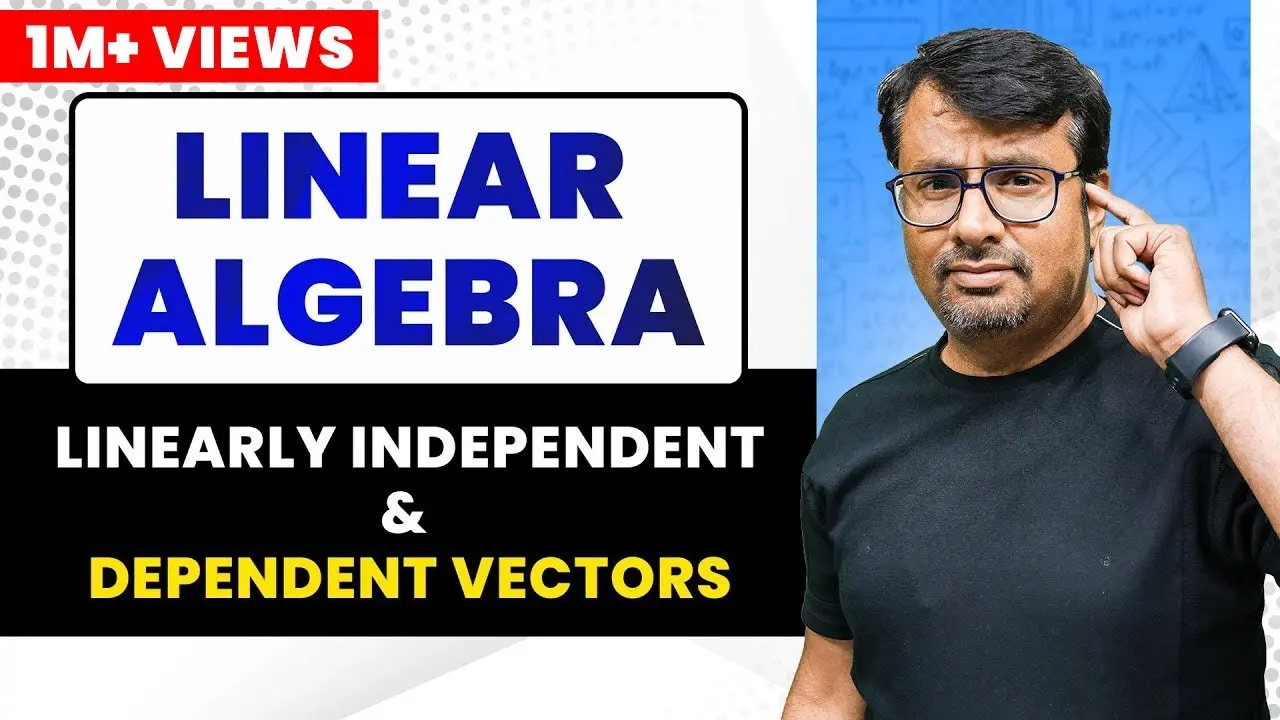
To test whether vectors are linearly independent, write them in column form and find the rank of the matrix: if the rank equals the number of vectors they are independent, and if the rank is less it means they are dependent. Equivalently, a nonzero determinant of the coefficients means independent, while a zero determinant means dependent.
Transcript
Hello Students! I'm Dr Gajendra Purohit and you're watching my youtube channel where I upload videos on Engg mathematics & BSc If you're preparing for any competitive exam where higher mathematics is asked then my youtube channel will be very helpful Click on the i tab to watch my previous videos on vector space and related topics On my new channel... Read More
Key Insights
- Linear independence is defined through a linear combination of vectors with scalars from a field: if the combination equals zero only when every scalar is zero, the vectors are linearly independent.
- Linear dependence occurs when the linear combination of vectors equals zero even though some of the scalars are not zero, meaning the vectors share a relation among themselves.
- Setting up the scalar equations for independence produces a homogeneous system, and homogeneous systems are analyzed using the determinant of the coefficient matrix to decide the nature of the solution.
- When the determinant of the coefficients is nonzero, all scalars are forced to zero and the vectors are independent, but when the determinant is zero, nonzero scalar solutions exist and the vectors are dependent.
- The short trick for testing independence is to write the vectors in column form and calculate the rank of the resulting matrix rather than solving the full scalar system.
- For three vectors, a rank of 3 means linearly independent, while a rank less than 3 means linearly dependent; the same logic extends so that four vectors need rank 4 to be independent.
- An upper triangular matrix makes rank easy to read off, and in the worked example the rank came out to 3 for three vectors, confirming they were linearly independent.
- Whenever vectors turn out to be linearly dependent, a relation always exists between them, and that relation can be found by computing the scalar coefficients (denoted lambda values) that combine the vectors to zero.
Install to Summarize YouTube Videos and Get Transcripts
Explore YouTube Video Summarizer or Get YouTube Transcript Extractor
Questions & Answers
Q: What does it mean for vectors to be linearly independent?
Vectors are linearly independent when a linear combination of them, formed with scalars from a field, equals zero only if every scalar in that combination is zero. In other words, there is no way to make the combination sum to zero unless all the scalar coefficients are zero. If, instead, the combination can equal zero while some scalars remain nonzero, the vectors are linearly dependent and a relation exists between them.
Q: How do you check if vectors are linearly independent or dependent?
Take a linear combination of the vectors with unknown scalars, substitute the vector values, and you obtain a homogeneous system of equations. You then analyze it two ways: compute the determinant of the coefficient matrix, or write the vectors in column form and find the rank of the matrix. These methods reveal whether only the zero solution exists (independent) or nonzero solutions exist (dependent).
Q: What is the short trick to determine linear independence?
The short trick is to write the vectors in column form and calculate the rank of the resulting matrix instead of solving the full scalar system. You reduce the matrix by making entries zero using other rows or columns, then read the rank. If the rank equals the number of vectors the set is independent, and if the rank is less than the number of vectors the set is linearly dependent.
Q: How does the determinant tell you if vectors are dependent?
Because the independence test forms a homogeneous system, the determinant of the coefficient matrix decides the solution type. If the determinant is nonzero, the only solution has all scalars equal to zero, so the vectors are linearly independent. If the determinant equals zero, nonzero scalar solutions exist, which means the linear combination can be zero without all scalars being zero, so the vectors are linearly dependent.
Q: What rank means three vectors are linearly independent?
For a set of three vectors, if the rank of the matrix formed from them is 3, they are linearly independent. If the rank is less than 3, they are linearly dependent. This rule generalizes: the vectors are independent only when the rank equals the total number of vectors, so four vectors require a rank of 4 to be independent and any rank below that indicates dependence.
Q: Why is the solution homogeneous when testing independence?
When you set a linear combination of the vectors equal to the zero vector and substitute the vector components, each equation is set to zero on the right-hand side. A system where all equations equal zero is a homogeneous system. Because of this, you can use the determinant concept: a nonzero determinant gives only the trivial zero solution, while a zero determinant permits nontrivial nonzero solutions indicating dependence.
Q: How do you find the relation between dependent vectors?
When vectors are linearly dependent there is always a relation between them. To find it, denote the relation using scalar coefficients such as lambda 1, lambda 2, and lambda 3, then solve for those scalar values. Calculating the rank first makes it easier to compute the values. Substituting the found values back into the linear combination gives the explicit relation connecting the dependent vectors.
Q: What prior knowledge do you need for this topic?
To follow this lecture you must be aware of the rank of a matrix, since the main short trick relies on computing rank from the vectors written in column form. The instructor notes a separate video on rank of a matrix is already available. Familiarity with vector space, determinants, and homogeneous systems of equations also helps, as these concepts are used throughout the independence and dependence tests.
Summary & Key Takeaways
-
The lecture defines linear independence and dependence using a linear combination of vectors with scalars from a field. If the combination equals zero only when all scalars are zero, the vectors are independent; if it can equal zero with some nonzero scalars, they are dependent.
-
Solving for the scalars yields a homogeneous system, so the determinant of the coefficient matrix decides the outcome. A nonzero determinant forces all scalars to zero (independent), while a zero determinant allows nonzero solutions (dependent). The example shown has a zero determinant, so it is dependent.
-
The short trick writes vectors in column form and computes the matrix rank: rank equal to the number of vectors means independent, rank less means dependent. For dependent sets a relation always exists, found via lambda coefficients. The next topic will be basis and dimension.
Read in Other Languages (beta)
Share This Summary 📚
Summarize YouTube Videos and Get Video Transcripts with 1-Click
Try YouTube Summary with ChatGPT & Claude or YouTube Transcript Generator
Explore More Summaries from Dr.Gajendra Purohit 📚





Summarize YouTube Videos and Get Video Transcripts with 1-Click
Try YouTube Summary with ChatGPT & Claude or YouTube Transcript Generator