Lisa Feldman Barrett: How the Brain Creates Emotions | MIT Artificial General Intelligence (AGI)
TL;DR
The brain creates and interprets emotions based on sensory input and past experiences rather than relying solely on facial expressions. Emotions are shaped by cultural norms, social interactions, and the body's regulatory systems, emphasizing that they are complex and cannot be universally defined by specific facial cues alone.
Transcript
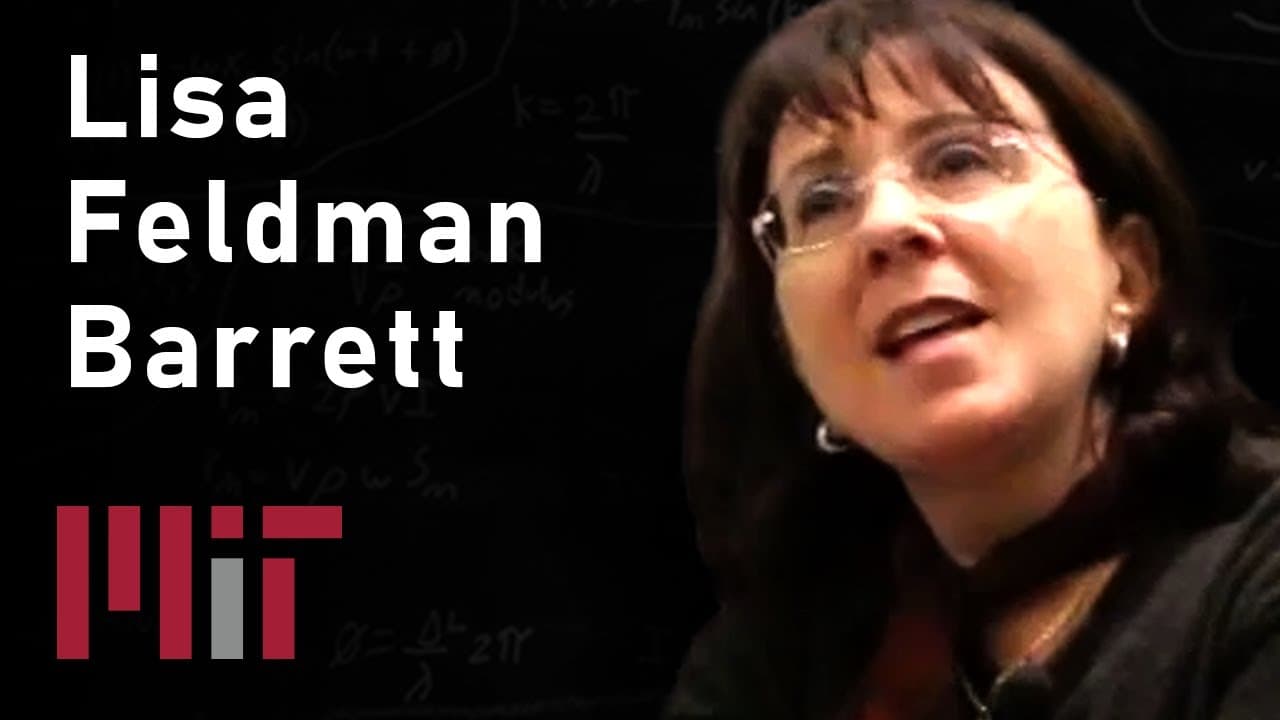
today we're going to try something different we're going to try a conversation we have Lisa Feldman Barrett with us she is a university distinguished professor of psychology at Northeastern University director of the interdisciplinary affective Science Laboratory author of the new amazing book how emotions are made the secret life of the brain she ... Read More
Key Insights
- 😑 Emotions are not solely based on facial expressions but are influenced by past experiences and cultural norms.
- 🧠 The brain regulates emotions by processing sensory information and interpreting emotional responses.
- 🖐️ Social connections play a crucial role in regulating emotions and overall well-being.
- 🎮 Neurotransmitters like serotonin and dopamine can impact emotional states but are not the sole determinants of emotions.
- 🎙️ More videos with Lisa Feldman Barrett:
Install to Summarize YouTube Videos and Get Transcripts
Explore YouTube Video Summarizer or Get YouTube Transcript Extractor
Questions & Answers
Q: How do facial expressions differ from real emotions?
Facial expressions are not universal indicators of emotions as emotions are complex and influenced by various factors like culture and individual experiences.
Q: How does the brain's wiring impact emotional experiences?
The brain processes sensory information to regulate the body and interpret emotional responses, influenced by past experiences and social interactions.
Q: Why is social connection important for regulating emotions?
Social interactions help regulate the nervous system and emotional responses, demonstrating the significance of social support for emotional well-being.
Q: How do neurotransmitters influence emotional states?
Neurotransmitters like serotonin and dopamine play a role in regulating emotional responses, but emotions are multifaceted and not solely determined by chemicals in the brain.
Summary
In this video, Lisa Feldman Barrett, a distinguished professor of psychology, discusses emotions and how they are created. She challenges common misconceptions about emotions, such as the idea that facial expressions are universal indicators of emotion. Barrett explains that emotions are not displayed but rather experienced and that our brains make educated guesses about the emotions of others based on various cues. She also delves into the different views on emotions throughout history and the role of culture in shaping emotional experiences. The conversation touches on the importance of physical systems in emotion regulation and the significance of social interactions in the formation of emotions. Barrett emphasizes that emotions are real and meaningful constructs that are impressed upon sensory cues by collective agreement.
Questions & Answers
Q: Have you ever cried while watching a movie? Which movie made you cry?
I have cried during many movies. The last time I cried was when discussing a study on Sophie's Choice, a movie about a woman forced to choose which of her children will die in a concentration camp. There are also other powerful scenes, such as one from a film called A Time to Kill, where a lawyer delivers a powerful defense for an African-American man accused of murder.
Q: Can we accurately read someone's emotions by just looking at their face?
One common misconception is that emotions can be read by looking at someone's facial expressions. However, facial expressions do not have intrinsic emotional meaning. People scowl, smile, and frown for various reasons, and there is no strong scientific evidence supporting the idea of universal facial expressions for each emotion.
Q: How are emotions created and how do they change in the presence of others?
Emotions are not displayed but rather experienced. When we interact with others, our brains make educated guesses about their emotions based on various cues, including facial expressions, body posture, and dynamic changes in these signals. However, the face is not the sole indicator of emotions, and the brain takes in the entire sensory array, such as voice and body posture, to make sense of emotions in the presence of others.
Q: What are the basic building blocks of emotion?
There are two main views on the building blocks of emotion. One view suggests that we are born with pre-wired circuits for different emotions, while the other view proposes that our brains have all-purpose capacities and use common ingredients to create different mental events, including emotions. These basic ingredients can be combined in various ways to form a range of emotional experiences.
Q: Where does emotion sit on the priority list of what makes us human?
The question of where emotion sits on the priority list of what makes us human may not be the right question to ask. Different cultures have different concepts and interpretations of emotions, and not all cultures have a concept of emotion. However, emotions are an integral part of human experience in many cultures and play a significant role in our social and cognitive lives.
Q: Are emotions real or are they just socially constructed?
Emotions are real and meaningful constructs that are impressed upon sensory cues by collective agreement. We impose meaning on sensory signals that don't have intrinsic emotional meaning, much like how we assign value to pieces of paper or objects in our culture. Emotions are experienced and expressed through social interactions and cultural agreements, making them real in our subjective experience.
Q: How do infants learn to express emotions and fit into their culture?
Infants learn through statistical learning and experiences provided by caregivers. From a young age, they learn to make sense of sensory cues and form abstract categories through labeling and language. Infants rely on the regulation of their nervous systems by caregivers to wire their brains to the physical and social realities they grow in. Language and socialization play a crucial role in the formation of emotional expression and fitting into culture.
Q: How would you build a robot that behaves like a human and evokes deep connection?
To build a robot that evokes deep connection, it would need physical systems analogous to human bodies and something akin to homeostasis to maintain balance. The goal would be to stabilize the system, regulate bodily functions, and have an understanding of sensory cues and social interactions similar to humans. The ability to regulate each other's nervous systems and the use of language to communicate would be essential aspects to consider.
Q: Can the same kind of deep connection and love be built with non-human objects like cars?
Humans are capable of forming attachments and even love with non-human objects, such as cars or toys. However, the question is whether these objects can reciprocate the attachment or love. While we can form emotional connections with objects, the depth and complexity of human attachment and love involve social regulation of each other's nervous systems, which is something non-human objects cannot provide.
Q: What is the significance of collective agreement in social realities like emotions?
Collective agreement plays a crucial role in social realities, including emotions. We impose meaning on sensory signals and assign emotions based on cultural agreements. It is through collective intentionality and shared concepts that we regulate our nervous systems and create social bonds. Social agreements form the basis of our emotional experiences and foster a sense of connection and understanding among individuals.
Takeaways
Emotions are complex and multifaceted experiences that involve the regulation of the body and the interpretation of sensory cues. Facial expressions are not universal indicators of emotions, and emotions are not simply displayed but instead experienced. Emotions are real and meaningful constructs that are impressed upon sensory cues by collective agreement. Social interactions and cultural agreements play a significant role in the formation and interpretation of emotions. Additionally, emotions are deeply connected to our social bonds and the regulation of each other's nervous systems, highlighting the importance of social connections for emotional well-being.
Summary & Key Takeaways
-
Lisa Feldman Barrett explains that human emotions are complex and not solely based on facial expressions.
-
Emotions are influenced by past experiences, cultural norms, and social interactions.
-
The brain regulates the body and sensory information to interpret emotional responses.
Read in Other Languages (beta)
Share This Summary 📚
Summarize YouTube Videos and Get Video Transcripts with 1-Click
Try YouTube Summary with ChatGPT & Claude or YouTube Transcript Generator
Explore More Summaries from Lex Fridman 📚






Summarize YouTube Videos and Get Video Transcripts with 1-Click
Try YouTube Summary with ChatGPT & Claude or YouTube Transcript Generator