Sean Carroll: Many-Worlds Interpretation of Quantum Mechanics
TL;DR
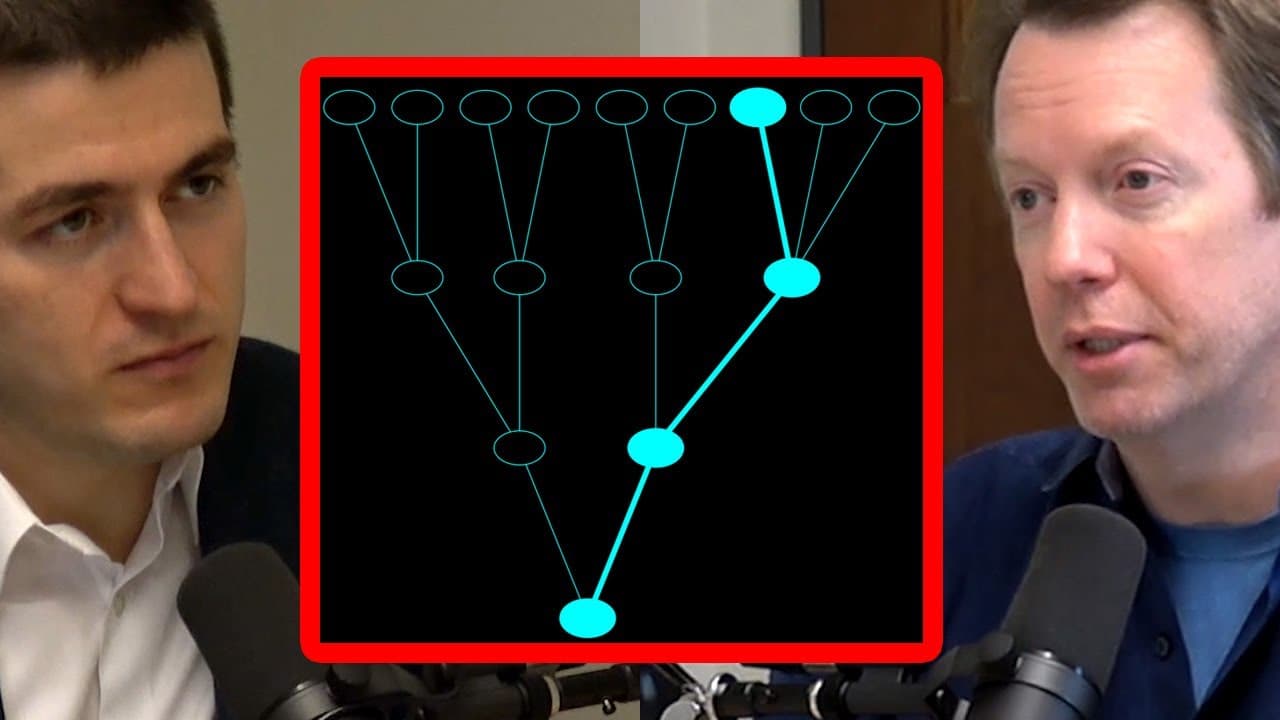
The Many-Worlds interpretation posits that every quantum event spawns parallel universes, each representing different outcomes. It emphasizes that observers are not special but rather entangled quantum systems, challenging our understanding of reality and observation.
Transcript
so coming back to the textbook definition of quantum mechanics this idea that we I don't think we talked about can you this one of the most interesting philosophical points we talked at the human level but at the at the physics level that it that at least a textbook definition of quantum mechanics separates what is observed and what is real one how... Read More
Key Insights
- 🥺 The Many-Worlds interpretation of quantum mechanics separates what is observed from what is real, leading to philosophical and scientific discussions.
- ❓ Many-Worlds proposes that observers are quantum systems and that observation occurs through entanglement with the observed object.
- ❓ The interpretation suggests the existence of multiple parallel universes or branches, each representing a different outcome.
- 🎙️ More videos with Sean Carroll:
Install to Summarize YouTube Videos and Get Transcripts
Explore YouTube Video Summarizer or Get YouTube Transcript Extractor
Questions & Answers
Q: How does the textbook definition of quantum mechanics separate observation and reality?
The textbook definition of quantum mechanics suggests that what is observed and what is real are distinct entities. It raises questions about the nature of observation and its relationship to reality.
Q: What is the Many-Worlds interpretation of quantum mechanics?
Many-Worlds posits that observers are simply quantum systems like any other and that observation involves becoming entangled with the observed object. This interpretation suggests the existence of multiple parallel universes or branches.
Q: What is the difference between the Many-Worlds interpretation and other interpretations of quantum mechanics?
Unlike other interpretations, Many-Worlds is considered the simplest because it does not require additional rules or variables. It also provides a clean framework for understanding quantum gravity and the emergence of space-time.
Q: Does the Many-Worlds interpretation violate the conservation of energy?
No, the Many-Worlds interpretation does not violate the conservation of energy. It suggests that the universe splits into thinner branches rather than creating new copies, ensuring energy conservation.
Key Insights:
- The Many-Worlds interpretation of quantum mechanics separates what is observed from what is real, leading to philosophical and scientific discussions.
- Many-Worlds proposes that observers are quantum systems and that observation occurs through entanglement with the observed object.
- The interpretation suggests the existence of multiple parallel universes or branches, each representing a different outcome.
- Many-Worlds is considered the simplest interpretation and provides a foundation for understanding quantum gravity and the emergence of space-time.
Summary
In this video, the concept of quantum mechanics and its various interpretations are discussed. The concept of observation and its role in quantum mechanics is explored, along with the idea of many-worlds interpretation, which suggests that multiple dimensions or worlds exist simultaneously. The video also touches upon alternative interpretations of quantum mechanics such as hidden variable theories and spontaneous collapse theories. The speaker expresses a preference for the many-worlds interpretation due to its simplicity and its compatibility with modern physics.
Questions & Answers
Q: How does quantum mechanics separate observed reality and what is really real?
Quantum mechanics, according to a textbook definition, separates the observed reality from what is truly real. The speaker personally believes that observation and mental processes might not play a fundamental role in the laws of physics. This belief is based on the evidence that has been observed so far. While it would be fascinating if observation did have a fundamental impact on reality, the speaker does not see any evidence supporting this idea.
Q: How can the role of measurement and observation be explained in the textbook interpretation of quantum mechanics?
The speaker suggests that better interpretations of quantum mechanics have been developed to explain the role of measurement and observation. A preferred interpretation is the many-worlds interpretation. According to this interpretation, observers are considered quantum systems just like anything else. When an observer thinks they are measuring or observing something, they are actually becoming entangled with the object being observed. This entanglement creates multiple instances of the observer, each perceiving a different outcome. These different instances of the observer no longer interact or influence each other, essentially creating separate worlds.
Q: How are new worlds or dimensions created in the many-worlds interpretation?
According to Hugh Everett III, who proposed the many-worlds interpretation, new worlds or dimensions are created when a quantum system in a superposition becomes entangled with the outside world. The outside world refers to all the parts of the universe that are not tracked or observed. While the exact process is not fully understood, it is believed that whenever a quantum system becomes entangled, multiple dimensions or worlds are created.
Q: How many worlds or dimensions are there in the many-worlds interpretation?
The exact number of worlds or dimensions in the many-worlds interpretation is unknown, but it is believed to be a very large number. It could be infinite or finite, but regardless, it is an incredibly large number. The estimate provided by the speaker is 10 to the power of 10 to the power of 122, which is significantly larger than the age of the universe or the number of particles in the universe.
Q: Is there a possibility of a duplicate or overlapping world in the many-worlds interpretation?
The possibility of a duplicate or overlapping world in the many-worlds interpretation depends on whether Hilbert space, which describes the wave function of the universe, is finite or infinite dimensional. If Hilbert space is finite, then after a certain number of branches, there would be a limit to the creation of new worlds. Once all the branching has occurred, the universe would enter a phase of expansion, emptiness, and cooling off. However, the exact nature of the formation of worlds and their potential duplication or overlap is still being explored.
Q: Is there a difference between splitting and copying in the many-worlds interpretation?
It is better to think of the universe splitting into separate worlds rather than creating new copies in the many-worlds interpretation. This distinction is made because the concept of energy conservation is not violated in the splitting scenario. When the universe splits, the conservation of energy is preserved as it is just a different way of describing the same energy distribution. Mathematically, this is similar to representing a vector of length one as the sum of two vectors pointing along different axes.
Q: Does the many-worlds interpretation violate the conservation of energy?
No, the many-worlds interpretation does not violate the conservation of energy. The interpretation is consistent with energy conservation, and there is no doubt regarding this aspect. While there might be other questions and concerns related to many-worlds, the conservation of energy is not one of them.
Q: Why is the many-worlds interpretation considered controversial?
The many-worlds interpretation of quantum mechanics is considered controversial because it is challenging to map the underlying mathematical formalism onto the observed reality. Unlike classical physics, which can be more easily mapped onto reality, interpreting quantum mechanics involves understanding wave functions, probabilities, and the connection to the physical world. Many-worlds interpretation requires a lot of effort to establish this connection, and the complexity involved creates a discomfort for some people.
Q: What are the alternatives to the many-worlds interpretation in quantum mechanics?
There are three main alternatives to the many-worlds interpretation in quantum mechanics. The first is hidden variable theories, which suggest that the wave function is not the only aspect of reality and that there are additional variables at play. The second alternative is spontaneous collapse theories, which propose that the wave function of particles can collapse spontaneously or due to certain conditions. The third alternative is the epistemic interpretation, which treats the wave function as a tool for making predictions rather than representing a physical reality.
Q: How do the alternatives to the many-worlds interpretation address the challenges of interpreting quantum mechanics?
Each alternative interpretation attempts to address the challenges of interpreting quantum mechanics differently. Hidden variable theories introduce additional variables beyond the wave function to account for the physical reality. Spontaneous collapse theories propose that wave functions can collapse spontaneously or due to certain conditions. Epistemic interpretations focus on the predictions made by the wave function rather than attributing physical reality to it. These alternative interpretations aim to provide a better mapping of quantum mechanics onto the observed reality.
Q: What makes the many-worlds interpretation compelling to the speaker?
The many-worlds interpretation is compelling to the speaker for two reasons. Firstly, it is the simplest interpretation of quantum mechanics, which aligns with the speaker's preference for simplicity in theories. Secondly, many-worlds is compatible with modern physics, including quantum fields, quantum gravity, and holography. Other interpretations bring along classical baggage, which hinders the understanding of quantum gravity and the emergence of space-time. Many-worlds, being the most quantum theory, allows for a clearer exploration of these complex concepts.
Summary & Key Takeaways
-
The textbook definition of quantum mechanics separates what is observed from what is real, raising questions about observation and the nature of reality.
-
The Many-Worlds interpretation states that observers are just quantum systems and that observation is the result of becoming entangled with the object observed.
-
Many-Worlds proposes the existence of multiple parallel universes or branches, with each branch representing a possible outcome.
Read in Other Languages (beta)
Share This Summary 📚
Summarize YouTube Videos and Get Video Transcripts with 1-Click
Try YouTube Summary with ChatGPT & Claude or YouTube Transcript Generator
Explore More Summaries from Lex Fridman 📚



Summarize YouTube Videos and Get Video Transcripts with 1-Click
Try YouTube Summary with ChatGPT & Claude or YouTube Transcript Generator