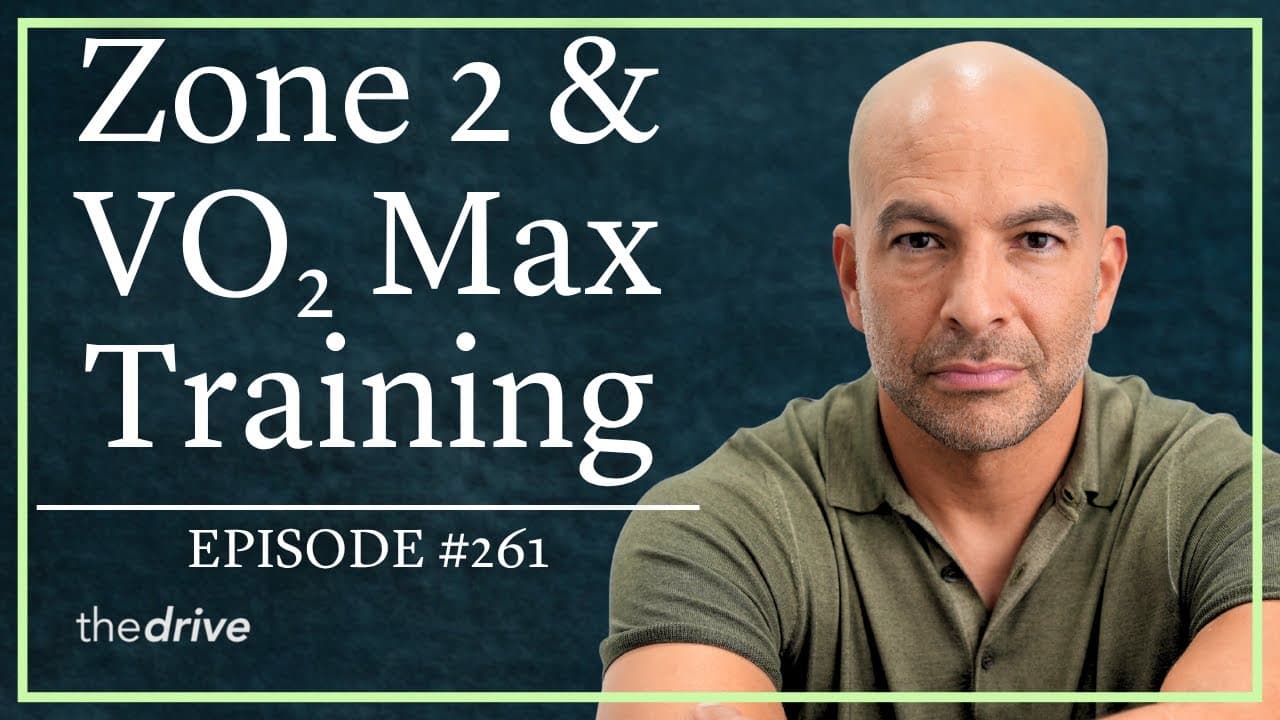
How to blend zone 2 and VO2 max for longevity training
TL;DR
The core idea is to allocate about 80% of cardio time to zone 2 and 20% to V2 max, with elites possibly doing 90% and 10%. A weekly plan includes four zone 2 sessions and targeted V2 max workouts, plus strength and stability work. Start with the maximum feasible cardio time and build from there.
Transcript
If you're really committed to developing your cardiorespiratory fitness, you're trying to maximize the area of a triangle, right? So, the triangle has a base and the triangle has a peak. And the goal is how big an area can I get? Not how wide, not how tall. You don't want one that's this wide and this tall. And you don't want one that's this tall a... Read More
Key Insights
- Zone 2 should comprise roughly 80 percent of training volume, with V2 max making up the remaining 20 percent.
- Elite athletes may approach 90 percent zone 2 and 10 percent VO2 max, indicating a strong base with selective high intensity.
- The weekly plan in the talk uses four zone 2 workouts spread across Monday to Sunday for balanced training.
- V2 max workouts are most effective when performed after substantial zone 2 base, not before it.
- Common modalities for zone 2 include treadmill, bike, swimming, and steady state cardio with low to moderate effort.
- V2 max sessions typically feature 3 to 8 minute intervals with controlled effort and recovery periods.
- A practical rule is to limit high intensity sessions to sustainable durations, avoiding burnout in early stages.
- Before V2 max, accumulate enough repetitions and a stable aerobic base to support harder efforts.
Install to Summarize YouTube Videos and Get Transcripts
Explore YouTube Video Summarizer or Get YouTube Transcript Extractor
Questions & Answers
Q: How should I structure a weekly cardio plan to balance zone 2 and VO2 max?
A practical weekly structure starts with four zone 2 sessions distributed across the week to provide a stable aerobic base. Pair these with one or two VO2 max sessions, each consisting of sustained intervals at a hard pace. Include strength and stability work on non running or cycling days to support overall performance and reduce injury risk.
Q: What modalities work best for zone 2 training?
Zone 2 can be trained on a treadmill with incline, a bike, swimming, or brisk walking, as long as the effort remains steady and sustainable. The key is to maintain a consistent pace that supports aerobic efficiency without frequent surges into higher intensity. Equipment availability dictates the best choice for a given day.
Q: How long should a VO2 max workout last and how should it feel?
A VO2 max workout typically uses 3 to 8 minute intervals with short recovery periods. The aim is to sustain a hard, taxing effort for each interval, reaching near maximal sustainable intensity without collapsing before the interval ends. Proper pacing and gradual build into the interval are crucial for effectiveness.
Q: Why is zone 2 performance considered foundational?
Zone 2 builds mitochondrial efficiency and oxidative capacity, creating a stable aerobic base that supports higher intensity efforts later. Spending most training time in zone 2 reduces fatigue during harder sessions and promotes sustainable improvements in cardiorespiratory fitness over time.
Q: How should I ramp up cardio time if I have limited hours?
If limited to 4 hours per week, allocate roughly 80 percent to zone 2 and 20 percent to V2 max. For example, four zone 2 sessions and one V2 max session fits within a manageable schedule while prioritizing base development and controlled high-intensity efforts.
Q: What should I do before attempting a VO2 max workout?
Before VO2 max work, accumulate adequate base training in zone 2 to ensure a stable aerobic system. This preparation makes high-intensity intervals more effective and lowers the risk of injury or excessive fatigue. A gradual buildup with consistency is key to long-term progress.
Q: Are there cautions about doing zone 2 workouts outside?
Outdoor zone 2 workouts can be affected by terrain and traffic, causing start-stop patterns that disrupt the steady state. If in a place with hills or interruptions, consider indoor options like a treadmill or stationary bike to maintain a true zone 2 rhythm and protect progression.
Q: How should someone choose between different zone 2 modalities?
Choose a modality that offers steady, controllable effort and minimal technical demands. For beginners, brisk walking or an easy run may be enough, while more experienced athletes can use cycling, swimming, or rowing. The aim is a consistent aerobic stimulus without excessive energy expenditure.
Summary & Key Takeaways
-
This summary explains the pyramid approach to cardiorespiratory training, emphasizing zone 2 as the foundation and VO2 max as the peak. It stresses balancing time across workouts within a week, using practical weekly layouts and equipment options. The aim is durable aerobic fitness with recoverable effort.
-
The guidance covers how to divide training time, when to insert V2 max sessions, and how to select modalities that suit the location and equipment available. It also notes the importance of progression and how not to overdo high intensity early on.
-
The takeaway is to structure routine around zone 2 majority, with purposeful V2 max efforts after accumulating sufficient base work, while incorporating mobility, stability, and strength work for overall health and longevity.
Read in Other Languages (beta)
Share This Summary 📚
Summarize YouTube Videos and Get Video Transcripts with 1-Click
Try YouTube Summary with ChatGPT & Claude or YouTube Transcript Generator
Explore More Summaries from Peter Attia MD 📚





Summarize YouTube Videos and Get Video Transcripts with 1-Click
Try YouTube Summary with ChatGPT & Claude or YouTube Transcript Generator