What Is the AI Engineer Roadmap from 40k Job Ads
TL;DR
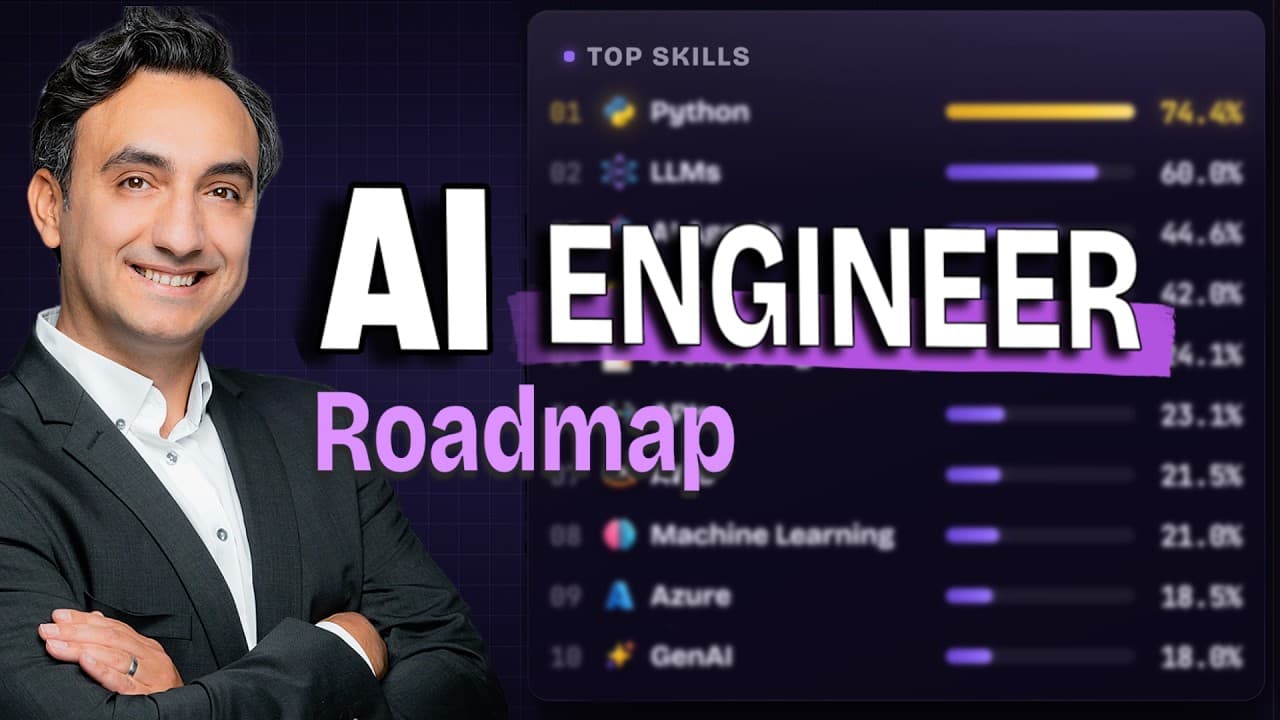
The AI engineer role centers on building AI powered systems, not training models. Key skills are Python and LLM usage, with focus also on AI agents and retrieval augmented generation. Deployment, monitoring, and evaluation in production are essential differentiators for real job success.
Transcript
I've spent two months building an AI system that runs daily and collect every data and AI job ads. And now I use it in order to understand how the job market is moving. So now, instead of just analyzing 10 jobs, the system collected over 40k jobs from more than [music] 10,000 companies in 100 countries. And more than 4,000 of them are actually sear... Read More
Key Insights
- Python is the most important programming skill for AI engineers.
- LLMs are the next critical capability after Python for AI applications.
- AI agents connect models to tools to take actions in real workflows.
- DRAG stands for retrieval augmented generation, enabling informed responses from document pools.
- Learning should focus on building AI powered applications rather than training models from scratch.
- Deployment and production readiness are essential skills for AI engineers.
- Familiarity with one framework (LangChain or LangGraph) and one provider (GPT or Claude) is advised.
- Cloud deployment, APIs, CI/CD, and Docker are important for real world success.
Install to Summarize YouTube Videos and Get Transcripts
Explore YouTube Video Summarizer or Get YouTube Transcript Extractor
Questions & Answers
Q: What is the core definition of an AI engineer according to the video
An AI engineer is a software engineer who builds applications using AI models and includes data engineering to feed data into their systems. They are expected to create end to end AI powered applications, integrate with tools through agents, and deploy these solutions in production, rather than focusing on training models from scratch.
Q: Why are Python and LLMs highlighted as must have skills
Python is highlighted as the foundational programming language because the entire workflow and tooling relies on it. LLMs are the next most important capability because they enable the AI components to understand and generate language, which is central to building AI driven applications. Together they form the core skill set for AI engineers.
Q: What is DRAG in the context of AI engineering
DRAG stands for retrieval augmented generation. It is the concept of having the AI system search a company's documents or data sources and then feed the relevant information to the model before it generates a response, improving accuracy and relevance of outputs in real world applications.
Q: What does the video say about learning versus training models
The video emphasizes that becoming an AI engineer is not about training models from scratch or becoming a data scientist. Instead, the goal is to build AI systems and applications that use existing models, integrate with tools, and deploy them effectively, focusing on engineering rather than theoretical model development.
Q: What deployment practices are considered essential for AI engineers
Deployment practices highlighted include deploying to production environments, maintaining the system, monitoring for issues, and being able to fix problems when something breaks. The speaker notes many learners skip deployment, which is a critical differentiator in a real job and makes you stand out as an engineer.
Q: What tools and platforms are recommended to learn for AI engineering
The recommendation is to pick one framework like LangChain or LangGraph for building agents, and learn either GPT or Claude as your model provider. For cloud and deployment, focus on a single cloud platform such as AWS and learn APIs, CI/CD, and Docker to ensure production readiness.
Q: What are the top tasks AI engineers are expected to perform
The top tasks include building the LLM application, creating AI agents to automate workflows, deploying and running the system in the cloud, and evaluating performance with benchmarks to ensure trust and reliability. These tasks reflect both development and operational responsibilities in real projects.
Q: What is the suggested learning path in the video
A practical learning path begins with Python fundamentals, followed by an Associate AI Engineer for Developers track to cover LLMs, agents, Rag, and deployment concepts. The plan then guides learners toward broader AI engineering competencies and demonstrates how to apply these in real projects, including hands on coding and projects.
Summary & Key Takeaways
-
A data driven view of AI engineer demand shows Python and LLM skills top the list, with agents and RAG as core concepts. The video argues that practical deployment and production readiness are what separate engineers from hobbyists.
-
The roadmap emphasizes not training models from scratch, but building end to end AI powered applications that deploy to the cloud with robust monitoring and evaluation.
-
A clear career path is presented with recommended learning tracks and tools, plus advice on which frameworks and providers to focus on for market relevance.
Read in Other Languages (beta)
Share This Summary 📚
Summarize YouTube Videos and Get Video Transcripts with 1-Click
Try YouTube Summary with ChatGPT & Claude or YouTube Transcript Generator
Explore More Summaries from Data with Baraa 📚


Summarize YouTube Videos and Get Video Transcripts with 1-Click
Try YouTube Summary with ChatGPT & Claude or YouTube Transcript Generator