How to Build a SQL Data Warehouse from Scratch
TL;DR
Learn to build a modern SQL data warehouse from scratch, focusing on practical skills for real-world applications. The project covers designing data architecture, implementing ETL processes, and creating a professional portfolio. By the end, you'll have a solid understanding of data warehousing concepts and hands-on experience with SQL Server.
Transcript
hey friends so today we are diving into something very exciting Building Together modern SQL data warehouse projects but this one is not any project this one is a special one not only you will learn how to build a modern Data Warehouse from the scratch but also you will learn how I implement this kind of projects in Real World Companies I'm bar zin... Read More
Key Insights
- A SQL data warehouse is a structured system for organizing and analyzing data from multiple sources.
- ETL (Extract, Transform, Load) is a critical process in data warehousing for moving and transforming data.
- Data warehouses support business decision-making by providing integrated, historical, and non-volatile data.
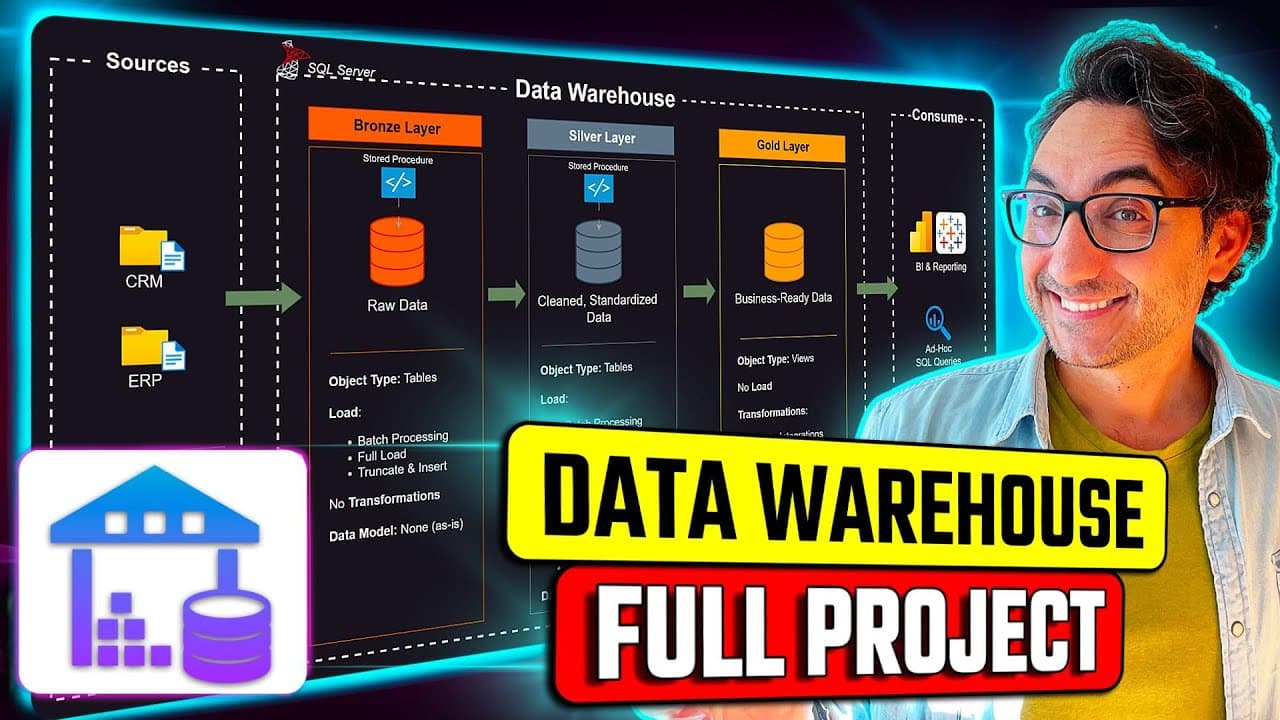
- The Medallion architecture involves three layers: Bronze (raw data), Silver (cleaned data), and Gold (business-ready data).
- Data modeling techniques like star schema and snowflake schema are crucial for organizing data in a warehouse.
- Data quality is ensured by validating data completeness and schema accuracy during the ETL process.
- Stored procedures in SQL help automate and manage complex data loading operations.
- A well-documented project plan and naming conventions are essential for maintaining consistency and clarity.
Install to Summarize YouTube Videos and Get Transcripts
Explore YouTube Video Summarizer or Get YouTube Transcript Extractor
Questions & Answers
Q: How to design a SQL data warehouse architecture?
Designing a SQL data warehouse architecture involves choosing the appropriate data management approach, such as a data warehouse, data lake, or data lakehouse. For a data warehouse, decide on the structure, such as the Medallion architecture with Bronze, Silver, and Gold layers. Each layer has specific tasks, from storing raw data to providing business-ready data, ensuring a well-organized and scalable system.
Q: What is the role of ETL in data warehousing?
ETL (Extract, Transform, Load) plays a crucial role in data warehousing by facilitating the movement and transformation of data from source systems to the data warehouse. The process involves extracting data, performing necessary transformations to clean and standardize it, and loading it into the warehouse. This ensures data is accurate, consistent, and ready for analysis and reporting.
Q: Why is data quality important in a data warehouse?
Data quality is essential in a data warehouse because it directly impacts the accuracy and reliability of business intelligence and decision-making. Ensuring data completeness and schema accuracy during the ETL process helps prevent errors and inconsistencies. High-quality data allows for meaningful analysis, leading to better insights and informed business decisions.
Q: What are the benefits of using stored procedures in SQL?
Stored procedures in SQL offer several benefits, including automation of repetitive tasks, encapsulation of complex logic, and improved performance. They help manage data loading operations efficiently, reduce code redundancy, and enhance security by controlling access to data. Stored procedures also facilitate easier maintenance and updates to the ETL process.
Q: How does the Medallion architecture organize data in a warehouse?
The Medallion architecture organizes data into three layers: Bronze, Silver, and Gold. The Bronze layer stores raw data as it is from the source, the Silver layer contains cleaned and standardized data, and the Gold layer provides business-ready data for analysis and reporting. This structure ensures data traceability, quality, and readiness for consumption by different business users.
Q: What is the importance of data modeling in a data warehouse?
Data modeling is crucial in a data warehouse as it defines how data is structured and organized for efficient access and analysis. Techniques like star schema and snowflake schema help create a logical framework for data storage, ensuring consistency, scalability, and performance. Proper data modeling supports effective business intelligence and facilitates insightful data analysis.
Q: How can SQL data warehouses support business decision-making?
SQL data warehouses support business decision-making by providing a centralized, integrated, and historical view of data. They enable organizations to analyze trends, generate reports, and gain insights into business performance. By organizing data in a structured manner, data warehouses facilitate informed decision-making, strategic planning, and operational improvements.
Q: What are the key components of a successful data warehouse project?
Key components of a successful data warehouse project include a well-defined data architecture, effective ETL processes, and robust data modeling. Additionally, ensuring data quality, following naming conventions, and maintaining thorough documentation are essential. Using tools like SQL Server for database management and implementing stored procedures for automation contribute to project success.
Summary & Key Takeaways
-
Building a SQL data warehouse involves designing a data architecture that organizes and integrates data for analysis. The process includes creating ETL scripts to load data from source systems, ensuring data quality, and documenting the project. By following best practices, you can create a robust data warehouse that supports business intelligence and decision-making.
-
The Medallion architecture, involving Bronze, Silver, and Gold layers, helps structure data warehousing projects. Each layer serves a distinct purpose, from storing raw data to preparing business-ready data. This approach ensures data integrity, traceability, and scalability.
-
Key components of data warehousing include understanding source systems, defining naming conventions, and using tools like SQL Server for database management. Effective data modeling and documentation are crucial for building a system that meets business needs and facilitates data-driven insights.
Read in Other Languages (beta)
Share This Summary 📚
Summarize YouTube Videos and Get Video Transcripts with 1-Click
Try YouTube Summary with ChatGPT & Claude or YouTube Transcript Generator
Explore More Summaries from Data with Baraa 📚






Summarize YouTube Videos and Get Video Transcripts with 1-Click
Try YouTube Summary with ChatGPT & Claude or YouTube Transcript Generator