How Do You Build a SQL Data Analyst Portfolio Project Like I Do in My Real Projects?
TL;DR
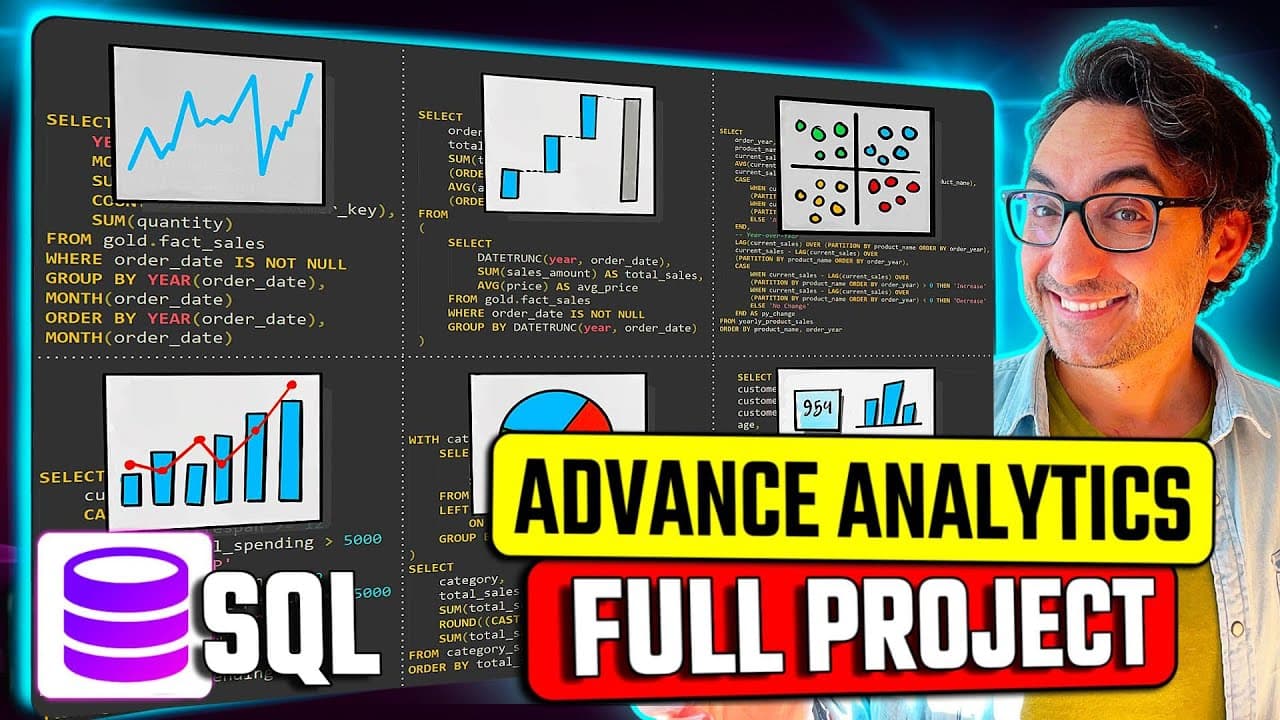
Build a SQL data analyst portfolio project by preparing customer, product, and sales tables, then using advanced SQL to analyze trends, performance, and segments. The project applies window functions, CTEs, and subqueries before combining the analysis into two large report queries for business requirements. Read on for the database setup options and core analysis workflow.
Transcript
hi friends so now we're going to take things to the next level where we're going to do Advanced analytics projects using Advanced SQL techniques my name is bar and I lead Big Data projects in big companies so that means I'm sharing with you not only Theory but as well real life skills so now we're going to do different types of analyzis on our data... Read More
Key Insights
- Advanced SQL analytics is the stage where complex queries answer business questions about trends, performance comparisons, data segmentation, and stakeholder reporting. The project applies window functions, common table expressions, and subqueries before combining the work into two large report queries.
- Data warehousing is the foundation that organizes, structures, and prepares information for analysis. A previously completed warehouse already provides the required database and data, while participants who skipped that project can use the supplied scripts, CSV files, or database backup.
- Exploratory data analysis is a separate project type focused on understanding datasets and uncovering insights. It teaches analysts how to ask appropriate questions and find answers with basic SQL before they move into more advanced business analysis and reporting work.
- The project database is created most directly by running the initialization script from the master database. The script creates a database, a schema, and three important tables, but its file paths must be changed to match the location of the downloaded project files.
- CSV importing is an alternative database setup method available through SQL Server's flat-file import workflow. The process requires selecting the gold-table CSV files, allowing null values to avoid errors, and repeating the import for all three tables used by the project.
- Database restoration is another setup option that uses the supplied backup file. The file must be copied into the relevant SQL Server backup location, after which the restore-database workflow can load the complete database without executing the initialization scripts.
- Change-over-time analysis is a technique for examining how a measure evolves across a date dimension. Combining an aggregated metric, such as total sales or average cost, with a year or month makes business trends and possible seasonality easier to identify.
- Yearly sales analysis works by filtering out null order dates, summing sales amounts, grouping records by the year extracted from each order date, and sorting chronologically. Distinct customer counts and summed quantities can then be added to expand the performance view.
Install to Summarize YouTube Videos and Get Transcripts
Explore YouTube Video Summarizer or Get YouTube Transcript Extractor
Questions & Answers
Q: How do you build an advanced SQL data analyst portfolio project?
Start with customer, product, and sales data in SQL Server. Use advanced SQL techniques to track changes over time, measure performance, segment customers and products, and answer business questions. The project concludes by combining the analysis into two large queries that generate two reports.
Q: What types of SQL data analytics projects are covered?
The three types are data warehousing, exploratory data analysis, and advanced analytics. Data warehousing organizes and prepares data, while exploratory analysis uses basic SQL to understand datasets and uncover insights. Advanced analytics uses complex queries to examine trends, compare performance, segment data, and generate reports.
Q: Which advanced SQL techniques does the project use?
The project uses advanced window functions, common table expressions, and subqueries. These techniques support complex SQL queries that answer real business questions and produce reports from the prepared datasets.
Q: How can you create the SQL Server database for this project?
You can execute the supplied initialization script, create a database and import the CSV files through the flat-file workflow, or restore the supplied database backup. The presenter recommends using the script, while the other methods are alternatives if that approach does not work.
Q: How do you run the database initialization script?
Open the init database file, copy its contents into a new SQL Server query, and switch to the master database. Change the file paths to match the downloaded project files, then execute the complete script. It creates the database, schema, and required tables and inserts the data.
Q: What tables are included in the project database?
The database contains customer, product, and sales tables. These are the three important tables created by the initialization script and used throughout the data analysis.
Q: How do you import the project CSV files into SQL Server?
Create a database, open Tasks, and select Import Flat File. Locate the gold-table CSV files, review the data, and allow null values to avoid errors. Repeat the import three times so every required table is loaded.
Q: What business questions does the SQL analytics project answer?
The project examines trends over time, compares performance, and segments customers and products into different sections. It then implements two business requirements and generates two reports for stakeholders using large SQL queries.
Summary & Key Takeaways
-
Definition: Data warehousing organizes, structures, and prepares data for analysis.
-
Definition: Exploratory data analysis helps analysts understand datasets, ask appropriate questions, and uncover insights using basic SQL.
-
Definition: Advanced analytics uses complex SQL queries to answer business questions about trends, performance, segmentation, and reporting.
-
Who: Bar leads big data projects in large companies and shares theory alongside real-life skills.
-
Tool: SQL Server hosts the project database, while Management Studio is used to write SQL queries.
-
Tool: Advanced window functions, common table expressions, and subqueries support the project analyses.
-
Number: Three database setup methods are provided: execute scripts, import CSV files, or restore the database backup.
-
Number: Three important tables support the analysis: customer, product, and sales.
-
Compare: The initialization script is recommended, while flat-file importing is an alternative if the script does not work.
-
Number: Two large SQL queries generate two reports based on business requirements.
Read in Other Languages (beta)
Share This Summary 📚
Summarize YouTube Videos and Get Video Transcripts with 1-Click
Try YouTube Summary with ChatGPT & Claude or YouTube Transcript Generator
Explore More Summaries from Data with Baraa 📚





Summarize YouTube Videos and Get Video Transcripts with 1-Click
Try YouTube Summary with ChatGPT & Claude or YouTube Transcript Generator