How to Become an AI Engineer in 2026: 4-Phase Roadmap
TL;DR
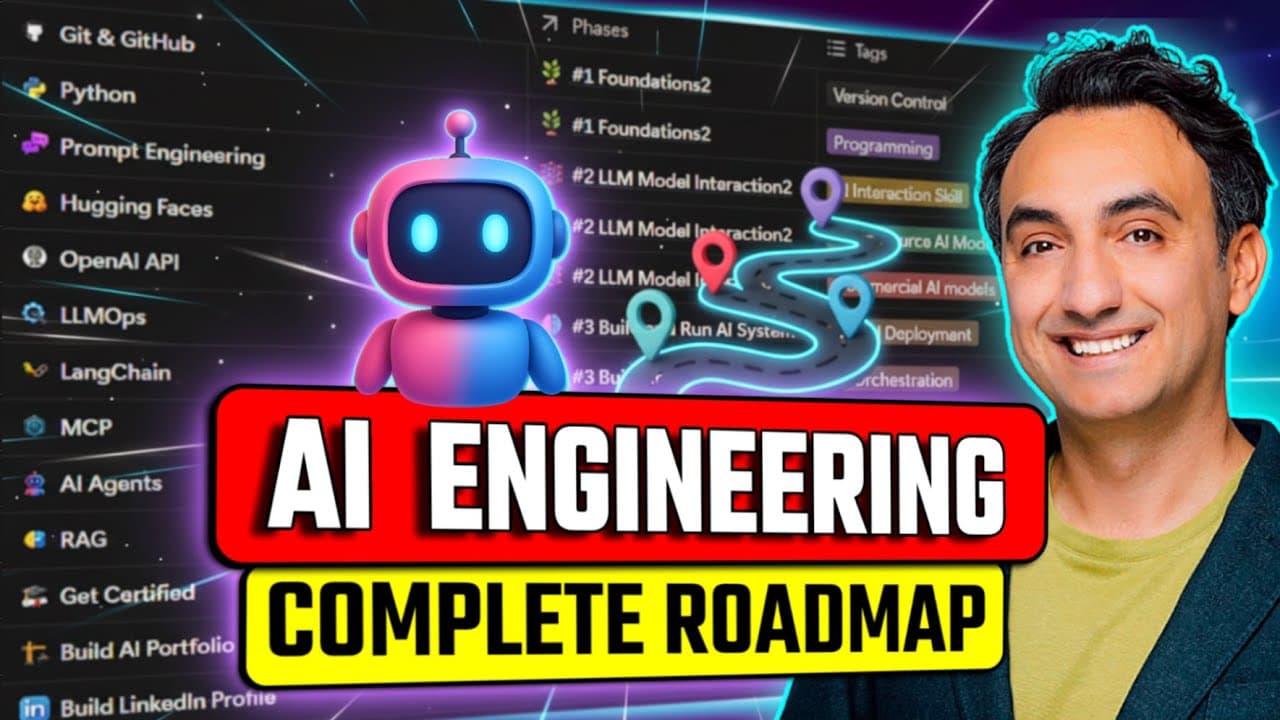
Becoming an AI engineer means learning to connect AI models, company data, tools, and interfaces into working systems, not training models from scratch. The roadmap runs four phases: foundations (Python and GitHub), LLM interaction (prompt engineering, the OpenAI API, Hugging Face), building full AI systems (LangChain and RAG), and finally a portfolio to get hired.
Transcript
Hey friends. So now a friend of mine called me and asked me, Barra, I want to become an AI engineer in 2026. What should I learn? What are the skills that's going to get me hired? So as usual, I went and drafted a road map for him. And I thought, why not sharing it with you? But of course, before we jump in, we going to answer quickly one question.... Read More
Key Insights
- An AI engineer is someone who builds systems that use AI to solve real business problems, not someone who trains models or builds a ChatGPT. Many roadmaps online mislabel data science content as AI engineering, sending learners toward mathematics, algorithms, and model training theory that companies are not hiring for.
- An AI system has four component groups: AI models such as OpenAI models or ones from Hugging Face, the company's data in databases, files, and documents, the company's tools and apps such as email and internal services, and interfaces where users interact with the system.
- The core job of an AI engineer is connecting those components in one place and making the result correct, secure, fast, scalable, and cost efficient. The value comes from integration quality rather than from novel model research.
- Python is the primary language because almost everything in AI systems, including tools, libraries, and models, is written in it. In real projects it cleans data, connects APIs, deploys models, and automates pipelines, so the four priorities are data structures and loops, functions and modules, file and JSON handling, and API requests.
- Storing Python files only on your own PC is risky because you might lose them. GitHub solves version management, sharing with employers or colleagues during job applications and collaboration, and working on your code from anywhere, so repositories, commits, pulls, merges, and branches should be learned from day one.
- Prompt engineering is the most underrated skill and works by giving detailed instructions and context, telling the model who it is and what its role is, showing examples of the wanted result, then reviewing each answer and improving the prompt step by step over time.
- Complaints about bad results and hallucinations usually trace back to the prompt itself, which is typically one very short sentence. Garbage prompts produce garbage results, so configuring the model to match business requirements is part of the engineering work, not an afterthought.
- OpenAI models are closed source, which means no control over the model, no visibility into how it works, high per-token costs, and company data leaving your environment unless you use Azure. Hugging Face answers this with over two million mostly free models that can be downloaded and deployed where the data lives.
Install to Summarize YouTube Videos and Get Transcripts
Explore YouTube Video Summarizer or Get YouTube Transcript Extractor
Questions & Answers
Q: What is AI engineering and how is it different from data science?
An AI engineer builds systems that use AI to solve real business problems. That means you are not building a ChatGPT and you are not training a model from scratch. Instead you assemble an AI system from AI models, the company's data in databases, files, and documents, the company's tools and apps such as email and internal services, and interfaces where users interact with the system. Much of the roadmap content online is actually data science, pushing mathematics, algorithms, model training, and theory. Companies do not need another data scientist, they need someone who can connect these pieces and make the result correct, secure, fast, scalable, and cost efficient.
Q: What are the four phases of the AI engineering roadmap?
The roadmap is organized in a Notion template with four phases. Phase one is foundations, covering core coding and how to collaborate with others on AI projects. Phase two is LLM interaction, where you learn to communicate with AI models and integrate them into your apps. Phase three is the big one, where you learn to build and run a whole AI system, including orchestration and retrieval. Phase four is all about building your portfolio, showing your work online, and getting hired. Each phase builds on the previous one, so foundations come before model integration and integration comes before full system construction.
Q: Why is Python the first language to learn for AI engineering?
Python is the primary programming language for AI engineering because almost everything you see in AI systems, including tools, libraries, and models, is written in Python. In real projects Python is used to clean up data, connect APIs, deploy models, and automate pipelines, so it becomes the foundation for building any AI system. Four areas deserve focus: data structures and loops, functions and modules so your code is reusable, handling files and especially the JSON format, and making API requests so your apps can connect to AI models. As an AI engineer the language choice is clear, master Python.
Q: How should an AI engineer use GitHub?
Storing your Python files on your own PC is risky because you might lose them. GitHub instead manages different versions of your code, lets you share it when applying for jobs or collaborating with colleagues on projects, and lets you work on your code from anywhere. The specific skills to learn are creating a repository, pushing your code, making commits with clear messages, pulling and merging changes, and creating branches for new work. Learning all of this from day one is what makes you professional rather than someone who picks up version control later under pressure.
Q: What makes a good prompt in prompt engineering?
Prompt engineering is not just typing something into ChatGPT and hoping for a good answer, there is a real skill behind communicating so the model understands exactly what you want. A good prompt gives detailed and clear instructions plus context, tells the model who it is and what its role is, and shows examples of the results you want. Then you review each answer you get and improve the prompt step by step, which can mean refining one prompt over a year until it produces exactly what you expect. When people complain that results are bad and full of hallucinations, their prompt is usually just one very short sentence.
Q: Why use the OpenAI API instead of just the ChatGPT browser interface?
Using your browser to interact with the AI is fine, but the real capability starts when you use the model behind ChatGPT through the OpenAI API. The API gives you access to the same model with one big difference: it runs inside your own app, your own website, and your own products. That lets you build chatbot assistants directly inside your tools with just a few lines of Python, sending a prompt, getting a response, and displaying it wherever you want. The skills to focus on are setting up your API keys, sending structured prompts with rules and context, and handling cost carefully through token usage.
Q: Why should AI engineers use Hugging Face models instead of relying only on OpenAI?
OpenAI models are closed source, which means you have no control over the model, you cannot see exactly how it works, you pay a lot in tokens every time, and unless you are using Azure your company data leaves your environment, which is a serious problem for many businesses. Hugging Face is the biggest community library for AI models with more than two million models available, most of them free, so you can find a model for almost any problem. You can download models locally to your machine and deploy them anywhere, which keeps you in control, allows sensitive data to stay in your environment, and reduces costs.
Q: What is LangChain used for in an AI system?
Being able to talk to AI models, write good prompts, and build cool demos is not enough to build an AI system, because you still need to connect everything together. LangChain orchestrates the whole process, connecting the models you need, the tools, the memory, and your business logic, so the AI can take multiple steps to complete a full task instead of returning one answer to one prompt. The learning path has four steps: understand core building blocks such as chains, tools, memory, and prompts, connect different models through LangChain, and build a mini workflow that solves a real problem. This is what moves you from demo builder to system builder.
Summary & Key Takeaways
-
An AI engineer builds systems that use AI to solve real business problems, which is different from a data scientist role. The job is not training models or building ChatGPT, but connecting AI models, company databases and documents, internal tools and apps, and user interfaces into one place, then making it correct, secure, fast, scalable, and cost efficient.
-
Phase one covers foundations: Python as the primary language, focused on data structures and loops, functions and modules for reusable code, file handling especially JSON, and API requests to connect apps to AI models. GitHub follows, covering repositories, pushing code, clear commit messages, pulling and merging, and branching for new work.
-
Phase two covers LLM interaction. Prompt engineering means giving detailed instructions and context, assigning the model a role, showing examples of the wanted output, and iterating on results. The OpenAI API moves work from the browser into your own apps, and Hugging Face offers over two million mostly free models you can download and run locally.
-
Phase three builds the whole AI system. LangChain orchestrates models, tools, memory, and business logic so the AI can take multiple steps to complete a full task rather than answering a single prompt. RAG follows, because AI models are pre-trained on public data while company data stays protected and unavailable publicly. Phase four is portfolio building and getting hired.
Read in Other Languages (beta)
Share This Summary 📚
Summarize YouTube Videos and Get Video Transcripts with 1-Click
Try YouTube Summary with ChatGPT & Claude or YouTube Transcript Generator
Explore More Summaries from Data with Baraa 📚



Summarize YouTube Videos and Get Video Transcripts with 1-Click
Try YouTube Summary with ChatGPT & Claude or YouTube Transcript Generator