What Is SQL and How Does It Work with Databases?
TL;DR
SQL is the language used to ask questions of a database and receive results quickly. Databases organize, secure, and manage much larger amounts of data than ordinary files or spreadsheets, while a database management system handles requests and permissions. Relational databases arrange data in connected tables made of columns, rows, cells, primary keys, and defined data types.
Transcript
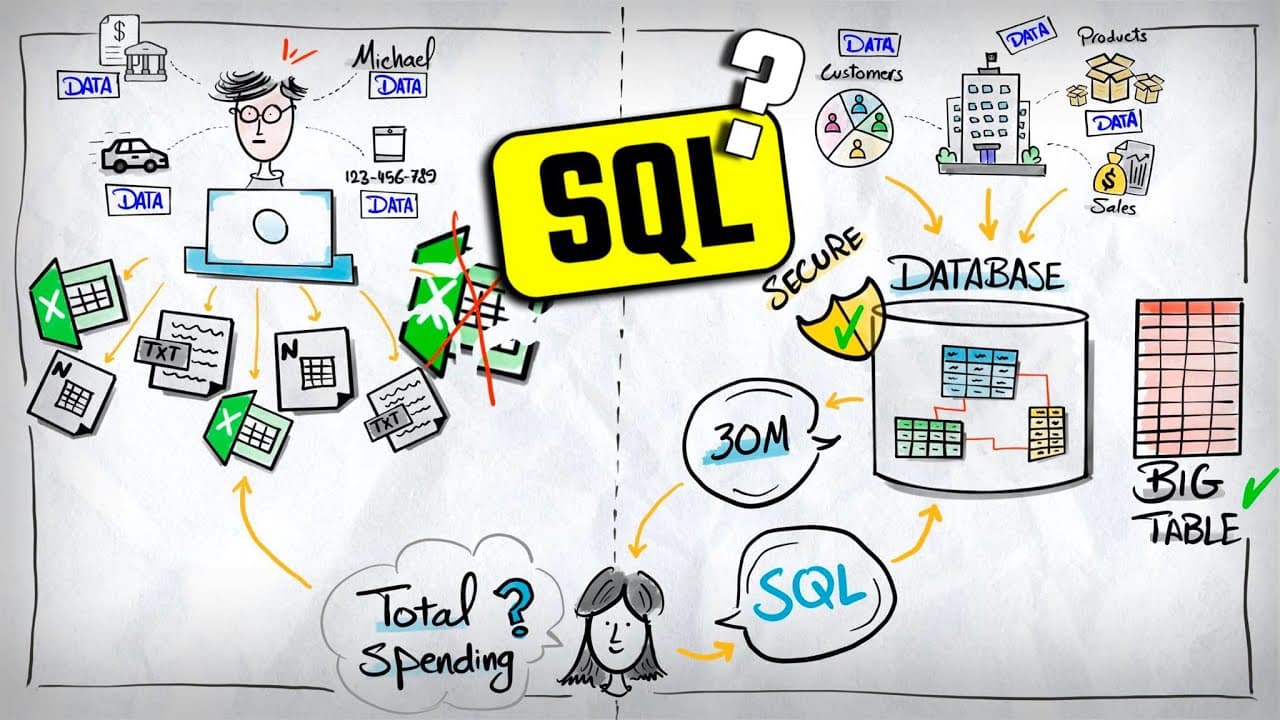
so what is exactly SQL everything generate data and data is everywhere your first name is data your mobile and everything inside the mobile is data car is as well generating a lot of data Bank your Finance statements everything is data and now of course the question is where do we store our data personally we store a lot of our data in like excels ... Read More
Key Insights
- SQL is a language for communicating with databases. Its name stands for Structured Query Language, and it allows users or software to submit questions about stored data and receive results without manually opening, searching, and combining many separate files.
- A database is an organized container for storing data. Unlike a collection of files placed in folders, it structures information so that the data is easier to access, manage, and search when people or systems need answers.
- Databases are better suited than spreadsheets for massive amounts of data. The transcript describes company databases containing millions of data items, while spreadsheets can fail when their stored data becomes too large to handle effectively.
- Database security controls who can access specific information. Important or critical data can be stored more safely in a database than in ordinary spreadsheets and files because access to the stored information and submitted requests can be managed.
- A database management system manages the database and its incoming SQL requests. It can prioritize which SQL statement should execute first and determine whether a request is authorized before allowing it to run against the stored data.
- A server is the physical machine where a database lives. Companies use servers because ordinary personal computers may be too weak or go offline, while a server is powerful, remains available continuously, and may operate inside the company or through cloud services.
- Relational databases store information in rows and columns across connected tables. Other database types organize information as key-value pairs, columns, graphs, or documents, with each structure emphasizing a different way to store, connect, or search data.
- A relational database follows an organized hierarchy from server to database, schema, and table. Within tables, columns define stored attributes, rows hold individual records, primary keys uniquely identify records, and data types specify whether values are integers, decimals, characters, dates, or times.
Install to Summarize YouTube Videos and Get Transcripts
Explore YouTube Video Summarizer or Get YouTube Transcript Extractor
Questions & Answers
Q: What is SQL and what is it used for?
SQL stands for Structured Query Language. It is used to communicate with a database by sending questions or requests and receiving results. Instead of opening multiple files, searching each one, and manually combining information, a user can write SQL that asks the database for the required data. Employees, applications, websites, dashboards, and reporting tools can all generate SQL requests.
Q: Why do companies use databases instead of files?
Companies produce massive amounts of data through products, customers, sales, and other activities, so simple files are difficult to search and combine efficiently. A database organizes that information for easier access, management, and searching. It can also handle millions of data items, provide stronger security for important information, and control who is allowed to access particular data.
Q: What is a database management system?
A database management system, identified in the transcript as a DBMS, is software that manages a database and the requests sent to it. When employees, websites, applications, dashboards, and reporting tools generate many SQL statements, the DBMS decides which request should execute first. It also manages security by checking whether a submitted SQL request is permitted to run.
Q: How do SQL, a database, a DBMS, and a server differ?
A database is the organized container that stores data, while SQL is the language used to communicate with that container. A DBMS is the software that manages the database, prioritizes incoming SQL requests, and checks permissions. A server is the powerful physical machine where the database lives, either inside a company or through cloud services, and it remains continuously available.
Q: What are the main types of databases described?
The transcript describes five database types: relational, key-value, column-based, graph, and document databases. Relational databases use connected tables with rows and columns. Key-value databases use paired keys and values, column-based systems group information by columns, graph databases emphasize relationships among objects, and document databases store information as complete documents where fitting related information together is more important than a rigid structure.
Q: How is a relational database organized?
A relational database begins with a server, which can host multiple databases for areas such as sales or human resources. Each database can contain multiple schemas. A schema acts as a logical category that groups related objects, including tables. Each table then organizes information into columns and rows, allowing related tables to be connected and managed within a structured hierarchy.
Q: What are columns, rows, cells, and primary keys?
Columns define the kinds of information stored in a table, such as a customer identifier, name, score, or birthday, and they may also be called fields. Rows, also called records, contain the actual data for individual entities such as customers. A cell is the intersection of a row and column. A primary key is a unique identifier for each record, comparable to a fingerprint.
Q: What data types can a relational table store?
A table assigns data types according to the information each column stores. Integers hold whole-number values, while decimals hold values containing decimal points. Character types store text such as names or descriptions. CHAR reserves a fixed amount of character space, while VARCHAR is dynamic. Date and time types store information such as birth dates and specific time values.
Summary & Key Takeaways
-
Databases provide organized containers for data produced by customers, products, sales, finances, devices, and other sources. Compared with searching through separate files, a database makes information easier to access, manage, search, and combine. It can also handle massive datasets and control which people or systems may access particular information.
-
SQL stands for Structured Query Language and enables people, websites, applications, dashboards, and reporting tools to communicate with databases. A database management system manages these requests, determines execution priority, and checks whether an SQL request is permitted. The database normally runs on an always-available server located within a company or through cloud services.
-
Relational databases organize data into related tables, while NoSQL categories include key-value, column-based, graph, and document databases. A relational system follows a hierarchy of server, database, schema, and table. Tables contain columns and rows, use primary keys as unique identifiers, and assign data types such as integer, decimal, character, date, and time.
Read in Other Languages (beta)
Share This Summary 📚
Summarize YouTube Videos and Get Video Transcripts with 1-Click
Try YouTube Summary with ChatGPT & Claude or YouTube Transcript Generator
Explore More Summaries from Data with Baraa 📚






Summarize YouTube Videos and Get Video Transcripts with 1-Click
Try YouTube Summary with ChatGPT & Claude or YouTube Transcript Generator