What Makes Argentinian Spanish Unique?
TL;DR
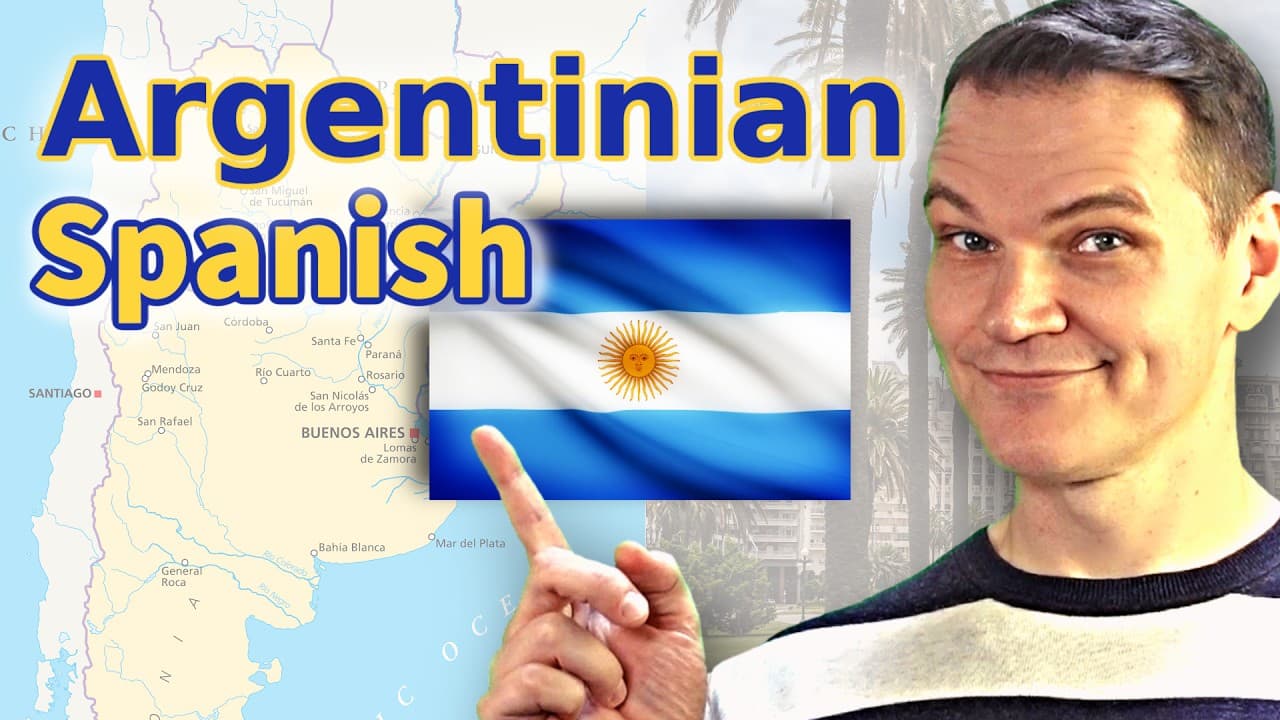
Argentinian Spanish, specifically Rio Platense, is distinct due to the influence of indigenous languages and Italian immigrants, which shape its unique vocabulary and pronunciation. Key features include the use of 'vos' instead of 'tú', unique verb conjugations, and the pronunciation of 'LL' and 'Y' as 'sh'. While it has its differences, its core grammar remains similar to other Spanish dialects.
Transcript
there are many varieties of Spanish spoken throughout the world which all share the same Common Core but also have some of their own features two of the varieties that are often said to be the most unique or different from others are Chilean Spanish and Argentinian Spanish spoken in the southern cone of South America I've already covered Chilean Sp... Read More
Key Insights
- Rio Platense Spanish, spoken in Argentina and Uruguay, has unique features influenced by indigenous languages and Italian immigrants.
- Indigenous languages like Quechua, Guarani, and Mapuche have contributed words to Rio Platense Spanish, such as 'tambo' and 'chajá'.
- Italian immigrants significantly influenced Rio Platense Spanish, especially in its intonation and slang, known as Lunfardo.
- The pronunciation of 'LL' and 'Y' as 'sh' is a notable feature of Rio Platense Spanish, distinguishing it from other Spanish dialects.
- The use of 'vos' instead of 'tú' for the second person singular pronoun is common in Rio Platense Spanish, with unique verb conjugations.
- Lunfardo, originally prison slang, has permeated Rio Platense Spanish, adding unique vocabulary like 'mina' and 'laburo'.
- Rio Platense Spanish features aspirated 's' sounds before consonants, altering pronunciation in certain contexts.
- Despite its distinct features, Rio Platense Spanish shares core grammar with other Spanish dialects, making it similar overall.
Install to Summarize YouTube Videos and Get Transcripts
Explore YouTube Video Summarizer or Get YouTube Transcript Extractor
Questions & Answers
Q: What are the origins of Rio Platense Spanish?
Rio Platense Spanish originated in the River Plate Basin area, influenced by indigenous languages such as Quechua, Guarani, and Mapuche, and later by Italian immigrants. These influences have shaped its vocabulary, pronunciation, and intonation, making it distinct from other Spanish dialects.
Q: How did Italian immigrants influence Rio Platense Spanish?
Italian immigrants influenced Rio Platense Spanish by contributing to its intonation, making it sound more 'sing-song'. They also introduced Lunfardo, a slang originally used among prison inmates, which has become part of everyday speech. Words like 'mina' and 'laburo' are examples of Lunfardo with Italian roots.
Q: What is Lunfardo in Rio Platense Spanish?
Lunfardo is a slang language that originated among prison inmates in Argentina to avoid detection by guards. It has Italian roots, reflecting the influence of Italian immigrants. Over time, Lunfardo spread to the general population, enriching Rio Platense Spanish with unique vocabulary like 'mina' for woman and 'laburo' for work.
Q: What phonetic features distinguish Rio Platense Spanish?
Rio Platense Spanish is distinguished by the pronunciation of 'LL' and 'Y' as 'sh', unlike the typical 'y' or 'j' sounds in other Spanish dialects. Additionally, the 's' sound is often aspirated before consonants, giving it a unique phonetic profile. These features contribute to its distinctiveness.
Q: How does the use of 'vos' differ in Rio Platense Spanish?
In Rio Platense Spanish, 'vos' replaces 'tú' as the informal second person singular pronoun. This includes unique verb conjugations, such as 'vos sos' instead of 'tú eres'. The use of 'vos' extends to both informal and formal contexts, making it a prominent feature of the dialect.
Q: What role did indigenous languages play in Rio Platense Spanish?
Indigenous languages like Quechua, Guarani, and Mapuche have contributed words to Rio Platense Spanish, enriching its vocabulary. Examples include 'tambo' for dairy farm and 'chajá' for a type of bird. These words reflect the historical presence and influence of indigenous cultures in the region.
Q: Is Rio Platense Spanish difficult for other Spanish speakers to understand?
Rio Platense Spanish can be challenging for other Spanish speakers due to its unique vocabulary, pronunciation, and use of Lunfardo slang. However, its core grammar remains similar to other Spanish dialects, which helps mitigate comprehension difficulties once speakers become accustomed to its distinct features.
Q: What makes Rio Platense Spanish similar to other Spanish dialects?
Despite its unique features, Rio Platense Spanish shares core grammatical structures with other Spanish dialects, including verb conjugations and sentence construction. This commonality allows speakers of other Spanish varieties to understand and communicate effectively, even if they need to adjust to its distinct pronunciation and vocabulary.
Summary & Key Takeaways
-
Rio Platense Spanish, spoken in Argentina and Uruguay, is influenced by indigenous languages and Italian immigrants, resulting in unique vocabulary and pronunciation. It features the use of 'vos' instead of 'tú' and distinct verb conjugations. Lunfardo slang, with Italian roots, adds to its uniqueness.
-
The pronunciation of 'LL' and 'Y' as 'sh' and the aspirated 's' are key phonetic features of Rio Platense Spanish. Despite these differences, it shares fundamental grammar with other Spanish dialects, making it both unique and familiar to Spanish speakers.
-
The historical influences on Rio Platense Spanish include indigenous languages and Italian immigration, shaping its vocabulary and intonation. While it has unique features, such as Lunfardo slang and the 'vos' pronoun, it remains largely similar to other Spanish dialects in grammar.
Read in Other Languages (beta)
Share This Summary 📚
Summarize YouTube Videos and Get Video Transcripts with 1-Click
Try YouTube Summary with ChatGPT & Claude or YouTube Transcript Generator
Explore More Summaries from Langfocus 📚




Summarize YouTube Videos and Get Video Transcripts with 1-Click
Try YouTube Summary with ChatGPT & Claude or YouTube Transcript Generator