How to Implement the Backward Pass in Neural Networks
TL;DR
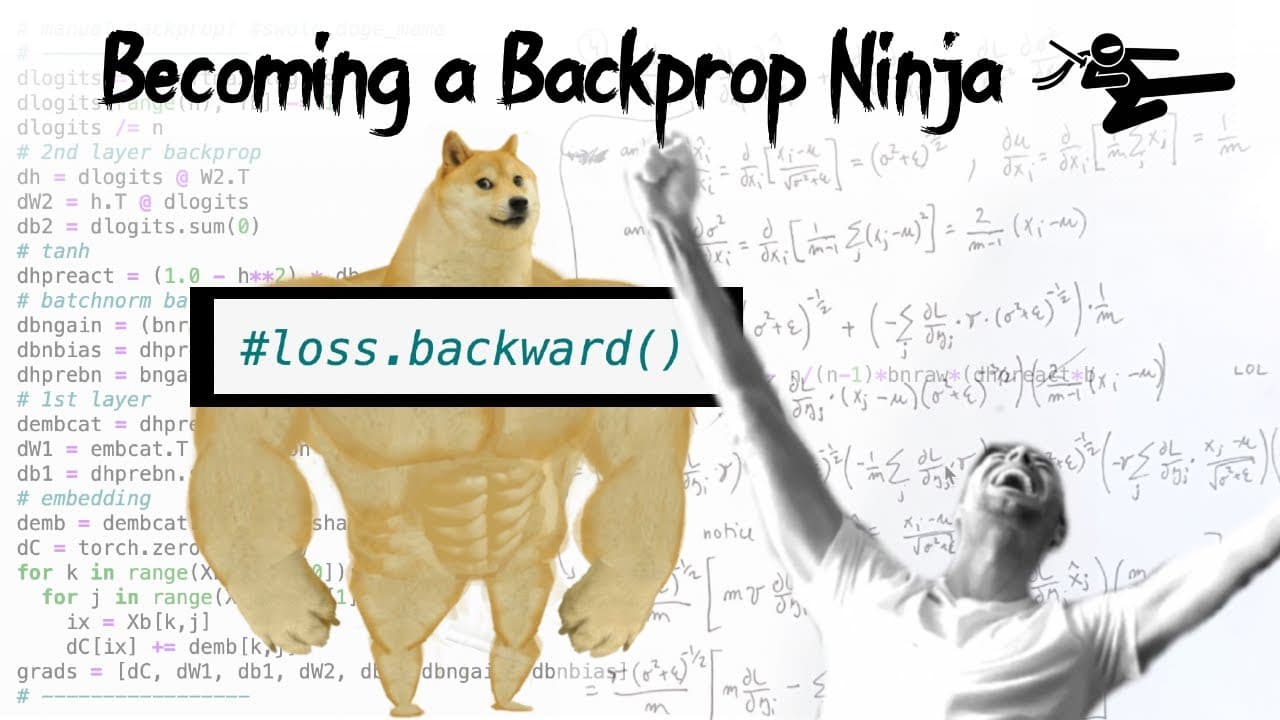
Manually implementing the backward pass in neural networks enhances debugging and deepens understanding of network architecture, helping to avoid issues like function saturation, dead neurons, and exploding or vanishing gradients. Although auto-grad engines like PyTorch are now standard, mastering the backward pass fosters better optimization techniques.
Transcript
hi everyone so today we are once again continuing our implementation of make more now so far we've come up to here montalia perceptrons and our neural net looked like this and we were implementing this over the last few lectures now I'm sure everyone is very excited to go into recurring neural networks and all of their variants and how they work an... Read More
Key Insights
- 🧑🦽 Manual implementation of the backward pass is valuable for debugging and optimizing neural networks.
- 💀 Understanding the internals of backpropagation helps address common issues such as function saturation and dead neurons.
- 🥺 Auto-grad engines like PyTorch provide convenience but may lead to a lack of understanding of the inner workings of the network.
Install to Summarize YouTube Videos and Get Transcripts
Explore YouTube Video Summarizer or Get YouTube Transcript Extractor
Questions & Answers
Q: Why is it important to manually implement the backward pass in neural networks?
Manual implementation of the backward pass allows for better debugging and a deeper understanding of the network architecture. It helps identify issues like function saturation, dead neurons, and exploding or vanishing gradients.
Q: How does manual implementation of the backward pass differ from using auto-grad engines like PyTorch?
Manual implementation requires understanding the internals of backpropagation and allows developers to have full control over the network. Auto-grad engines provide convenience but may hide important details about the working of backpropagation.
Q: What are some common issues that can be avoided by understanding the backward pass?
Some common issues that understanding the backward pass can help to avoid include function saturation, dead neurons, and the problem of exploding or vanishing gradients.
Q: Why was manually implementing the backward pass more common in deep learning a decade ago?
Before auto-grad engines like PyTorch became prevalent, manual implementation was the standard practice. It allowed for a better understanding of neural networks and troubleshooting potential issues.
Summary & Key Takeaways
-
The lecturer explores the importance of manually implementing the backward pass in neural networks.
-
Implementing the backward pass manually improves debugging capabilities and ensures a deeper understanding of network architecture.
-
It helps avoid common issues such as the saturation of functions, dead neurons, and exploding or vanishing gradients.
-
Manually implementing the backward pass was a standard practice in deep learning a decade ago but today, auto-grad engines like PyTorch are commonly used.
Read in Other Languages (beta)
Share This Summary 📚
Summarize YouTube Videos and Get Video Transcripts with 1-Click
Try YouTube Summary with ChatGPT & Claude or YouTube Transcript Generator
Explore More Summaries from Andrej Karpathy 📚





Summarize YouTube Videos and Get Video Transcripts with 1-Click
Try YouTube Summary with ChatGPT & Claude or YouTube Transcript Generator