What Would the Founding Fathers Think of Modern America?
TL;DR
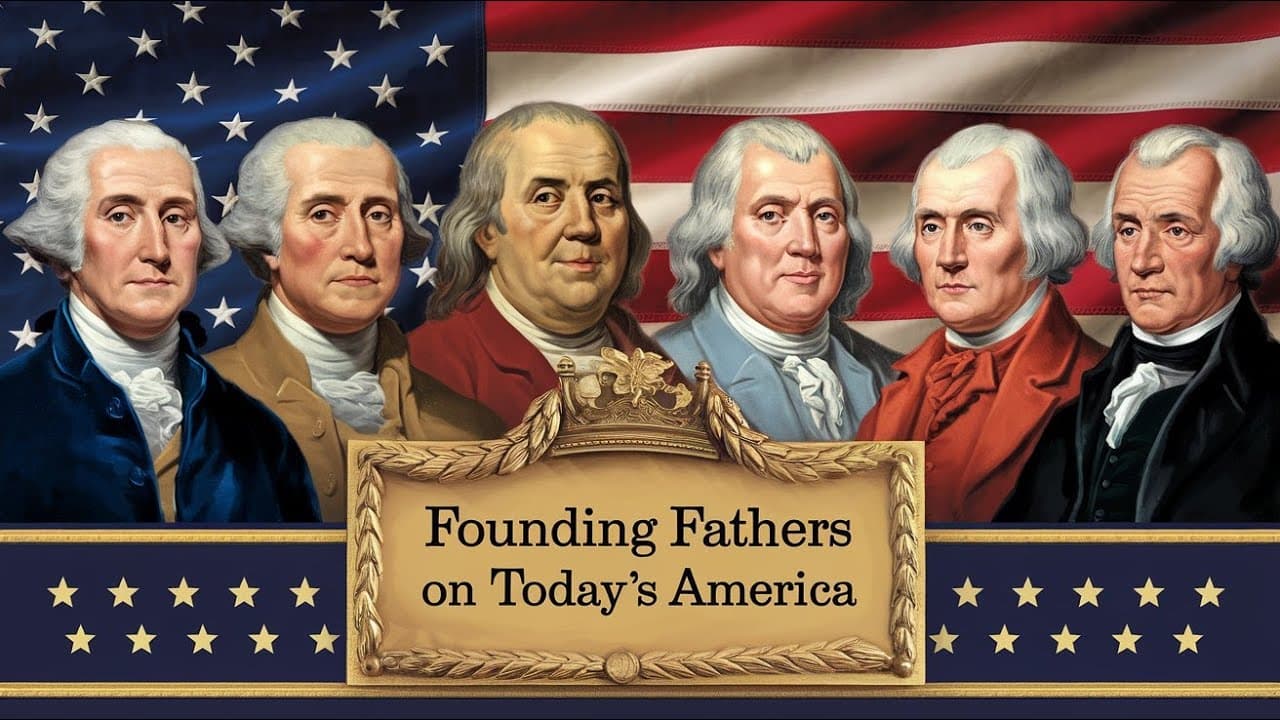
The Founding Fathers would likely find today's America a mix of pride and concern. They would appreciate the expansion of rights and the complexity of governance but question the concentration of federal power, the role of surveillance, and the influence of political parties and corporations on democracy. Additionally, they'd seek a revival of civic education that emphasizes moral virtues alongside technical skills.
Transcript
what the founding fathers would think of today's America written by 01 Pro and prompted by Andre carpy on December 16th 2024 chapter 1 the Constitutional framework under modern strain the founders conceived a constitutional order as a delicate balance of power among three branches of government they believe that each branch the executive the legisl... Read More
Key Insights
- ❓ The original constitutional framework established by the founders is experiencing strain under the pressures of modern federal authority and complexity.
- 🤙 The significant evolution in the relationship between individual privacy and government surveillance would likely concern the founders, prompting calls for enhanced protections.
- 🥳 The emergence of political parties, while inevitable, may divert focus from civic virtue and collaborative governance as envisioned by the founders.
- ✊ Modern economic dynamics, characterized by corporate concentration, necessitate reforms ensuring that market power does not overshadow the public interest.
- 😖 The founding principles of equality and civil rights continue to evolve, demonstrating both significant progress and persistent inequality in modern America.
- 🎓 The founders would advocate for a renaissance in civic education, emphasizing moral reasoning alongside technical skill development.
- 🥺 The enduring principle of religious freedom, coupled with the challenges of secularism and pluralism, would lead to advocacy for protecting diverse beliefs within the public square.
Install to Summarize YouTube Videos and Get Transcripts
Explore YouTube Video Summarizer or Get YouTube Transcript Extractor
Questions & Answers
Q: How did the founding fathers envision the balance of power among government branches?
The founders designed a system of checks and balances to ensure that no single branch—executive, legislative, or judicial—could dominate the others. This framework was underpinned by the belief that ambition would counteract ambition, preventing the concentration of power. However, modern complexities and expansions of federal authority have tested this balance, making the founders question if their intended restraints still function effectively today.
Q: What concerns might the founders have regarding contemporary surveillance practices?
The founders would likely express deep concern about the normalization of pervasive state surveillance in the digital age. They established constitutional safeguards against unreasonable searches and arbitrary intrusions, but would be alarmed by the scope of modern data collection and the blurred lines between state and corporate surveillance. They might advocate for the preservation of civil liberties while recognizing the state’s responsibility to protect national security.
Q: How would the founders react to the rise of political parties?
Initially skeptical of political factions, the founders would view the entrenched two-party system with disappointment. They believed that factionalism could hinder national unity and compromise. Today’s intense partisanship, where party loyalty supersedes collaborative governance, could lead the founders to suggest reforms that promote fluid coalitions and lessen the grip of money in politics, ensuring that public good remains the priority over party interests.
Q: In what ways might the modern economy challenge the founders' views on economic power?
The founders viewed economic liberty as essential for preserving democracy but could be perplexed by the scale and influence of modern corporations. They would likely express concerns about how concentrated corporate power undermines political representation and public interest. The founders might advocate for antitrust measures and greater accountability within the corporate framework to uphold economic opportunity and prevent monopolies that threaten citizen autonomy.
Q: How would the founders evaluate contemporary civil rights movements?
The founders would be both impressed by the progress made in civil rights and uneasy about the ongoing challenges to equality. While their principles of liberty and justice have inspired movements like the abolition of slavery and women's suffrage, they would likely stress the importance of continued vigilance to address inequalities that persist. They would recognize that the journey towards genuine equality is ongoing and requires active citizen engagement.
Q: What educational reforms might the founders advocate for today?
The founders would emphasize the importance of civic education as foundational for a self-governing republic. They would encourage curricula that foster critical thinking, moral reasoning, and respectful deliberation about public issues, rather than purely vocational training. They might argue for integrating the principles of democracy into lifelong learning, ensuring that citizens are well-informed and capable of defending their freedoms and responsibilities.
Q: How would the founders view the relationship between religion and state in modern America?
The founders would appreciate the religious pluralism in modern America but would caution against allowing any single faith to dominate public life. They might argue for a renewed commitment to maintaining government neutrality while safeguarding the free exercise of conscience. The challenge would be to embrace diversity without allowing it to fracture the public sphere, promoting respectful dialogue among different belief systems.
Q: What guidance might the founders offer regarding America’s role in global affairs?
The founders would caution against unchecked military expansion and entangling alliances, emphasizing the need for a foreign policy rooted in American values of liberty and morality. They would advocate for the restoration of Congressional authority over declarations of war and a careful weighing of international engagements to ensure they reflect the people's will. Their guidance would focus on maintaining a balance between national interests and moral principles in foreign relations.
Summary & Key Takeaways
-
The founders' vision of a balanced government has been strained by the modern complexities of federal power, executive discretion, and judicial intervention, leading them to question if their original blueprint still functions effectively.
-
Surveillance technologies and the digital age raise critical questions about individual liberty and privacy, with the founders likely advocating for stronger protections against government overreach while recognizing the need for national security.
-
Political parties, corporate powers, and evolving notions of equality challenge the founders' ideals of representation, with calls for reforms that ensure transparency, accountability, and genuine representation in modern governance.
Read in Other Languages (beta)
Share This Summary 📚
Summarize YouTube Videos and Get Video Transcripts with 1-Click
Try YouTube Summary with ChatGPT & Claude or YouTube Transcript Generator
Explore More Summaries from Andrej Karpathy 📚






Summarize YouTube Videos and Get Video Transcripts with 1-Click
Try YouTube Summary with ChatGPT & Claude or YouTube Transcript Generator