How to Implement a Multi-Layer Perceptron for Character Prediction
TL;DR
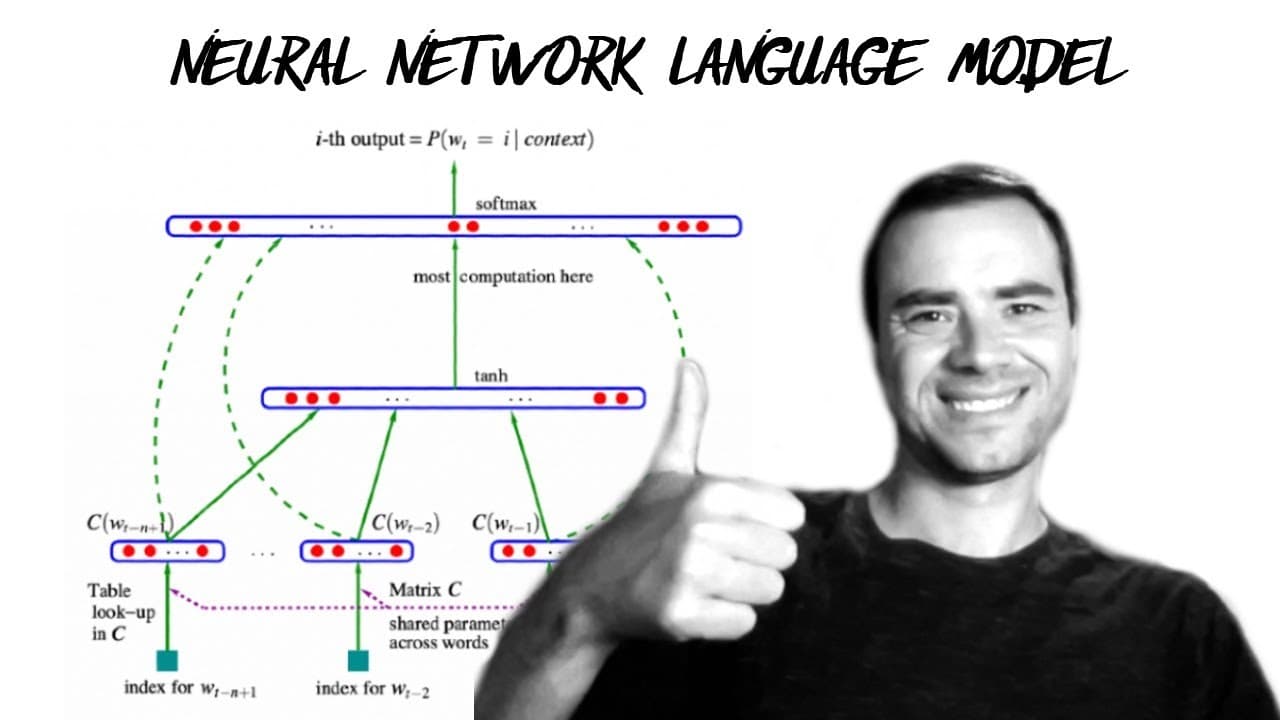
To implement a multi-layer perceptron for character prediction, start by constructing an embedding layer for contextual information, followed by a hidden layer for feature extraction. Train the model using backpropagation and the negative log-likelihood loss function, allowing it to effectively learn character relationships beyond single-character context.
Transcript
hi everyone today we are continuing our implementation of makemore now in the last lecture we implemented the bigram language model and we implemented it both using counts and also using a super simple neural network that had a single linear layer now this is the jupyter notebook that we built out last lecture and we saw that the way we approached ... Read More
Key Insights
- 💁 The previous model's limitations were addressed by implementing a multi-layer perceptron model that considers more contextual information.
- ❓ The neural network architecture consists of an embedding layer, a hidden layer, and an output layer.
- 👻 The embedding layer maps characters to lower-dimensional feature vectors, allowing the model to learn representations of the characters.
- 🎭 The hidden layer performs non-linear transformations on the input, capturing complex patterns and features.
- 🧑💻 The model is trained using backpropagation and the negative log-likelihood loss function.
- 👥 The embedding vectors learned by the model exhibit a degree of structure, with similar characters grouped together.
Install to Summarize YouTube Videos and Get Transcripts
Explore YouTube Video Summarizer or Get YouTube Transcript Extractor
Questions & Answers
Q: Why is the previous model's predictions not very good?
The previous model only took into account one character of context, resulting in limited information for predicting the next character accurately. This led to poor predictions.
Q: How does the new model address the limitations of the previous model?
The new model uses a multi-layer perceptron approach, which allows it to consider more contextual information when predicting the next character. This improves the accuracy of the predictions.
Q: How does the embedding layer work in the neural network architecture?
The embedding layer maps each character to a lower-dimensional feature vector. This mapping allows the model to learn representations of the characters in a continuous space, capturing similarities and relationships between them.
Q: What is the purpose of the hidden layer in the neural network?
The hidden layer performs non-linear transformations on the embedded input characters. It captures complex patterns and features in the data, enabling the model to make more accurate predictions.
Q: How is the model trained using backpropagation?
The model is trained by optimizing the parameters (weights and biases) to minimize the negative log-likelihood loss. The gradients of the loss with respect to the parameters are computed using backpropagation, and the parameters are updated accordingly to improve the model's predictions.
Key Insights:
- The previous model's limitations were addressed by implementing a multi-layer perceptron model that considers more contextual information.
- The neural network architecture consists of an embedding layer, a hidden layer, and an output layer.
- The embedding layer maps characters to lower-dimensional feature vectors, allowing the model to learn representations of the characters.
- The hidden layer performs non-linear transformations on the input, capturing complex patterns and features.
- The model is trained using backpropagation and the negative log-likelihood loss function.
- The embedding vectors learned by the model exhibit a degree of structure, with similar characters grouped together.
- Scaling up the embedding size will improve the model's predictions but make it harder to visualize the embeddings directly.
Summary & Key Takeaways
-
The previous implementation of the model predicted the next character based on only one character of context, resulting in poor predictions.
-
The new approach uses a multi-layer perceptron model to predict the next character, taking into account more contextual information.
-
The neural network architecture consists of an embedding layer, a hidden layer, and an output layer, with each layer having its own set of parameters.
-
The model is trained using back propagation and the log-likelihood loss function.
Read in Other Languages (beta)
Share This Summary 📚
Summarize YouTube Videos and Get Video Transcripts with 1-Click
Try YouTube Summary with ChatGPT & Claude or YouTube Transcript Generator
Explore More Summaries from Andrej Karpathy 📚



Summarize YouTube Videos and Get Video Transcripts with 1-Click
Try YouTube Summary with ChatGPT & Claude or YouTube Transcript Generator