How to profit from voice AI agents and SaaS
TL;DR
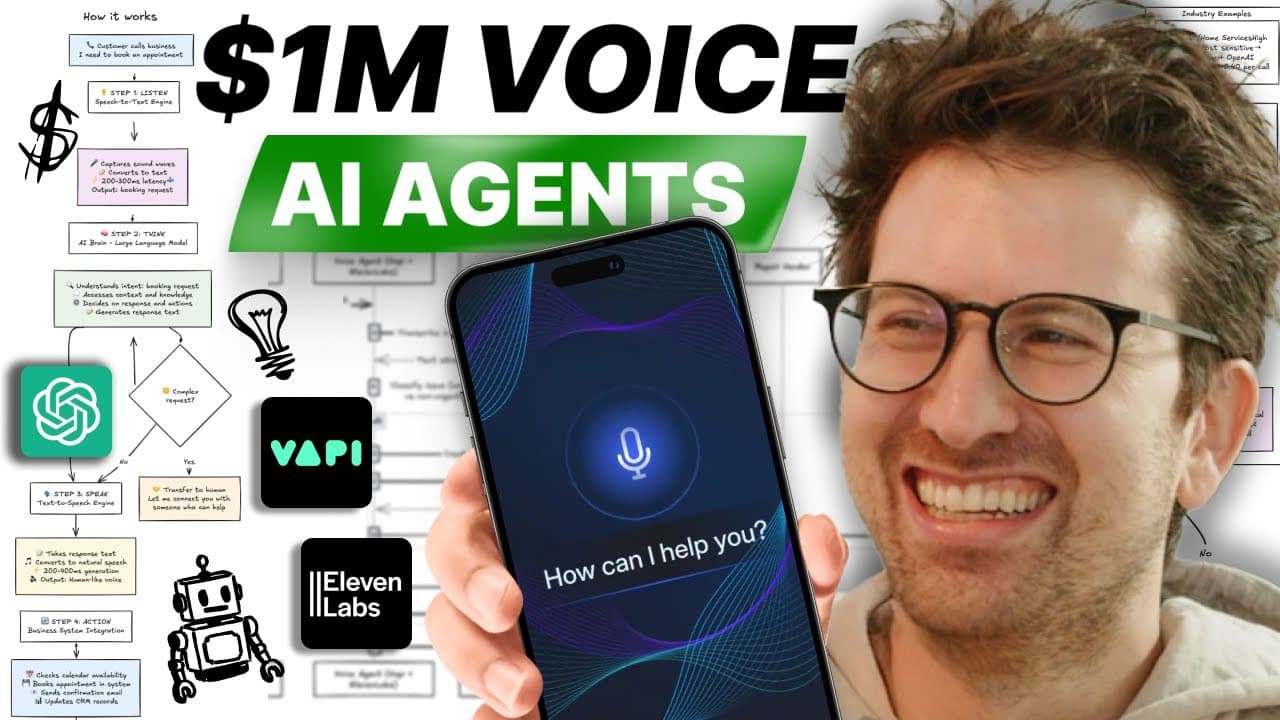
Voice AI agents can operate as digital employees that listen, reason, and act in real time to handle customer needs. The four main use cases are customer service, sales qualification, appointment scheduling, and information support. A practical startup framework includes ready-made workflows, tech stacks, and niche positioning to build recurring revenue.
Transcript
Today we're going to talk about how to make money with voice AI agents. Now I think a lot of people when they hear voice AI agents they just think of these robot callers that actually are horrible experiences. Now I think that there are tons of those poorly set up voice AI agents but at the same time we're getting to a point where some of these... Read More
Key Insights
- Voice AI agents are software systems that can have natural phone conversations, understand speech, reason about requests, and take actions to solve problems.
- There are four main types of voice AI agents: customer service, sales leads qualification, appointment scheduling, and information and support.
- The key tech stack includes speech-to-text engines (DeepGram, Whisper), an AI brain (GPT, Claude), and text-to-speech (11 Labs), plus platform layers that manage end-to-end workflows.
- A hybrid model can mix voice AI with human agents for complex requests, reducing costs while preserving quality and sales potential.
- Startup ideas include a AI property manager line and other sector specific lines that handle urgent classifications, ticket creation, and self-help steps.
- The architecture supports integration with external software like AppFolio, Buildium, and Twilio to automate issue tracking, notifications, and dashboards.
- Voice AI can serve multiple industries such as real estate, healthcare, restaurants, and legal, showing broad applicability beyond basic customer service.
- The episode promises a complete roadmap and a detailed tech stack breakdown, with practical demonstrations through an AI assistant mockup.
- More videos from this channel:
- More from this channel: Greg Isenberg
Install to Summarize YouTube Videos and Get Transcripts
Explore YouTube Video Summarizer or Get YouTube Transcript Extractor
Questions & Answers
Q: A real search query question about the video (e.g. 'How to...', 'What is...', 'Why does...', 'When should...'). Question 1
How can you start a profitable voice AI SaaS business today, and what is the simplest first startup idea that still demonstrates a working, scalable workflow? The answer outlines a property management voice line that classifies urgency, creates tickets, and notifies tenants with status updates, while integrating external tools for tickets and SMS.
Q: Question 2
What four main types of voice AI agents exist and how do they map to common business needs? The four categories are customer service handling complaints and order status, sales leads qualification, appointment scheduling, and information and support, each addressing a distinct customer interaction flow.
Q: Question 3
What is the basic operational flow of a voice AI agent in a typical call? It listens to the user, determines intent with an AI brain, converts speech to text, generates a response with text-to-speech, and performs an action such as updating a CRM or creating a ticket.
Q: Question 4
How does the hybrid approach with humans work in this model, and why is it beneficial? A hybrid approach transfers complex or high-value cases to humans while routine tasks are handled by AI, reducing costs and preserving quality while enabling scalable outreach.
Q: Question 5
What tech stack components are essential for building a voice AI agent, and what are some recommended tools? Essential components include speech-to-text (DeepGram, Whisper), an AI brain (GPT, Claude), text-to-speech (11 Labs), and platform layers like Lindy AI or Vappy that manage end-to-end workflows.
Q: Question 6
What are some niche opportunities suggested in the video to differentiate a voice AI business? The speaker proposes ideas such as an AI property manager line tailored to a region or brand, and emphasizes niching by sector or locale to stand out against legacy providers.
Q: Question 7
What is the claim about market viability and pricing power for these voice AI services? The video argues that a single property management line could be priced at 500 to 1500 dollars per month and that even a small customer base can scale to a million-dollar business with the right setup.
Q: Question 8
How should founders approach tool selection for technical versus non-technical teams, according to the video? Technical founders can leverage advanced stacks like GPT and Whisper with custom integrations, while non-technical founders should use managed platforms like Lindy AI, Vappy, or Retail to accelerate development without deep coding expertise.
Summary & Key Takeaways
-
The video outlines a practical framework to build profitable businesses using voice AI agents, including five startup ideas and the core tech stack needed to implement them.
-
It emphasizes 24/7 availability of voice AI while noting times when humans should handle complex requests, enabling cost savings and scalable customer interactions.
-
It highlights the importance of niching and integration with external software like CRM systems and repair vendors to create end-to-end solutions.
Read in Other Languages (beta)
Share This Summary 📚
Summarize YouTube Videos and Get Video Transcripts with 1-Click
Try YouTube Summary with ChatGPT & Claude or YouTube Transcript Generator
Explore More Summaries from Greg Isenberg 📚






Summarize YouTube Videos and Get Video Transcripts with 1-Click
Try YouTube Summary with ChatGPT & Claude or YouTube Transcript Generator