How to Choose an LLM for Your Use Case and Budget
TL;DR
The best model depends on your use case, not just benchmarks. Start with your task and balance performance, speed, and price, then compare proprietary versus open source options. Use local testing tools like Ollama and open leaderboards to filter models before deployment, including RAG workflows and data integration options.
Transcript
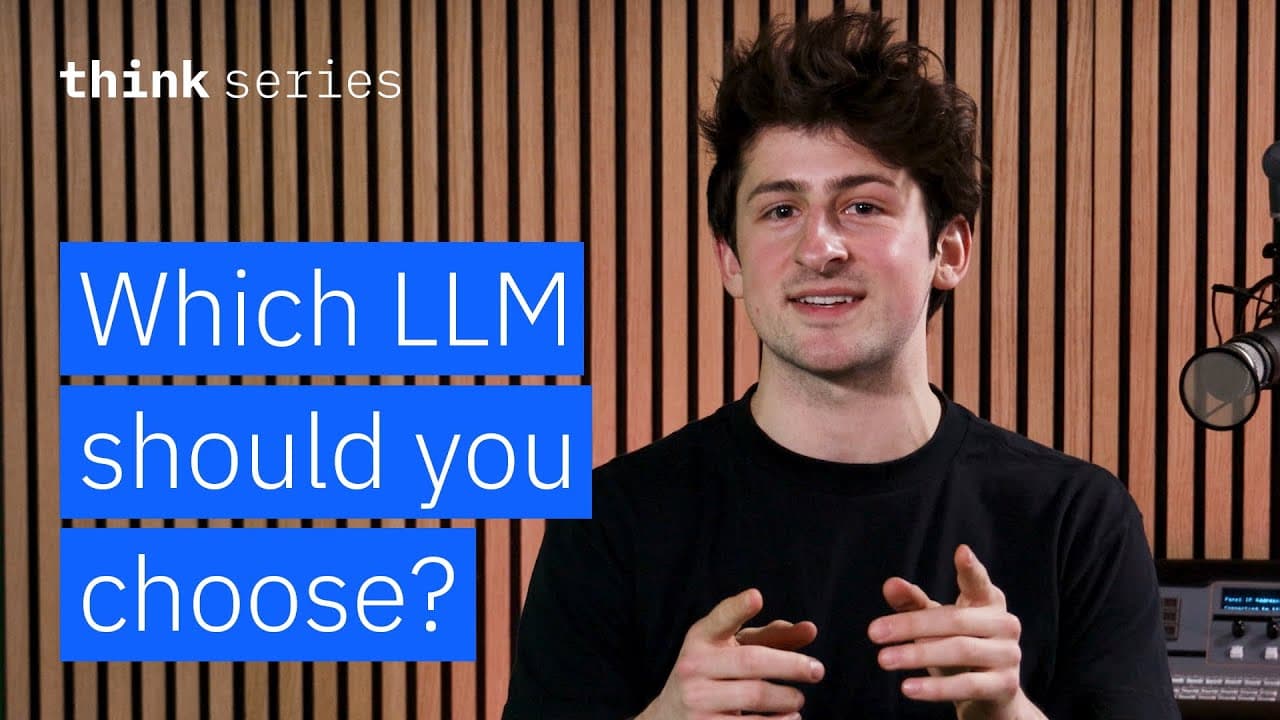
With the huge amount of large language models out there today, it can be a bit overwhelming to choose the perfect one for your use case. Plus, the decision you make might have an impact on the accuracy of your results, as well as cost and performance. But don't worry. In the next few minutes, I'll show you as a developer how I independently evaluat... Read More
Key Insights
- LLM choice should start from the problem you are solving, not just benchmarks.
- Open source options offer control and customization that may fit production needs.
- Leaderboards like Chatbot Arena provide community-backed ranking for real-world abilities.
- RAG and embeddings enable retrieval augmented generation for data grounded answers.
- Local testing with tools like Ollama demonstrates feasibility of on-device or private deployments.
- Comparing models with a common interface (e.g., prompts or prompts with JSON) helps apples-to-apples evaluation.
- GPU availability and deployment constraints influence model selection and tuning decisions.
- Plugins and integrations (IDE extensions, web interfaces) demonstrate practical workflows for developers to use models in code.
Install to Summarize YouTube Videos and Get Transcripts
Explore YouTube Video Summarizer or Get YouTube Transcript Extractor
Questions & Answers
Q: What factors should drive LLM selection rather than just benchmarks
LLM selection should be driven by the actual problem you are trying to solve, because different tasks demand different capabilities. The video emphasizes that higher intelligence often costs more and may not be necessary for simple tasks, so you should balance accuracy, speed, and price according to use case. This approach helps ensure the chosen model meets real operational needs without overpaying.
Q: How do open-source options compare to proprietary models for production use
Open-source models like Llama or Granite provide control, customization, and flexibility that are valuable for production. The video discusses weighing these advantages against the convenience of proprietary SaaS models, noting that organizations may need on-device or private inference capabilities, which open-source solutions can better support when paired with tools like Ollama.
Q: What role do community leaderboards play in model evaluation
Community leaderboards such as the Chatbot Arena Leaderboard and the Open LLM Leaderboard aggregate independent assessments and user votes to reflect practical capabilities like reasoning and writing. They offer a more holistic view of model performance beyond isolated benchmarks, helping developers gauge real-world usefulness and alignment with tasks.
Q: What is RAG and how does it help with using LLMs on your data
RAG, or retrieval augmented generation, combines embeddings and a vector store to retrieve relevant information from user data and provide cited, source-backed answers. This approach enables models to answer with data grounded in enterprise documents or external sources, improving accuracy and traceability for specialized applications.
Q: How can developers test models locally before production
Developers can test models locally using tools like Ollama to run open-source models on their own hardware, enabling real-time demos, chat, tool calls, and embedding-based retrieval. Local testing helps validate performance, latency, and integration with data before scaling to production environments, while preserving control over data.
Q: What is the value of using a platform like Hugging Face for model deployment
Hugging Face provides a marketplace and model repository where developers can discover, compare, and deploy millions of models and datasets. It supports local deployment and easy switching between models, which simplifies experimentation and helps find the best fit for a given use case and hardware setup.
Q: How does the video suggest balancing cost and performance
The video explains that higher intelligence often comes with higher cost, while smaller models can offer faster speeds and lower costs. A hybrid approach—using a powerful model for complex tasks and a smaller model on-device for routine work—can optimize both performance and expense for production systems.
Q: What practical workflows are demonstrated for integrating LLMs into development
Practical workflows shown include using an IDE extension to chat with code, generate comments, and document code with a local model, and connecting a local model to a front end like an Open WebUI to build AI applications. These examples illustrate how to integrate LLMs into everyday development and data workflows.
Summary & Key Takeaways
-
This video explains that model choice should be driven by the problem you are solving rather than benchmarks alone. It highlights the trade offs between higher intelligence, price, and speed and suggests using open and community resources to compare models. It also demonstrates local testing with tools like Ollama and workflows such as RAG to test with your data and needs.
-
The presenter shows how to compare models on leaderboards like Chatbot Arena and Open LLM Leaderboard, and how to use Hugging Face for model discovery and local deployment. Practical demos include running Granite locally and evaluating it against Llama using a web interface.
-
The guide emphasizes end to end evaluation including architecture choices, on device inference, and enterprise data use cases, ending with a prompt to audience to share their current AI projects and goals.
Read in Other Languages (beta)
Share This Summary 📚
Summarize YouTube Videos and Get Video Transcripts with 1-Click
Try YouTube Summary with ChatGPT & Claude or YouTube Transcript Generator
Explore More Summaries from IBM Technology 📚

Summarize YouTube Videos and Get Video Transcripts with 1-Click
Try YouTube Summary with ChatGPT & Claude or YouTube Transcript Generator