What are the four core OOP concepts and why use them
TL;DR
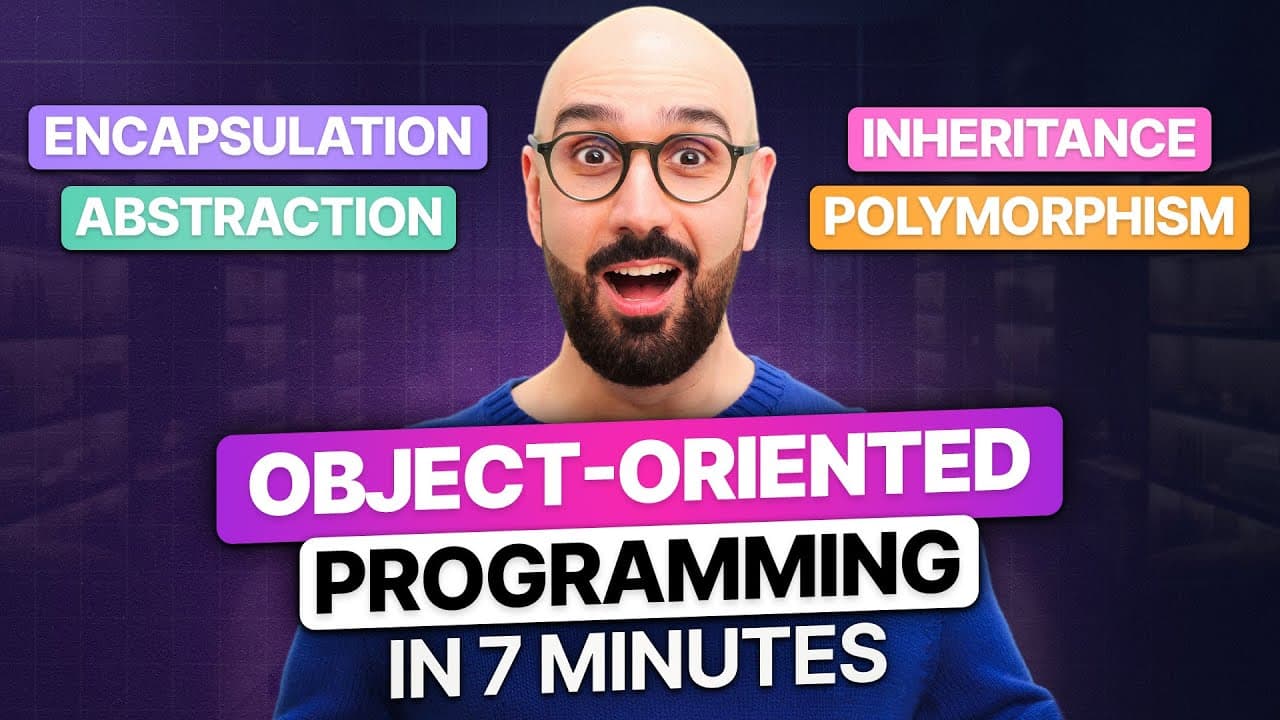
Encapsulation keeps related data and behavior together inside an object, reducing parameter count and improving maintainability. Abstraction hides complexity behind a simple interface, protecting internals and easing change. Inheritance eliminates redundant code by sharing common properties and methods, while polymorphism lets different objects render or behave through a common interface. Together they improve code organization and reusability.
Transcript
a popular interview question concerns the four core concepts in object-oriented programming this concepts are encapsulation abstraction inheritance and polymorphism let's look at each of these concepts before object-oriented programming we had procedure of programming that divided a program into a set of functions so we have data stored in a bunch ... Read More
Key Insights
- Encapsulation uncouples data from unrelated code by bundling properties and methods into an object.
- Abstraction reduces complexity by exposing only essential features and hiding inner workings.
- Inheritance eliminates redundant code by sharing common properties and methods across related objects.
- Polymorphism enables different objects to be treated uniformly through a common interface.
- A practical example used is an HTML element family that shares common properties like hidden and innerHTML and methods like click and focus.
- Procedural code places data and functions separately, while object-oriented code groups them into a single unit.
- A method such as getWage in an employee object can access properties without passing many parameters.
- Polymorphism allows a render method to behave differently for different objects, removing long switch or case statements.
Install to Summarize YouTube Videos and Get Transcripts
Explore YouTube Video Summarizer or Get YouTube Transcript Extractor
Questions & Answers
Q: What are the four core concepts of object-oriented programming and their role
The four core concepts are encapsulation, abstraction, inheritance and polymorphism. Encapsulation groups related data and functions into objects to reduce interdependencies. Abstraction hides complex details and presents a simple interface, which protects internal changes and simplifies usage. Inheritance shares common code to avoid redundancy, and polymorphism allows different objects to render or respond through a unified interface, eliminating the need for many conditional statements.
Q: How does encapsulation reduce the need for parameters
Encapsulation stores related properties inside an object and exposes behavior through methods, so a function can operate on the object's internal state without requiring external parameters. This leads to fewer parameters in methods, making them easier to use and maintain, which is highlighted by the example where a wage calculation moves into an object with a getWage method that uses internal properties.
Q: What is abstraction and why is it beneficial
Abstraction hides internal details and shows only essential features, creating a cleaner interface for users. It reduces the impact of changes by containing them within the object, so external code does not need to adapt to every internal modification. In the DVD player analogy, pressing play interacts with a simple external interface while internal logic remains hidden.
Q: How does inheritance help in programming according to the video
Inheritance allows sharing a set of common properties and methods among related objects, eliminating redundant code. By defining a generic base object like an HTML element, derived objects can inherit its features such as properties and methods, enabling code reuse and easier maintenance across multiple related element types.
Q: What is polymorphism and how does it simplify code
Polymorphism enables many forms of a behavior by letting different objects implement a common interface in their own way. For example, a render method can be defined once and implemented differently by various elements, so code can render multiple object types without a long switch or case statement.
Q: What problem does object-oriented programming aim to solve compared to procedural programming
OOP aims to solve spaghetti code and high interdependence that arises when functions operate on data in isolation. By grouping data and related functions into objects, OOP reduces interconnections, makes code more modular, and allows parts of a program or even different programs to reuse existing objects, improving maintainability and scalability.
Q: What is a practical example used to illustrate encapsulation and abstraction
A practical example is modeling an employee with properties like salary over time and rate and a method getWage, which demonstrates encapsulation by bundling data and behavior. Abstraction is shown by hiding internal wage calculation details and exposing a simple getWage interface, reducing complexity and providing a clean usage contract.
Q: Why might a developer favor a render method over a switch-case structure
Favoring a render method over a switch-case structure reduces code duplication and makes adding new object types easier. Each object can implement its own render behavior while sharing a common interface, which eliminates the need to add or modify switch-case logic every time a new element type is introduced.
Summary & Key Takeaways
-
Encapsulation combines properties and methods into a cohesive unit called an object, reducing interdependencies and making functions easier to use. It also enables smaller parameter lists by relying on object state. This simplifies maintenance and reuse across programs.
-
Abstraction hides internal details and exposes a simplified interface, which makes objects easier to use and protects internal changes from leaking to other parts of the codebase. It also helps isolate changes when the underlying implementation changes.
-
Inheritance provides a mechanism to share code among similar objects, reducing redundancy by defining common features once and reusing them in derived elements. This leads to less duplication and easier maintenance across a family of related objects.
Read in Other Languages (beta)
Share This Summary 📚
Summarize YouTube Videos and Get Video Transcripts with 1-Click
Try YouTube Summary with ChatGPT & Claude or YouTube Transcript Generator
Explore More Summaries from Programming with Mosh 📚





Summarize YouTube Videos and Get Video Transcripts with 1-Click
Try YouTube Summary with ChatGPT & Claude or YouTube Transcript Generator