How Does Language Shape Human Communication?
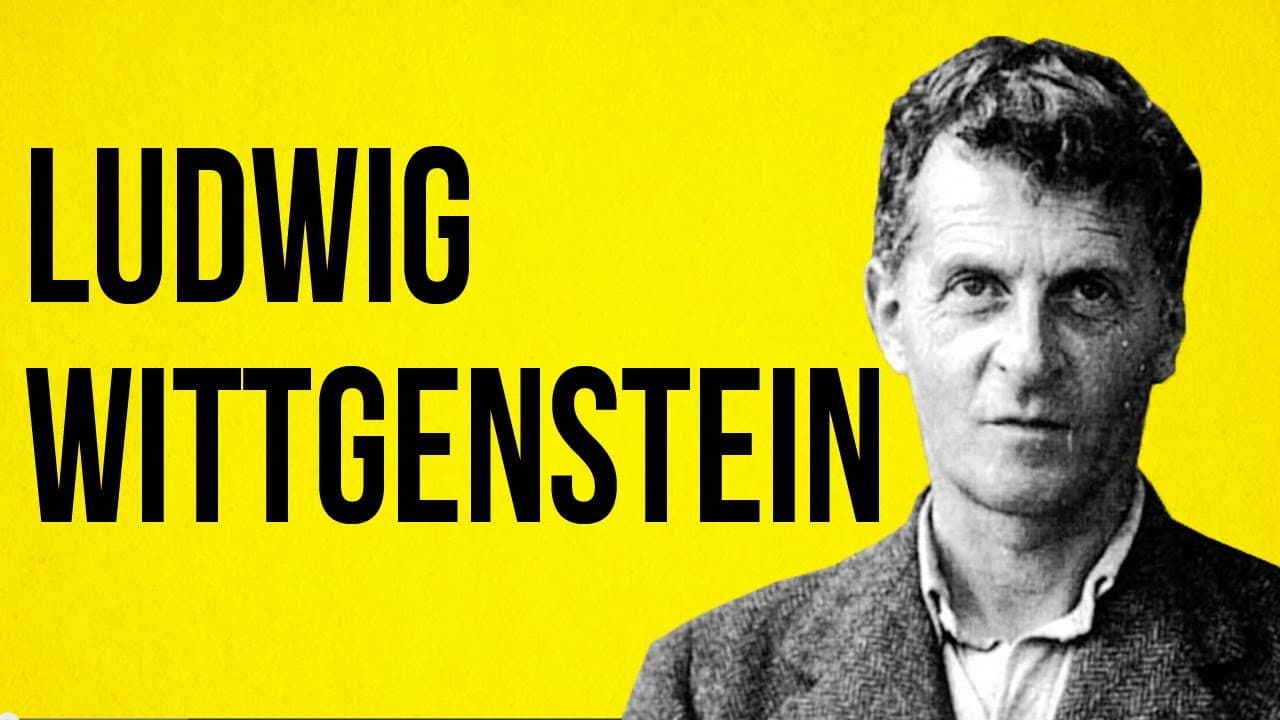
TL;DR
Clear communication depends on forming an accurate picture of what you mean and recognizing what another person is trying to do with words. Wittgenstein first described language as a way of picturing facts, then treated it as a collection of language games used for purposes such as prediction, comfort, reassurance, and self-understanding.
Transcript
A lot of unhappiness comes about in this world because we can't let other people know what we mean clearly enough. One of the philosophers who can help us with our communication problems is Ludwig Wittgenstein. He was a recluse. He had a stutter, paused for ages in the middle of his sentences and had a habit of storming out if he didn't like what p... Read More
Key Insights
- Language is described in the Tractatus Logico-Philosophicus as a means of creating mental pictures of facts. A sentence such as "The palm tree is by the shore" gives another person a rapid internal sketch of a situation and makes understanding possible.
- Miscommunication is often caused by different mental pictures. A speaker may intend an innocent meaning while a listener constructs a more troubling interpretation, or a speaker may begin without a sufficiently clear and detailed picture of what they want to express.
- Careful speech is central to Wittgenstein's early philosophy. The Tractatus urges people to avoid impulsive, vague, or unelaborated statements because words that do not represent a clear thought cannot reliably create understanding in another person's mind.
- Language games are patterns of intention that determine what words are doing in a particular situation. Wittgenstein's later philosophy treats language as a set of tools rather than only as a system for representing factual pictures of the world.
- Words of comfort are not necessarily failed predictions. When a parent tells a frightened child that everything will be fine, the purpose is to provide security and reassurance, not to make a rational forecast based on all available facts.
- Relationship complaints can function as requests for care rather than literal factual claims. Answering "You never help me" with a list of completed tasks misses the relevant language game when the intended message is a desire for greater nurturing and reassurance.
- Language is a public tool for understanding private life. Words developed communally before an individual is born can name elusive experiences, allowing that person to recognize an internal mood and communicate it more clearly to others.
- A rich vocabulary supports greater self-knowledge because available words shape what people can identify in themselves. Reading books expands the linguistic tools through which experiences such as angst, nostalgia, melancholy, and ambivalence can be understood and shared.
- More videos from this channel:
- More from this channel: The School of Life
Install to Summarize YouTube Videos and Get Transcripts
Explore YouTube Video Summarizer or Get YouTube Transcript Extractor
Questions & Answers
Q: How does Wittgenstein explain human communication?
Wittgenstein's early account says that language communicates by triggering pictures of facts in another person's mind. Words such as "The palm tree is by the shore" create a quick internal sketch of a situation. His later account adds that language is also a tool used in different language games, with purposes that include stating facts, offering comfort, requesting help, and providing reassurance.
Q: Why does communication go wrong according to Wittgenstein?
Communication often fails because the speaker and listener form different mental pictures of what is being discussed. A speaker may not have a clear or accurate idea before speaking, resulting in vague or undeveloped words. A listener may also read more meaning into those words than the speaker intended. Both problems prevent the intended picture from passing reliably between people.
Q: What is Wittgenstein's picture theory of language?
The picture theory presented in Tractatus Logico-Philosophicus holds that words enable people to form mental pictures of facts. Wittgenstein was inspired by a report about a Paris court using model cars and pedestrians to reproduce an accident at a road junction. He concluded that sentences work similarly by arranging elements that let another person imagine a situation.
Q: What are language games in Wittgenstein's philosophy?
Language games are patterns of intention that govern how words function in particular contexts. They are not literally games. The same kind of sentence can serve different purposes, including factual description, rational prediction, comfort, security, help, or reassurance. Understanding communication requires identifying which game is being played instead of assuming that every statement is intended as a factual report.
Q: How can language games improve communication in relationships?
Recognizing the relevant language game helps a listener respond to the intention beneath the literal words. If a partner says, "You never help me," listing completed errands treats the remark as a factual claim. Wittgenstein's approach suggests it may instead belong to a help and reassurance game, where the intended message is a request for more nurturing and emotional support.
Q: How does language contribute to self-knowledge?
Language provides publicly developed words for experiences that can otherwise remain private, worried, or confused. Terms such as angst, nostalgia, melancholy, and ambivalent help people identify elusive areas of their inner lives. Once an experience has a name, a person can understand it more clearly and communicate it to others using concepts developed communally over many centuries.
Q: Why does reading support self-understanding?
Reading exposes people to a richer range of words, and those words become tools for recognizing private experiences. Without suitable language, a mood may remain confused or difficult to explain. Vocabulary such as angst, nostalgia, melancholy, and ambivalent makes subtle states easier to identify. Books therefore enlarge the public language through which individuals can understand and describe who they are.
Q: How did Wittgenstein's view of language change?
In Tractatus Logico-Philosophicus, published in 1921, Wittgenstein emphasized language as a system that creates pictures of facts. After returning to Cambridge and philosophy in 1929, he developed a broader view in Philosophical Investigations. Language became a collection of tools used in different language games, with meaning shaped by purposes such as prediction, comfort, reassurance, and requests for care.
Summary & Key Takeaways
-
Wittgenstein's Tractatus Logico-Philosophicus asks how people communicate ideas and proposes that words trigger pictures of facts. Miscommunication occurs when speakers lack a clear picture themselves or when listeners construct a different picture. Its practical lesson is to speak carefully, precisely, and only where meaningful expression is possible.
-
In Philosophical Investigations, Wittgenstein presents language as a tool used within different language games, or patterns of intention. A statement may offer comfort, request reassurance, or report facts. Communication improves when listeners identify the purpose of an utterance instead of interpreting every sentence as a literal factual claim.
-
Publicly developed words help people recognize and communicate private experiences. Terms such as angst, nostalgia, melancholy, and ambivalent give names to otherwise elusive feelings. Exposure to a rich language, including through reading books, therefore expands the tools available for self-knowledge and for explaining one's inner life to others.
Read in Other Languages (beta)
Share This Summary 📚
Summarize YouTube Videos and Get Video Transcripts with 1-Click
Try YouTube Summary with ChatGPT & Claude or YouTube Transcript Generator