How to stop needing to be exceptional in life?
TL;DR
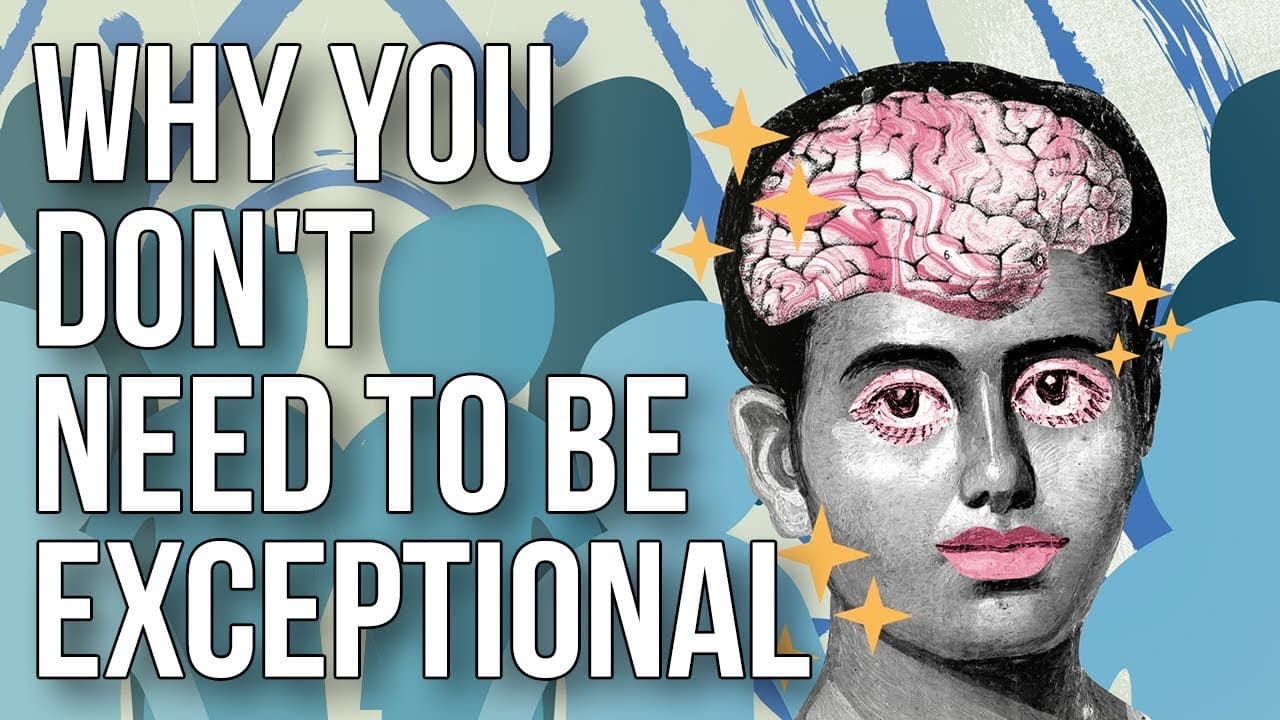
Being ordinary can be a source of strength and health, not failure. The talk argues that many people feel pressure to be remarkable due to childhood messages and social norms, but true well being comes from embracing a reasonable, simple life and relationships. Quiet, ordinary joys and responsibilities can be deeply meaningful when viewed without judgment.
Transcript
It’s a rather simple question that quickly gets to the core of someone’s sense of well-being and legitimacy: did your childhood leave you feeling that you were - on balance - OK as you were, or did you somewhere along the way derive an impression that you needed to be extraordinary in order to deserve a place on the earth? And, to raise an associat... Read More
Key Insights
- Excellence pressure often stems from childhood and parental expectations.
- A breakdown can serve as a health bid to slow down and reassess life.
- Ordinary life can be more emotionally rich than high achievement.
- Societal images glorify busyness and success, skewing self-worth.
- Contentment comes from simplicity, friendship, and vulnerability.
- Quiet domestic life holds as much value as public acclaim.
- True luxury may be warm baths, simple foods, and meaningful ties.
- Hope lies in accepting good enough, not needing to be exceptional.
- More videos from this channel:
- More from this channel: The School of Life
Install to Summarize YouTube Videos and Get Transcripts
Explore YouTube Video Summarizer or Get YouTube Transcript Extractor
Questions & Answers
Q: What is the central idea of not needing to be exceptional
The central idea is that most of us do not need to be extraordinary to deserve a place in the world. Many people carry a heavy burden from childhood, where parents or society implied that only remarkable achievement is valuable. Accepting a good enough, ordinary life can lead to better wellbeing and less self hatred.
Q: How does a breakdown relate to growth according to the video
A breakdown can be a paradoxical bid for health, an invitation from the mind to slow down, reflect, and change. It may reduce commitments and push off external expectations, enabling self understanding and a process of healing that moves away from relentless striving toward a more balanced life.
Q: What role do societal images play in our self worth
Societal images tend to equate success with being busy, famous, or at the center, which can diminish the value of simple, everyday contributions. They often present the idea that a peaceful ordinary life signals failure, encouraging people to chase status rather than cultivating inner wellbeing.
Q: What examples does the talk give of ordinary but meaningful life
The talk highlights raising a child to be independent, maintaining a long term relationship, keeping a home, getting early nights, doing a steady job with care, listening to others, and avoiding madness or rage as demonstrations of meaningful living. These acts are framed as noble and valuable.
Q: How is happiness defined in contrast to public acclaim
Happiness is defined through personal balance, reliable relationships, and quiet pleasures rather than external validation. It emphasizes sheltering from other peoples expectations, appreciating simple luxuries, and finding meaning in ordinary duties rather than dramatic feats.
Q: What ancient or literary references support the main idea
References include Montaigne on living simply with household duties, Vermeer’s The Little Street, Chekhov, Raymond Carver, Bob Dylan, Thomas Jones, and Rohmer’s Le Rayon Vert. These works are used to illustrate the value of quiet, ordinary life over spectacular achievement.
Q: What does the talk suggest as the true luxuries of life
The true luxuries suggested are simplicity, quiet, vulnerability in friendship, creativity without an audience, love without excessive hope or despair, hot baths, dried fruits, walnuts, and dark chocolate. These are presented as deeper sources of contentment than conspicuous success.
Q: What is the final takeaway about mediocrity and worth
The final takeaway is that mediocrity can be a form of emotional strength and health. People not driven to extraordinary feats can possess rich inner lives, stable relationships, and genuine happiness, which challenges the cultural fixation on being exceptional and reframes worth around humane, everyday living.
Summary & Key Takeaways
-
The talk reframes success as a quiet, balanced life rather than public achievement, suggesting that ordinary tasks sustain wellbeing.
-
It argues that many people push for excellence to soothe parental or societal pain, which can mask deeper emotional struggles.
-
Finding contentment in everyday duties, relationships, and self acceptance is presented as a noble form of flourishing.
Read in Other Languages (beta)
Share This Summary 📚
Summarize YouTube Videos and Get Video Transcripts with 1-Click
Try YouTube Summary with ChatGPT & Claude or YouTube Transcript Generator