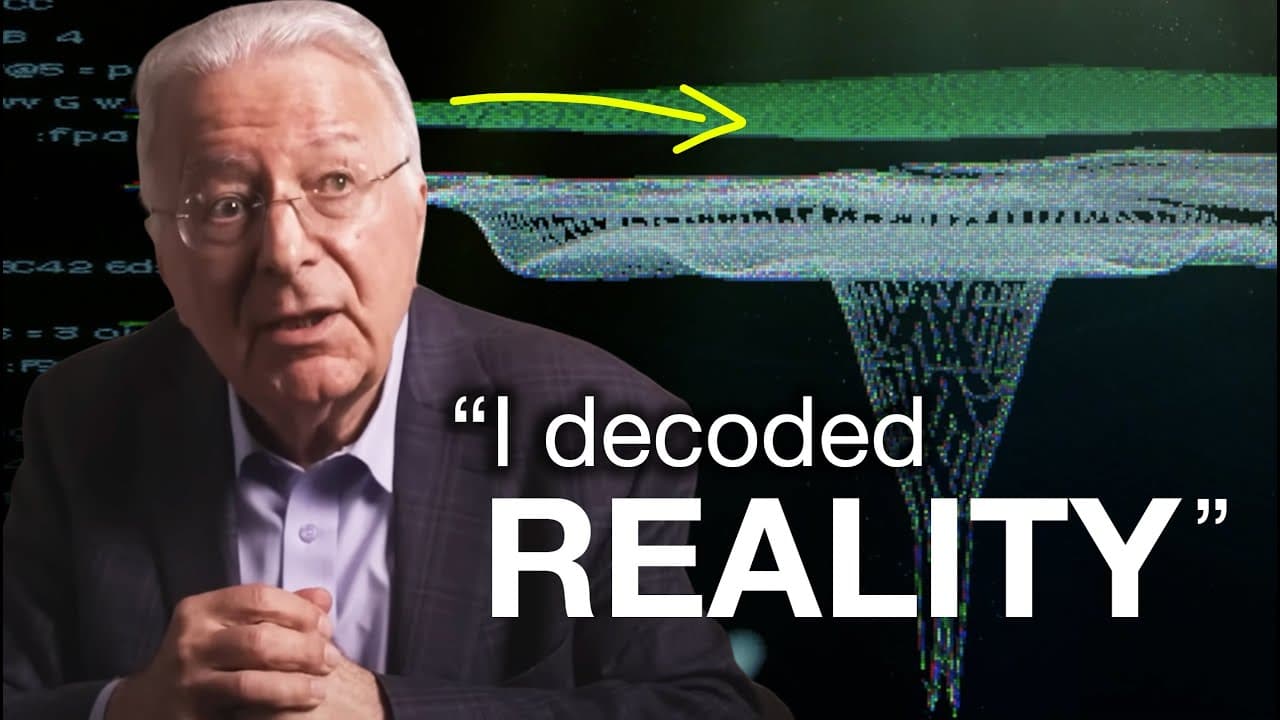
Federico Faggin on Why Reality Is Not Physical
TL;DR
Consciousness is foundational, not a byproduct of brain chemistry, argues microprocessor inventor Federico Faggin. Particles are not objects but states of quantum fields, and feelings behave like quantum information that cannot be copied or measured without collapse. Meaning lives inside the field, expressed through the brain rather than generated by it.
Transcript
It took me 30 years to figure out. I can explain what physicists in a 100 years have not understood. Nobody can understand why quantum computers work because their actual operation cannot occur in spacetime. There is a deeper reality where the feelings and the fields exist. The meaning of information exist and from that world you have this world th... Read More
Key Insights
- Particles are not objects but states of a field, according to Faggin. They are temporary ripples that come and go, cannot be separated from the fields they emerge from, and are entangled rather than isolated building blocks of matter.
- The no-cloning theorem means quantum information cannot be copied or reproduced. The maximum information obtainable from a quantum bit is a single classical bit, and observing a qubit collapses its infinite possibilities down to one, destroying the original state.
- Quantum information behaves more like experience than data, Faggin argues. It is private, cannot be separated from the system holding it, and mirrors how your inner world cannot be downloaded, cloned, or transferred to anyone else.
- Consciousness may not be produced by the brain but filtered through it. In this view the brain is a translator for a deeper quantum field that already contains awareness, flipping the classical model that treats consciousness as brain-chemistry byproduct.
- The collapse of the wave function is a way of saying we don't know how potential becomes actual. Physics offers no formula or mechanism, and the transition is instantaneous, unpredictable, and outside classical cause and effect.
- Every cell of the roughly 50 trillion cells in the body contains the entire blueprint of the whole, which Faggin calls holographic rather than mechanical. Cells connect to the whole body through quantum fields, forming a field of intelligence.
- Classical science operates on the rule that if you cannot measure it, it does not exist, reducing life to chemical reactions. This describes only the visible, measurable half and misses the invisible quantum connections holding everything together.
- AI can generate a good idea but does not know it is a good idea, Faggin says. Algorithms simulate structure without feeling meaning, so recognition of value comes from human understanding and comprehension, not from the machine itself.
Install to Summarize YouTube Videos and Get Transcripts
Explore YouTube Video Summarizer or Get YouTube Transcript Extractor
Questions & Answers
Q: Who is Federico Faggin and what does he claim about reality?
Federico Faggin is the inventor of the microprocessor. He claims that reality is not fundamentally physical and that it took him 30 years to figure out. He argues there is a deeper reality where feelings, fields, and the meaning of information exist, and that the classical world we perceive is constructed with our bodies rather than being the only world that exists.
Q: Why does Faggin say particles are not objects?
Faggin says particles are not little marbles bouncing around but states of a field, temporary ripples in something much deeper. They come and go, are not permanent, and are not separable from the fields they emerge from. Because the body's cells are made of these entangled quantum states, the idea of a person being a self-contained machine was never true.
Q: What is the no-cloning theorem and why does it matter for consciousness?
The no-cloning theorem says you cannot clone even a single quantum bit, so quantum information cannot be reproduced, unlike classical information. The maximum information obtainable from a quantum bit is one classical bit, and the quantum bit itself cannot be known. This makes quantum information private and inseparable from its system, behaving more like personal experience than copyable data.
Q: How does Faggin explain the collapse of the wave function?
Faggin describes the collapse of the wave function as one of the most mysterious transitions in science and admits it is just a way of saying we don't know. Particles exist in multiple states at once until observed, then instantaneously collapse into a single outcome. Physics offers no formula or mechanism for how this happens, and it lies outside classical cause and effect.
Q: Why does the human body work more like a hologram than a machine?
Faggin says every one of the body's roughly 50 trillion cells contains the entire blueprint of who you are, making each cell a miniature reflection of the whole. This is holographic rather than mechanical. Each cell connects to the whole body through quantum fields, so the body is a constantly adapting, self-aware network of intelligence rather than isolated parts.
Q: What is the limitation of classical science according to the video?
Classical science operates under the rule that if you cannot measure it, it does not exist, which reduced life to chemical reactions and firing neurons. This method describes only the visible, measurable half of the picture and misses the invisible quantum fields that hold everything together. Science clings to the machine model because it is predictable, controllable, and gives the illusion of certainty.
Q: Can artificial intelligence understand meaning the way humans do?
No. Faggin argues algorithms cannot produce meaning, only simulate structure. A machine might generate a sentence but does not feel its meaning. Even if AI produces a good idea, it does not know that it is a good idea. Recognition of that value comes from human understanding and comprehension, because meaning lives within the conscious field, not in the information itself.
Q: How might consciousness relate to observation and reality?
The video suggests consciousness may be the reference point that finalizes reality, since quantum states collapse only when measured and measurement requires a reference. Awareness could be an active agent embedded in the field rather than a passive observer. In this view every act of awareness is a moment of creation where infinite possibilities collapse into a single lived experience meaningful because you experience it.
Summary & Key Takeaways
-
Federico Faggin, inventor of the microprocessor, argues that reality is not fundamentally physical. Beneath the classical world of measurable matter lies a deeper reality where fields, feelings, and the meaning of information exist. Human beings are fields that are part and whole of the totality of what exists.
-
Quantum physics shattered the machine model of the body. Particles are not marbles but states of a field, entangled and inseparable from it. Every one of the body's roughly 50 trillion cells holds the whole blueprint and connects through quantum fields, making the body a self-organizing field of intelligence rather than isolated parts.
-
Quantum information cannot be cloned, copied, or observed without collapse, behaving like private inner experience rather than transferable data. This suggests consciousness and free will are foundational, expressed through the brain rather than generated by it. The wave function collapse may represent free will, with awareness participating in creating reality.
Read in Other Languages (beta)
Share This Summary 📚
Summarize YouTube Videos and Get Video Transcripts with 1-Click
Try YouTube Summary with ChatGPT & Claude or YouTube Transcript Generator
Explore More Summaries from Be Inspired 📚

Summarize YouTube Videos and Get Video Transcripts with 1-Click
Try YouTube Summary with ChatGPT & Claude or YouTube Transcript Generator