How to Cut Fable 5 Costs Without Losing Quality
TL;DR
Lower Fable 5 from high effort to medium or low for the fastest reduction in usage and cost while retaining strong benchmark performance. Reserve it for planning, architecture, and difficult decisions, then delegate research and execution to Opus, Sonnet, GPT 5.5, or local models, while testing token-saving tools such as Ponytail and workflows such as advisor mode.
Transcript
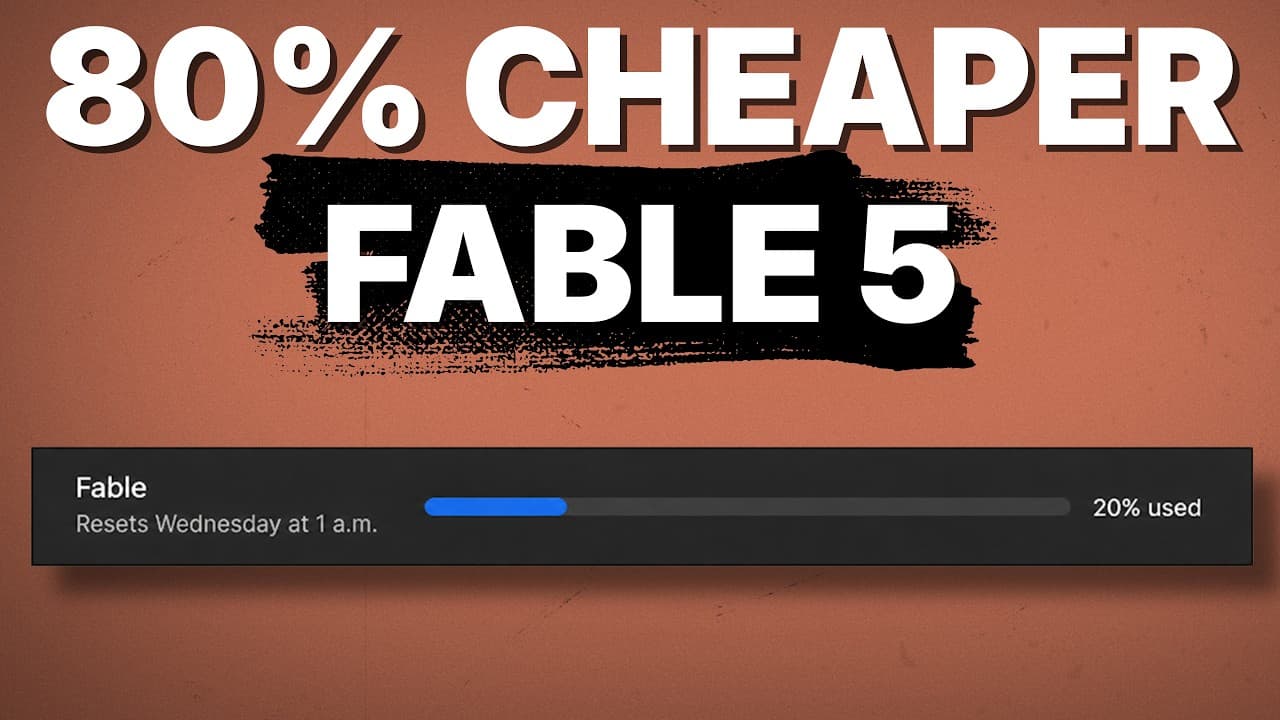
What if I told you we could reduce Fable 5's cost by 80% while still beating Opus 4.8? Well, that is just one of five tricks I'm going to show you today that are all about reducing Fable 5's usage and token cost without losing what makes this model great. Because we all know the clock is ticking. We just got a few days left until Fable 5 is kicked ... Read More
Key Insights
- Fable 5 low effort averaged $3.76 per Deep Suite task, compared with $22 at maximum effort. That represents a cost reduction of more than 80%, while low effort still achieved a 60% pass rate on the long-running agentic task benchmark.
- Fable 5 low effort slightly exceeded Opus 4.8 at maximum effort on Deep Suite. The reported pass rates were 60% and 59%, respectively, while Opus cost $13 per task compared with $3.76 for low-effort Fable.
- Higher effort levels produce diminishing benchmark gains. Deep Suite performance increased from 60% at low effort to 65% at medium, 69% at high, and 70% at extra high, suggesting that the most expensive settings may be unnecessary for less complicated work.
- The effort level can be changed through the terminal by entering the forward-slash effort command and selecting the desired setting. Testing the same task at medium or low effort provides a direct way to judge whether higher settings are actually necessary.
- Fable 5 can serve as the architect instead of planning and executing every task. It can create the plan, divide the work, and identify whether Opus, Sonnet, GPT 5.5, or a local model is appropriate for each part.
- Ponytail is a set of guidelines intended to reduce Claude's verbosity while preserving effective output. In the presented Fable 5 tests at medium effort, it generated fewer tokens across the board and reduced cost by approximately 22%.
- Deep research can gather information before Fable performs high-level planning. The workflow used during preparation spawned 109 subagents, making lower-level models such as Opus or Sonnet more practical for research than using Fable for every subagent.
- Advisor mode separates strategic guidance from routine execution. A lower-level executive model reads, writes, and uses tools, then shares its context with the smarter adviser when stuck, allowing Fable to focus on difficult decisions instead of every operational step.
Install to Summarize YouTube Videos and Get Transcripts
Explore YouTube Video Summarizer or Get YouTube Transcript Extractor
Questions & Answers
Q: How can I reduce Fable 5 costs by more than 80%?
Set Fable 5 to low effort instead of maximum effort. On the Deep Suite benchmark presented, maximum effort averaged $22 per task, while low effort averaged $3.76, a reduction of more than 80%. Low effort still reached a 60% pass rate, slightly above the reported 59% result for Opus 4.8 at maximum effort, which cost $13 per task.
Q: Which Fable 5 effort level should I use for ordinary tasks?
Medium or low effort is the suggested starting point for work that is not highly complicated, including web design. The benchmark results showed 60% at low effort and 65% at medium, compared with 69% at high and 70% at extra high. Testing the same task at lower settings can reveal whether the small gain from higher effort justifies the added usage and cost.
Q: How do I change the effort level in Fable 5?
Open the terminal, enter the forward-slash effort command, and choose the setting you want. The available levels discussed are low, medium, high, extra high, and maximum. Because high is the default described in the transcript, deliberately switching to medium or low is the simplest way to test whether your task can be completed with less usage and lower cost.
Q: How should Fable 5 and cheaper models divide coding work?
Use Fable 5 as the architect that creates the plan, divides the project into components, and identifies an appropriate model for each component. Opus, Sonnet, GPT 5.5, or a local model can execute routine steps. A simpler version is to let Fable produce a markdown plan and prepare the codebase context, then open another session with Opus to execute it.
Q: What is Ponytail, and how much can it reduce Fable 5 costs?
Ponytail is a set of guidelines designed to make Claude less verbose while retaining effective output, particularly by writing less code and consuming fewer tokens. In the tests described, Fable 5 used Ponytail at medium effort and produced fewer tokens across the board. The resulting cost was approximately 22% lower than the baseline presented in the comparison.
Q: Why should lower-cost models perform research before Fable 5 plans?
Research can require many subagents to browse, gather context, and perform baseline adversarial checks. The deep research run used in preparation for the content spawned 109 subagents, so using Fable for every one would consume limits rapidly. Opus or Sonnet can gather the information first, after which Fable can use that supplied context for high-level architecture and planning.
Q: What is advisor mode for Fable 5 workflows?
Advisor mode pairs a smarter planning model with a lower-level executive model. The executive handles tool use, reading, writing, and routine implementation. When it becomes stuck, it shares its current context with the adviser and asks what to do next. With Fable serving as the adviser, its usage can be concentrated on difficult judgments rather than continuous execution.
Q: When should Fable 5 handle both planning and execution?
The workflow presented does not recommend making Fable handle every planning and execution step by default. Its usage is better reserved for high-level intellectual architecture, complex decisions, and situations where a lower-level executive becomes stuck. Routine implementation, information gathering, and large multi-agent research workflows can instead be assigned to Opus, Sonnet, GPT 5.5, or local models.
Summary & Key Takeaways
-
Fable 5 becomes substantially cheaper when its effort level is reduced. On Deep Suite, low effort averaged $3.76 per task with a 60% pass rate, compared with $22 at maximum effort. Medium reached 65%, while high and extra high reached 69% and 70%, respectively, showing diminishing returns at higher settings.
-
Fable 5 should be reserved for work that benefits from its stronger reasoning. It can design the architecture, prepare a plan, and recommend which model should handle each component. Lower-cost models such as Opus, Sonnet, GPT 5.5, or local alternatives can then perform routine execution without consuming as much Fable usage.
-
Additional savings can come from token-reduction guidance and model-separated workflows. Ponytail produced fewer tokens across the presented Fable 5 tests and was about 22% cheaper at medium effort. Deep research can gather current context with lower-level models, while advisor mode lets an executive model consult Fable only when it becomes stuck.
Read in Other Languages (beta)
Share This Summary 📚
Summarize YouTube Videos and Get Video Transcripts with 1-Click
Try YouTube Summary with ChatGPT & Claude or YouTube Transcript Generator
Explore More Summaries from Chase AI 📚



Summarize YouTube Videos and Get Video Transcripts with 1-Click
Try YouTube Summary with ChatGPT & Claude or YouTube Transcript Generator